

You closed the round. The board wants a sales team. You want one too, yesterday. So you go hire a big-name VP of Sales with a fat Rolodex, and eighteen months later you’re writing a severance check and starting over.
I’ve watched that movie for 30 years. Here’s the short version of how to avoid it: prove the motion first, hire builders, vet them hard, and judge them fast.
TL;DR
- Don’t hire a VP of Sales until the founders have closed the first 10 to 25 deals and at least two other people are closing too.
- Your first sales hire is usually a hands-on AE, not a big-company executive.
- Hire builders who took a company from zero to one in a similar motion. Skip the Rolodex.
- Run a scored interview loop with backchannel references. A friendly chat is a coin flip.
- Judge the hire in 3 to 6 months. A bad fit is not a ramp problem.
Table of Contents
- Why Series A sales hires blow up
- Before you hire anyone: what has to be true
- Your first sales hire is probably an AE
- Builder or Rolodex? Pick the builder
- How to vet a sales leader without getting fooled
- Fractional, interim or permanent?
- The first 6 months: don’t check out
- What a Series A sales team looks like
- Our perspective
- Want a second set of eyes on your search?
- FAQ
- Sources
Why Series A sales hires blow up
Most Series A sales hires fail for boring reasons. Wrong timing. Wrong profile. Weak vetting. Nobody checks in until it’s too late.
The most common mistake is hiring a “big company” VP too early. One first-sales-leader guide says this hire usually fails within 9 to 12 months. The reason is simple. That person ran a machine with SDRs, marketing, sales ops and a brand. You have a Notion doc and a founder who still takes demo calls at 10 p.m.
The same source puts the total cost of the mis-hire above $1M once you count lost pipeline and wasted runway. I’d say that’s believable. Salary is the small part. The big part is the 12 months you didn’t get back.
One more number. An analysis of first-time VP Sales hires at early-stage startups estimates the success rate is below 25%, mostly from bad timing and no proven sales motion. Those aren’t great odds. Don’t bet your Series A on them.
Before you hire anyone: what has to be true
Founders hate this part. You have to keep selling.
The research says founders should personally close the first 10 to 25 deals to validate the ideal customer profile and the objection map, per this benchmark write-up on founder-led sales. If you hand a rep a blank page and say “figure it out,” they will blame the product. And you won’t have a good answer, because you never learned the answer yourself.
Bessemer’s founder playbook lands in the same place. Pick an uncomfortably narrow ICP, and let founder-led sales win the first dozen customers.
Here is my checklist before you open a VP search:
- The motion repeats. Not once. Not twice. Repeatedly, with a known buyer and a known pitch.
- Two non-founders are closing. One lucky AE is an anecdote. Two is the start of a pattern. The VP-timing research uses the same bar, along with roughly $1.2M or more in ARR.
- You can write the playbook on one page. ICP, top objections, deal stages, average cycle, average deal size.
- You have pipeline. A new leader can’t build pipeline and run the team at the same time on day one.
- You know what you’re hiring for. Builder, scaler, or player-coach. They are different people.
If you can’t check all five, you don’t need a VP. You need an AE. For more on timing, we wrote up when to hire your first VP of Sales.
Your first sales hire is probably an AE
That surprises founders. They picture a title. I picture a person who can run a discovery call tomorrow morning.
An early AE does three jobs:
- Closes deals you hand over.
- Tells you where your pitch breaks.
- Proves the motion works without you in the room.
What to look for in that AE:
- Has sold at an early-stage SaaS company, not just a household name.
- Comfortable with messy CRM, no enablement team, and a product that changes monthly.
- Can show quota attainment with context. What was the quota, the territory, the deal size, the cycle?
- Doesn’t need a lot of inbound to hit number.
On OTE, I won’t invent a magic figure. It varies by market, deal size and whether you sell mid-market or enterprise. Our VP Sales compensation benchmarks and templates are a better starting point for the leadership side. One principle holds everywhere: tie the plan to what the person can actually control. Pay a first AE on a quota nobody has ever hit and you’ll lose them in six months.
Builder or Rolodex? Pick the builder
The Rolodex hire is mostly a myth. Executives bring contacts, sure. Those contacts rarely buy a Series A product from a company nobody’s heard of.
According to a discussion with a go-to-market operator on Series A enterprise decisions, the most successful Series A sales leaders have taken a company from zero to one in a similar sales motion. They’re not people who only managed large, established teams.
The same conversation suggests giving an early VP real ownership, with a point or two or three of equity-like upside, so they can grow into a CRO role. Whether that fits your cap table is your call. The principle is right though: you want someone who acts like an owner.
A builder tends to show these traits:
- Hired and fired their own first reps.
- Wrote the first comp plan, first pitch deck and first forecast.
- Still carries a bag, or did until recently.
- Talks about specific deals, not “the team.”
- Is a little uncomfortable in a big, polished org.
Watch the language in interviews. Builders say “I.” Big-company leaders say “we” and “my team.” Neither is wrong. But you need to know which one you’re hearing.
How to vet a sales leader without getting fooled
Sales people interview well. That’s the job. You’re hiring someone whose whole career is persuading strangers, so a casual chat tells you almost nothing.
Treat it like a scored process. One VP Sales interview structure recommends four rounds: a work-sample case study, backchannel references, a live board simulation, and a comp negotiation. Each is scored against a shared rubric and anchored by a written 30/60/90-day plan. Anything less, it says, is often a coin flip.
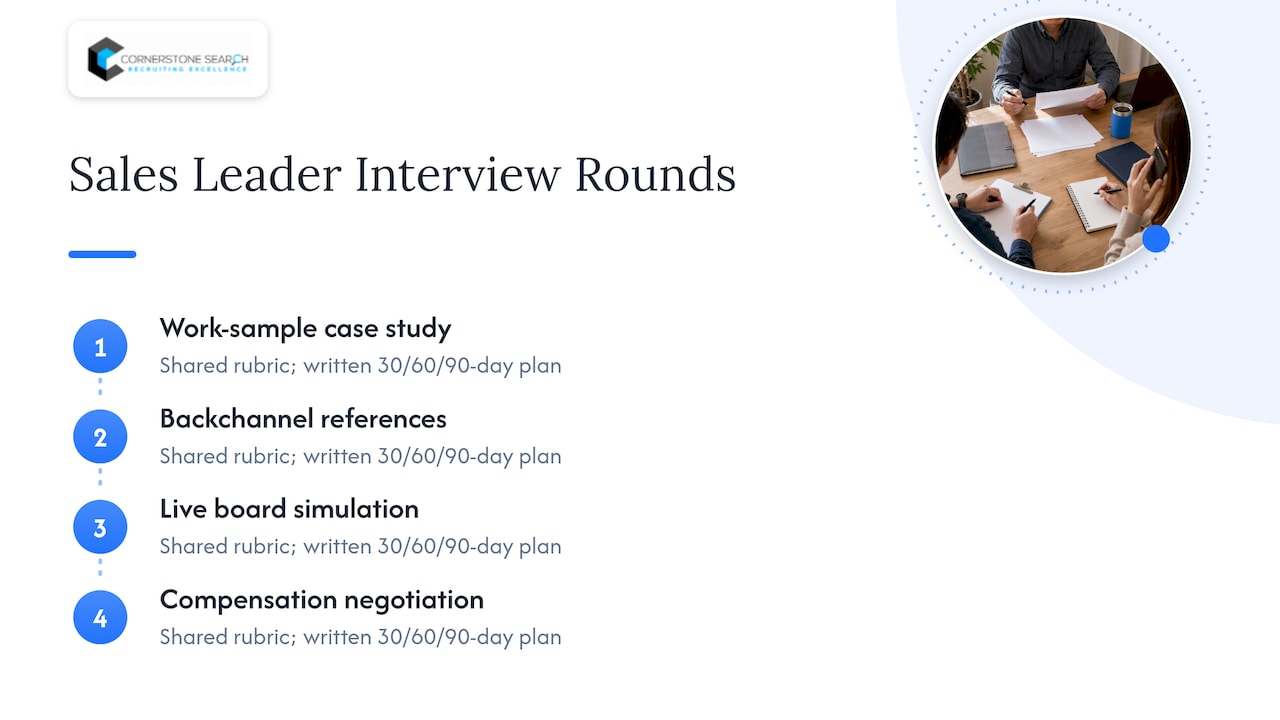
Round 1: the work sample
Give them your real numbers. Ask for a 30/60/90-day plan. Ask what they’d cut, what they’d hire first, and what they’d want to know about your pipeline.
A good candidate asks hard questions back. A weak one hands you a framework with a clever name.
Round 2: backchannel references
The references a candidate hands you are cheerleaders. Skip them as your main signal.
Backchannel means you find peers and former direct reports the candidate didn’t pick. The best question, per the same interview guide: “If you had an open role today, would you hire them again?” Anything short of an enthusiastic yes is a red flag.
We’ve written down how we do it in backchannel rules for SaaS hiring managers and reference check questions for VP Sales. Short version: call five to eight people, and listen for the pause before the answer.
One warning. Reference calls for executives work differently from standard checks, which is why executive references differ from standard checks in what you ask and who you ask.
Round 3: the board simulation
Put them in front of two or three of your investors or advisors. Make them present a plan and take a beating. You learn how they handle pressure, and your board learns who they’re about to back.
Round 4: the comp talk
This one is underrated. How someone negotiates tells you how they’ll negotiate with your customers, and with you at the next quota reset. Do they ask about ramp, accelerators and territory? Or only about base?
Need a faster way to screen a pile of candidates? See how to evaluate sales candidates fast.
Fractional, interim or permanent?
Sometimes you’re not ready for the full-time VP and you know it. That’s a smart read.
A fractional or interim leader can fill the gap while you finish proving the motion. A permanent VP makes sense when the motion repeats and you need someone to scale it. We break down that call in when to hire a permanent VP Sales and how to hire interim sales leadership.
The trap is using interim as a way to avoid the decision. Set a date. Set the criteria. Then decide.
The first 6 months: don’t check out
Founders hire a leader, exhale, and disappear. Bad idea.
The first 3 to 6 months matter most. A VC newsletter on first sales hires argues that if pipeline isn’t moving or targets keep getting missed, that’s usually a bad fit, not a ramp problem. It also says dragging out a bad hire costs far more than restarting the search.
I agree with that. I’ve heard “they’re still ramping” at month eight too many times.
Here is how I tell a slow ramp from a bad fit:
| Signal | Normal ramp | Bad fit |
|---|---|---|
| Pipeline | Builds week over week, even if small | Flat or shrinking after 90 days |
| Questions | Sharp, about your buyer and product | Vague, or blaming the product |
| Hiring | Candidates are better than the last batch | Weak reps, slow hiring |
| Forecast | Misses, but explains why | Misses, and surprises you |
| Founder time | Needs less of you each month | Needs more of you each month |
Give them a fair start. Real onboarding helps, and so does a good buddy system. If you want ideas, here are some onboarding buddy activities for the first 90 days. But don’t use onboarding as an excuse to ignore results.
And stay involved. Sit in on calls. Look at pipeline every week. Founder involvement isn’t micromanaging. It’s the job until the motion is on rails.
What a Series A sales team looks like
Keep it small. One Series A org chart outline describes four to eight quota carriers under a single Director or VP Sales, built as pods of one AE plus one SDR, with shared customer success and sales engineering coverage.
You don’t need a CRO. You don’t need a regional VP. You need a few good reps, someone who can coach them, and a founder who still knows what’s going on.
Our perspective
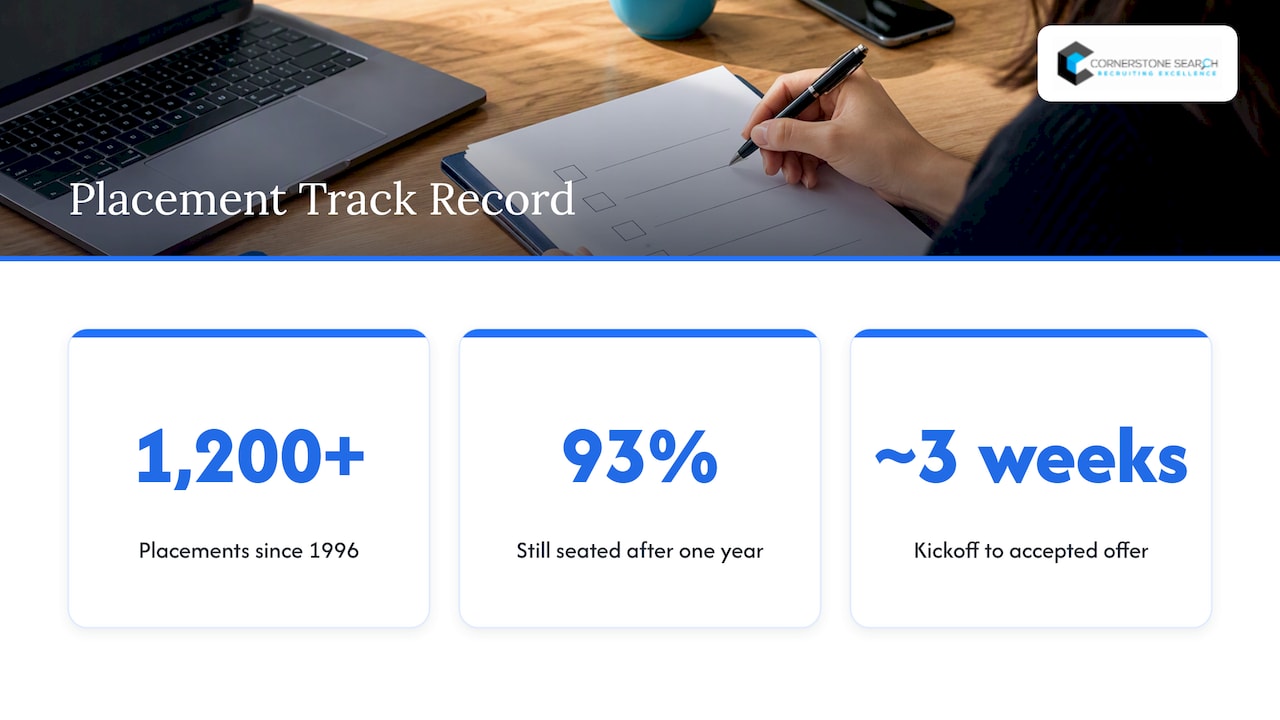
We’ve placed more than 1,200 sales professionals since 1996. About 93% of our placements are still in seat after a year. Here’s what that taught us.
First, timing beats talent. We’ve seen a great VP fail because the company wasn’t ready, and an average one look good because the motion was already working. If you’re not ready, we’ll tell you. That’s a lost fee for us sometimes. Fine. A bad placement costs more.
Second, the intake matters more than the sourcing. Every search we run is personally led by a recruiter with deep SaaS sales experience, and that starts with a long conversation about your product, your buyer and what’s broken. Skip that and you get a nice resume of the wrong person.
Third, speed is a risk reducer. Our searches average about three weeks from kickoff to accepted offer. Long searches burn runway and let your best candidates take other jobs. Slow doesn’t mean careful. Often it means sloppy.
Fourth, references decide close calls. Resumes lie by omission. People who worked with the candidate rarely do.
If you take one thing from this: hire for the company you are in 12 months, not the one you wish you were today.
— Rich Rosen
Want a second set of eyes on your search?
If you’re staring at a Series A sales hire and not sure what to hire first, we can help you sort that out. We run software sales recruitment searches for AEs, sales engineers and customer success leaders, and executive search for VP Sales and CRO roles. Not sure whether retained or contingent fits? Read how retained search differs from contingency. Or talk to us and we’ll give you a straight answer.
FAQ
Should my first sales hire be a VP of Sales?
Usually not. Most B2B startups do better with a hands-on AE first, because the playbook isn’t finished and a VP needs something to scale. Hire the VP once the motion repeats and at least two non-founders are closing.
How long should I give a new sales leader before deciding?
Look hard at months 3 to 6. If pipeline isn’t moving and targets keep slipping, treat it as a fit problem, not a ramp problem. Waiting longer usually costs more than restarting the search.
How do I check references on a sales executive?
Call people the candidate didn’t give you: peers and former direct reports. Ask whether they would hire the person again if they had an open role today. A lukewarm answer matters more than a glowing one from a handpicked reference.
What’s the biggest Series A sales hiring mistake?
Hiring a big-company VP too early. They’re used to SDRs, marketing and process that your company doesn’t have yet. Builders who have taken a company from zero to one in a similar motion do better.
Sources
- When Not To Hire Your First VP Sales
- Real Impact: What Success (and Failure) Actually Look Like
- Founders Sell Every Deal Until the Motion Is Proven
- The Founder’s Playbook for Scaling to $1 Million ARR
- Justin Michael on Why the Series A Go Enterprise Decision Blows Up 18 Months Later
- How do I structure a sales-leadership interview for VP Sales candidates
- The First Sales Hire: Avoiding Pitfalls, Benchmarks & When to Make a Change
- Sales Org Chart for Series A SaaS