

TL;DR:
- Founder-led sales hiring replaces HR bureaucracy with direct evaluation methods focused on behavioral interviews and live simulations. It is most effective after meeting specific sales readiness gates such as existing customers, a sales playbook, and pipeline capacity. Using structured assessments and hiring two candidates simultaneously improves success rates and reduces early failures.
Sales hiring without an HR team is a founder-led recruitment process where you replace HR bureaucracy with direct, sales-oriented evaluation methods built around behavioral interviews, live simulations, and structured scoring. Most founders don’t realize this is actually the better approach for early-stage companies. HR processes are designed for scale and compliance, not for finding the scrappy, pipeline-building rep your startup needs right now. Done right, self-directed sales hiring takes 2–3 weeks and produces better fits than a six-week HR-driven process ever will.
When should you hire sales talent without an HR team?
The honest answer is: not yet, for most of you reading this. Founders often try to hire their way out of selling pain, but without a repeatable sales process, new hires amplify chaos rather than solve it. That’s the trap. You’re tired of selling, so you hire someone to take over. Then they fail in six months and you’re back to square one, only now you’ve burned runway and time.
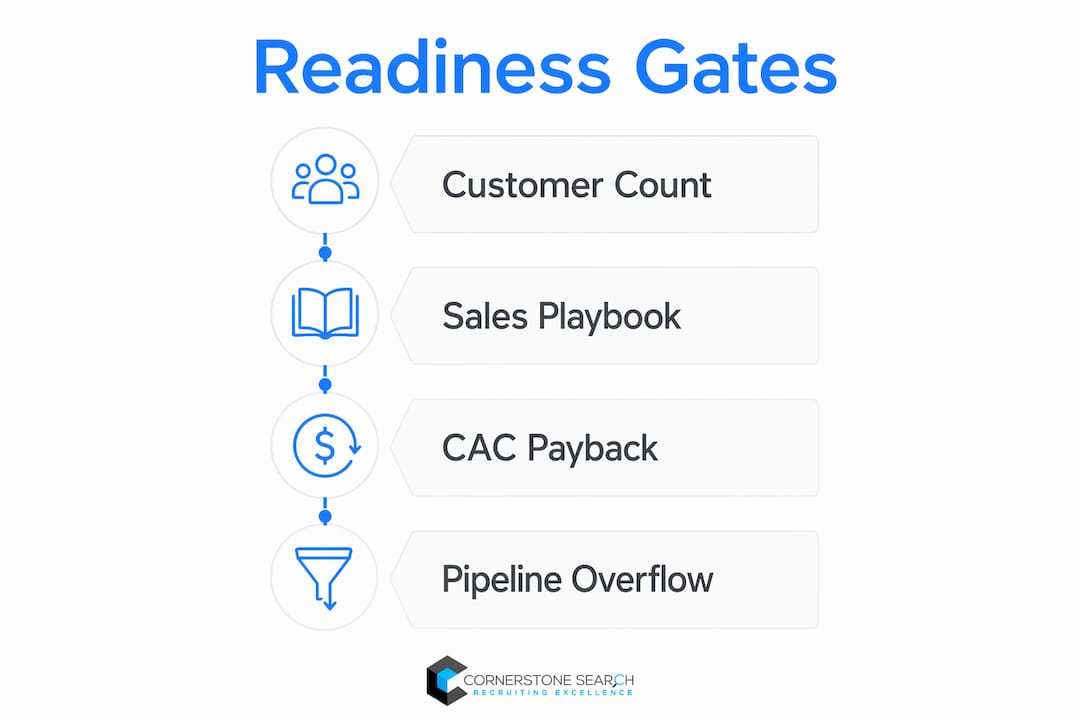
Before you post a single job description, check these four readiness gates:
- 10 closed customers. You need proof the product sells. Not pilots. Not free trials. Paying customers.
- A written sales playbook. If you can’t hand a new rep a document explaining who buys, why they buy, and how you close them, you’re not ready.
- CAC payback under 18 months. The unit economics have to work before you add headcount.
- Your pipeline exceeds your capacity. If you can still handle every deal yourself, you don’t need a rep yet.
Hiring before these gates are met leads to high failure rates within 6–12 months. The rep can’t replicate what you do because you haven’t codified it. They invent their own sales motion. It doesn’t work. You blame them. They blame you. Everyone loses.
The flip side is also true. The founder must have closed 10–20 customers and be able to explain precisely why each one bought before bringing on a first rep. That clarity is what you’re handing off. Without it, you’re not hiring a salesperson. You’re hiring a guinea pig.
What tools and mindset do you need before recruiting sales reps?
Recruiting salespeople without HR support requires a few non-negotiable foundations. Get these in place before you talk to a single candidate.

| Foundation | What it looks like in practice |
|---|---|
| Written sales playbook | ICP, buyer personas, objection handling, and a documented close process |
| Scoring rubric | A 1–4 scale rating candidates on discovery, objection handling, and coachability |
| Bottleneck clarity | You know exactly which part of the funnel the new hire will own |
| Runway budget | You’ve calculated ramp time and have 6–9 months of runway to support it |
| Live simulation script | A scripted role play where the candidate sells your product back to you |
The mindset shift matters as much as the tools. You’re not filling a seat. You’re making a sales judgment call. The best candidates won’t necessarily have the shiniest resume. Resourcefulness is the top predictor of startup sales success. Look for candidates who proactively own pipeline creation and self-diagnose their own performance gaps. That trait is worth more than a logo from a Fortune 500 company.
A well-documented sales qualification process also gives your new hire a framework to work from on day one, which cuts ramp time significantly.
Pro Tip: Build your scoring rubric before you interview anyone. Rate each candidate on discovery skills, objection handling, and coachability on a 1–4 scale. This removes gut-feel bias and gives you a defensible comparison across candidates.
How do you run a step-by-step hiring process without HR?
Here’s the process that works. It’s not complicated, but most founders skip steps and pay for it later.
- Write a clear, honest job description. State the OTE, the ramp timeline, and what the first 90 days actually look like. Candidates who bail on honesty aren’t your people anyway.
- Send a written screen first. Screen candidates with a written questionnaire before any call. Ask them to describe their top deal, how they built pipeline at their last job, and what they’d do in week one. Poor communicators self-select out fast.
- Run a 30-minute discovery call. Assess communication, energy, and basic fit. This is not the deep interview. It’s a filter.
- Conduct a live sales simulation. Have the candidate sell your product back to you after a 15-minute briefing. Score them on your rubric. This is the most predictive step in the entire process.
- Do a structured behavioral interview. Use the STAR method (Situation, Task, Action, Result) to probe past performance. Focus on pipeline generation, not just closing.
- Check references with real questions. Ask references how the candidate handled a lost deal and what they’d coach them on. Soft references tell you nothing.
- Set 30, 60, 90-day milestones before the offer. Agree on what success looks like before anyone signs anything.
On that last point: 30, 60, 90-day milestones should focus on learning and activity, not revenue. In month one, you want pipeline built and discovery calls logged. Revenue comes later. Founders who demand quota attainment in month two burn out good reps before they’ve had a fair shot.
Pro Tip: Hire two reps at the same time when your budget allows. About 50% of initial sales hires fail in the first 6–9 months. Two hires give you a performance benchmark and protect you from losing all momentum if one doesn’t work out.
The evaluation methods for sales candidates that work best combine live simulations with structured scoring. Gut feel alone is how you end up with a great storyteller who can’t close.
What mistakes do founders make when hiring sales reps without HR?
Most of the damage happens before the first interview. Here are the mistakes worth avoiding:
- Hiring too early. Skipping the readiness gates is the single most expensive mistake in early-stage sales hiring. A rep with no playbook to follow will invent their own process. It won’t match yours.
- Mistaking polish for fit. A polished sales executive from a large company is often a poor fit for early-stage startups that lack lead generation, brand recognition, and sales support infrastructure. Startup reps need to build pipeline from zero and sell in ambiguity.
- Skipping structured evaluation. Founders who rely on vibes and charm assessments hire great lunch companions and mediocre closers. Use the rubric every time.
- Setting unrealistic ramp targets. Expecting revenue in month one is a fantasy. It also signals to the candidate that you don’t understand sales, which makes recruiting harder.
- Hiring only one rep. One hire is a coin flip. Two hires is a learning system.
“Founders often try to hire their way out of selling pain, but without a repeatable sales process, new hires amplify chaos rather than solve it. The rep fails. The founder blames the hire. The real problem was never having a process to hand off in the first place.”
The common struggles startups face in sales recruitment almost always trace back to one of these five mistakes. The good news is every one of them is preventable.
How do you manage new sales hires without an HR framework?
Managing your first sales hire without HR is simpler than it sounds. Keep your focus on three pipeline metrics: build, advance, close. Everything else is noise in the early months.
- Track activity before revenue. Count calls made, emails sent, meetings booked, and demos delivered. Revenue is a lagging indicator. Activity tells you what’s coming.
- Do weekly call reviews. Listen to recordings together. Give specific feedback. “You talked too much in that discovery call” is useful. “Good job” is not.
- Use your behavioral rubric for ongoing coaching. The same criteria you used to hire them become the framework for performance conversations. Consistency matters.
- Stay in the deal cycle yourself. Early on, founders should be in deals with their reps. Founder involvement accelerates knowledge transfer and aligns the sales approach to the company vision.
- Give feedback fast. A rep who gets feedback two weeks after a bad call can’t connect it to behavior. Same-day or next-day feedback loops are the standard.
A documented sales booking process gives your new hire a repeatable framework and reduces the time you spend answering the same process questions every week.
Pro Tip: The first 90 days are a two-way evaluation. Your rep is deciding whether to stay just as much as you’re deciding whether to keep them. Show up as a coach, not just a quota enforcer.
Key Takeaways
Founder-led sales hiring without HR works when you meet the readiness gates, use structured evaluation, and manage new reps as a coach before you manage them as a boss.
| Point | Details |
|---|---|
| Meet readiness gates first | Close 10+ customers and document your sales process before hiring anyone. |
| Screen with writing, not just calls | A written questionnaire filters poor communicators before you invest interview time. |
| Simulate before you hire | Live role plays scored on a 1–4 rubric predict performance better than resumes alone. |
| Hire two reps when possible | Dual hires create a benchmark and cut your risk given the roughly 50% early failure rate. |
| Manage activity before revenue | Track pipeline metrics in the first 90 days. Revenue follows behavior, not the other way around. |
Why founder-led sales hiring is the right call for startups
Here’s my honest take after placing over 1,200 sales professionals since 1996. The founders who hire best are the ones who treat recruiting like selling. They know their ICP. They know their pitch. They know what a good rep looks like because they’ve been doing the job themselves.
HR processes are built for compliance and volume. They’re not built for finding the one rep who can sell your specific product to your specific buyer in a market where nobody’s heard of you yet. Generic job postings, resume screens, and competency frameworks designed for 500-person companies will not find that person.
Hiring salespeople is itself a sales exercise. You’re selling your vision and your opportunity to candidates who are simultaneously evaluating whether your company is worth betting their career on. Founders are better at that pitch than any HR generalist will ever be. You know why the product matters. You know the customers. You know what the next 18 months look like. Use that.
The risk is real. This takes time you don’t have and judgment you’re still developing. But the alternative, handing the process to someone who doesn’t know your business or your buyers, produces worse results at higher cost. Own the process. Use the frameworks. Get help when you need it. But don’t outsource the judgment call.
— Rich Rosen
How Cornerstonesearch supports founders who are hiring without HR
Cornerstonesearch specializes in placing top sales talent at SaaS and software companies, including early-stage startups with no HR function. The average time from search kickoff to offer acceptance is 21 days.
Founders working with Cornerstonesearch get access to a network built over 30 years, a structured evaluation process already built in, and a team that knows the difference between a rep who can sell at scale and one who can build from zero. If you’re ready to hire but want to move faster and smarter, the sales recruitment tips and frameworks at Cornerstonesearch are built for exactly this situation. You can also explore the SaaS sales recruiting FAQ to see how the process works before you commit to anything.
FAQ
What are the readiness gates before hiring a first sales rep?
The four gates are 10 closed customers, a written sales playbook, CAC payback under 18 months, and a pipeline that exceeds the founder’s capacity. Missing any one of these significantly raises the risk of a failed hire within 6–12 months.
How long does sales hiring without an HR team take?
A focused founder-led process using behavioral interviews and live sales simulations typically takes 2–3 weeks from kickoff to offer acceptance.
What is the biggest mistake founders make when hiring salespeople?
Hiring before the sales process is documented and proven. A new rep with no playbook will invent their own sales motion, and it almost never matches what actually works for your product.
Should I hire one sales rep or two at the same time?
Hire two when your budget allows. Roughly 50% of first sales hires fail within 6–9 months. Two simultaneous hires give you a performance benchmark and protect your momentum if one doesn’t work out.
How do I evaluate sales candidates without an HR team?
Use a written screen first, then a live sales simulation scored on a 1–4 rubric covering discovery, objection handling, and coachability. This combination outperforms resume reviews and unstructured interviews every time.