

Sales training is defined as a structured program that improves the skills, behaviors, and performance of existing sales reps, while recruiting is the process of sourcing and hiring new talent to fill gaps or grow capacity. The role of sales training versus recruiting is one of the most consequential decisions a sales manager makes, and the financial stakes are real. Continuous training programs return an average of 353% ROI, or $4.53 for every dollar invested. Meanwhile, median cost per hire sits at $1,200 for non-executive roles and $10,625 for executive positions in 2026. Knowing which lever to pull, and when, separates teams that scale from teams that stall.
What are the ROI and cost differences between training and recruiting?
The financial comparison between sales training and recruiting is not close when the goal is performance improvement rather than headcount growth. Sales training produces 5 to 40 times higher ROI than hiring new reps when the objective is closing more deals with the team you already have. That range reflects the compounding effect of skill development across an entire team versus the single-rep impact of a new hire.
Recruiting carries costs that extend well beyond the job board fee or agency retainer. The median time-to-fill for sales roles is approximately 45 days, and that clock does not include the onboarding and ramp period that follows. Once hired, a new rep without structured training takes 4.5 to 6 months to reach full productivity. That is lost revenue sitting in a chair.

Here is a direct comparison of the two investments:
| Factor | Sales training | Recruiting |
|---|---|---|
| Average ROI | 353% (continuous programs) | Variable; depends on rep quality and ramp |
| Primary cost | Program design, time, coaching | Job boards, agency fees, lost productivity |
| Time to impact | 6 to 10 weeks with structured programs | 45 days to hire, plus 4.5 to 6 months to ramp |
| Turnover effect | Reduces rep turnover from ~35% to ~18-22% | No direct effect on existing rep retention |
| Best use case | Performance improvement, retention | Capacity growth, backfilling departures |
The hidden ROI lever in this comparison is turnover. Replacing a sales rep costs six to nine months of that rep’s salary when you account for lost productivity, recruiting fees, and ramp time. A training investment that retains even two reps per year pays for itself before a single new hire clears their first 90-day review.
Pro Tip: Track your team’s annualized turnover cost before setting your training budget. If you are losing three reps per year at $80,000 base salary, you are absorbing up to $360,000 in replacement costs. That number reframes what a $30,000 training program is actually worth.
How does sales training affect quota attainment, win rates, and turnover?
The performance impact of structured sales training is measurable and consistent across research. Companies with formal training programs see 16 to 20% higher quota attainment and 18.4% higher win rates compared to teams without them. Those are not marginal gains. On a team of 10 reps each carrying a $1 million quota, a 16% lift means $1.6 million in additional revenue from the same headcount.
Objection handling training drives a disproportionate share of the win rate improvement. When reps practice responses to price pushback, competitive comparisons, and procurement delays through structured role-play, they convert more late-stage opportunities. The key word is “practice.” A one-time workshop does not produce this result.
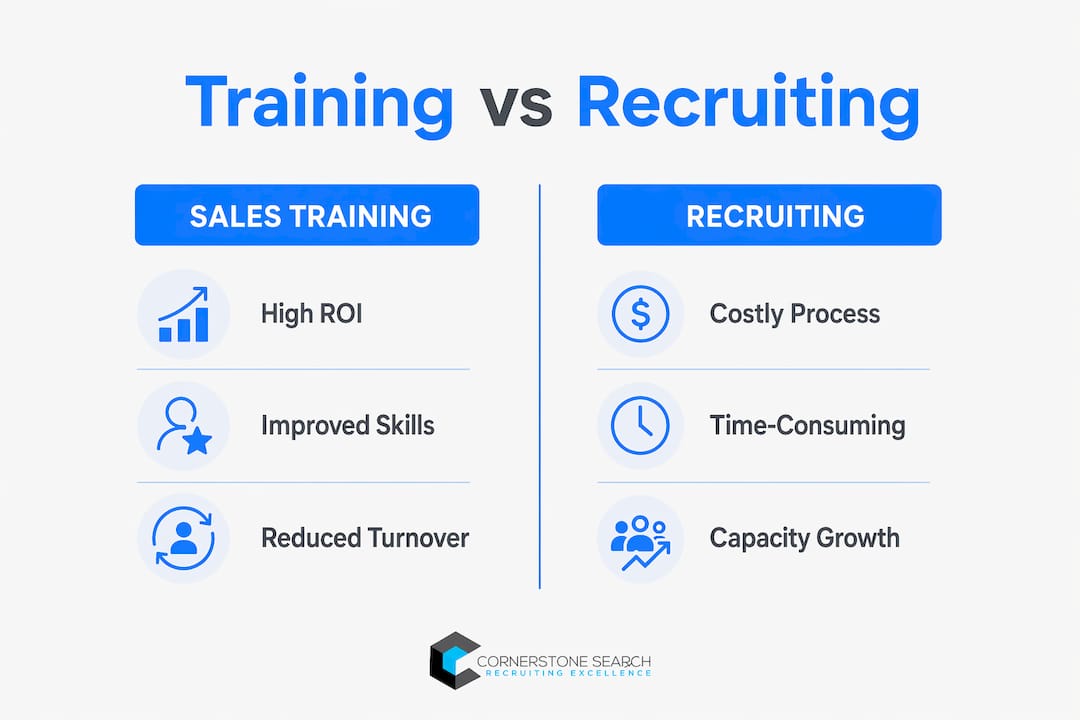
Turnover reduction is where the importance of sales training compounds most dramatically. Structured training can cut rep turnover from the industry average of 35 to 40% down to 18 to 22%. Reps who receive consistent development feel invested in, perform better, and stay longer. That retention effect directly reduces your recruiting spend.
The critical caveat is reinforcement. Without manager coaching and behavior reinforcement, training effects decay rapidly. Continuous practice and feedback double program effectiveness compared to single-event training. This means the sales manager’s role is not just to approve a training budget. It is to show up in the field, on call reviews, and in one-on-ones to reinforce what was taught.
Pro Tip: Replace annual sales kickoff training with monthly 30-minute skill sprints tied to your current pipeline stage. Spaced repetition and immediate application produce behavioral change. A two-day offsite does not.
What are the challenges of relying solely on recruiting to build sales teams?
Recruiting is a necessary tool, but it is a blunt one when used as the primary response to underperformance. The core problem is that recruiting solves headcount, not skill gaps. If your existing reps are losing deals at the proposal stage, adding three new reps with the same habits does not fix the problem. It scales it.
The financial and time costs of a recruiting-only approach accumulate quickly:
- Time-to-fill delays revenue. With a 45-day median time-to-fill, a territory sits uncovered for six weeks before a new rep even starts. Add the ramp period and you are looking at eight to ten months of reduced output from that seat.
- Onboarding without training fails. New hires who receive no structured development program repeat the same mistakes as the reps they replaced. The recruiting investment produces no performance improvement.
- High turnover creates a recruiting treadmill. Organizations that do not invest in development see turnover rates near 35 to 40%. That means constantly refilling seats rather than building a team.
- Executive recruiting costs compound fast. At a median cost of $10,625 per executive hire, replacing a VP of Sales or a senior account executive without addressing the underlying culture or coaching gap is expensive and often futile.
“Recruiting for capacity growth makes sense. Recruiting as a substitute for performance improvement is a budget drain with a predictable outcome: the same results, with different names on the org chart.”
Talent acquisition works best when it is paired with a development infrastructure that captures and accelerates new rep performance. Without that infrastructure, even the best hire underperforms their potential.
When should sales managers prioritize training over recruiting?
The decision between training and recruiting maps directly to the problem you are trying to solve. Misdiagnosing the problem is the most common and costly mistake sales leaders make.
Prioritize sales training when:
- Win rates are declining despite stable pipeline volume. This signals a skill gap, not a headcount gap.
- Ramp times are long. If new hires take more than four months to hit quota, your onboarding and training program needs work before you add more reps.
- Turnover is above 25%. Reps leaving at that rate signals a development and culture problem that more recruiting will not solve.
- You have budget constraints. Training your current team costs a fraction of a new hire, with faster time to impact.
- The market is stable. When you are not in aggressive expansion mode, optimizing your existing team’s performance is the higher-return move.
Prioritize recruiting when:
- You are entering a new market or territory that requires specific domain expertise your current team lacks.
- A key rep departs and the territory cannot be covered by redistribution.
- Revenue targets require headcount growth beyond what performance improvement can deliver.
- You need a specific skill set that cannot be developed internally in the required time frame.
Pipeline volume growth does not automatically translate into quota attainment improvements. Behavior consistency and coaching are what convert training investments into results. This means even when you recruit, the training infrastructure must be in place to make that hire productive.
How can training and recruiting work together to optimize sales performance?
The most effective sales organizations treat training and recruiting as complementary systems, not competing budget lines. The integration point is onboarding. When a new hire enters a structured training program from day one, ramp time drops from 4.5 to 6 months down to 6 to 10 weeks. That acceleration is worth more than the cost of the training program itself.
Recruiting insights also sharpen training design. When you interview candidates and consistently hear that competitors are winning on pricing flexibility or technical depth, that is a signal to build objection handling modules around those specific gaps. Your recruiting process becomes a market intelligence feed for your training team.
Manager coaching is the multiplier that makes both investments work. Sales enablement performance improves significantly when managers actively coach behaviors in the field, beyond initial training events. A new hire who receives weekly call reviews and structured feedback in their first 90 days outperforms a veteran rep who received a two-day onboarding and was left to figure it out.
AI-powered tools like Gong, Chorus, and Salesforce Einstein now make it practical to analyze call recordings, flag skill gaps, and deliver targeted coaching at scale. These tools close the reinforcement gap that causes most training programs to underperform. They also give recruiting teams data on what behaviors and communication patterns correlate with top performance, which sharpens candidate evaluation criteria.
The practical framework for integrating both:
- Use recruiting to bring in talent with the right baseline behaviors and coachability.
- Use onboarding training to ramp new hires fast and set behavioral standards.
- Use continuous development to retain top performers and close skill gaps.
- Use manager coaching to reinforce all of the above in the field, every week.
Key takeaways
Sales training delivers superior ROI for performance improvement, while recruiting is the right tool for capacity growth. Using both with a reinforcement architecture produces the highest long-term sales team output.
| Point | Details |
|---|---|
| Training ROI is measurable | Continuous programs return 353% ROI versus the variable and often slower return of new hires. |
| Recruiting costs more than it appears | Median time-to-fill of 45 days plus a 4.5 to 6 month ramp means months of lost revenue per hire. |
| Training reduces turnover | Structured development cuts rep turnover from 35 to 40% down to 18 to 22%, reducing recruiting spend. |
| Reinforcement determines training success | Manager coaching and spaced repetition double program effectiveness versus one-time training events. |
| Integration beats either approach alone | Combining recruiting with structured onboarding and continuous training produces the fastest ramp and best retention. |
Why I think most sales leaders are solving the wrong problem
After working with sales leaders across hundreds of SaaS and software companies, the pattern I see most often is this: a team misses quota, the instinct is to recruit, and six months later the team is larger but still missing quota. The problem was never headcount.
Executives often prioritize recruiting over training because hiring feels like action. You can point to a new rep on the org chart. Training ROI is slower to show up in a quarterly review, even though the medium-term returns are substantially higher. That short-term bias is expensive.
The organizations that consistently outperform are the ones that treat manager coaching as a non-negotiable operating rhythm, not an occasional event. Many organizations fail to tie training to revenue because they track attendance at training sessions rather than behavioral changes in the field. That measurement gap is why training gets defunded. Fix the measurement, and the investment case becomes obvious.
My honest recommendation: before you open a new req, run a skills audit on your current team. Map where deals are being lost. If the answer is skill-related, train first. If the answer is capacity-related, recruit. Most of the time, it is both, and the sequence matters. Build the training infrastructure first, then recruit into it.
— Rich
Build your sales team with the right talent from day one
Cornerstonesearch specializes in placing top-tier sales talent for SaaS and software companies, with an average time from search kickoff to offer acceptance of just 21 days. When recruiting is the right call, speed and precision matter. A slow hire costs you pipeline, territory coverage, and team morale. Cornerstonesearch’s network of over 1,200 placed sales professionals since 1996 means you get candidates who are pre-vetted for the specific behaviors and domain expertise your team needs. Explore the sales recruitment essentials guide to understand how to build a winning team, or review Cornerstonesearch’s software sales recruitment services to start a search.
FAQ
What is the average ROI of sales training programs?
Continuous sales training programs return an average of 353% ROI, or $4.53 per dollar invested, according to ATD’s 2026 benchmarks. That figure applies to structured, ongoing programs with reinforcement, not one-time workshops.
How much does it cost to recruit a sales rep in 2026?
The median cost per hire is $1,200 for non-executive sales roles and $10,625 for executive positions, based on SHRM 2025 recruiting benchmarks. These figures exclude lost productivity during the 45-day average time-to-fill and the subsequent ramp period.
When should I train instead of recruit?
Train when win rates are declining despite stable pipeline, ramp times exceed four months, or turnover is above 25%. These are skill and culture signals that adding headcount will not fix.
How does training reduce sales rep turnover?
Structured training programs cut rep turnover from the industry average of 35 to 40% down to 18 to 22% by giving reps the skills to succeed and the sense that the organization is invested in their development.
Can recruiting and training work together?
Yes. The highest-performing sales teams use recruiting to bring in coachable talent and structured training to ramp them fast, cutting time to productivity from 4.5 to 6 months down to 6 to 10 weeks.