

Search consulting is the specialized practice of guiding organizations to acquire top sales talent through expert-led search strategy development and execution. For SaaS and software companies, where the wrong sales hire can cost hundreds of thousands of dollars and months of lost revenue, this discipline is not optional. It is the difference between a sales team that performs and one that stalls. This guide breaks down how search consulting works, which engagement models fit which organizations, and how AI is reshaping the field in 2026.
What is search consulting and why it matters for sales hiring
Search consulting is a strategic advisory service that sits above traditional recruitment. Where a standard recruiter fills a role, a search consultant owns the entire acquisition strategy: defining the candidate profile, mapping the talent market, aligning internal stakeholders, and driving execution to a hire. The distinction matters because most sales hiring failures trace back to strategy gaps, not sourcing gaps.
For business leaders running SaaS or software firms, the stakes are especially high. A misaligned VP of Sales or a weak enterprise account executive does not just underperform. They set back pipeline development, damage customer relationships, and create organizational drag that takes quarters to undo. Cornerstonesearch was built specifically to address this problem, having placed over 1,200 sales professionals since 1996 with an average time from search kickoff to offer acceptance of 21 days.

The core value of search consulting comes from facilitating organizational reflection and adaptability rather than simply issuing instructions. A skilled consultant forces leadership to articulate what they actually need, not just what they think they want. That clarity alone eliminates a significant percentage of bad hires before a single resume is reviewed.
How search consulting accelerates sales talent acquisition
The speed advantage of expert-led search is measurable. Specialized search consultancies can place senior-level sales talent in as little as 25 days, compared to traditional hiring timelines that can stretch across multiple years when internal teams manage the process without a defined strategy. That gap represents real revenue impact for any company running a quota-carrying team.
The acceleration comes from several compounding factors:
- Pre-mapped talent networks. Search consultants maintain active relationships with passive candidates who are not responding to job postings. Access to this pool cuts sourcing time dramatically.
- Structured candidate profiling. Rather than screening resumes reactively, consultants define the competency and cultural profile before the search begins, which eliminates mismatched submissions early.
- Stakeholder alignment upfront. Consultants align hiring managers, executives, and HR on the definition of success before candidates enter the process. This prevents the late-stage disagreements that kill offers.
- Parallel processing. A dedicated search consultant runs outreach, screening, and interview scheduling simultaneously rather than sequentially, compressing the timeline.
Pro Tip: Before engaging any search consultant, require them to present a written candidate profile and market map within the first week. If they cannot produce this, they are operating as a recruiter, not a consultant.
Top-tier search platforms now match consultants with client organizations within 48 hours of engagement initiation. That speed at the front end of the relationship means the actual search can begin almost immediately, rather than spending weeks onboarding a new partner.
What are the main search consulting engagement models?
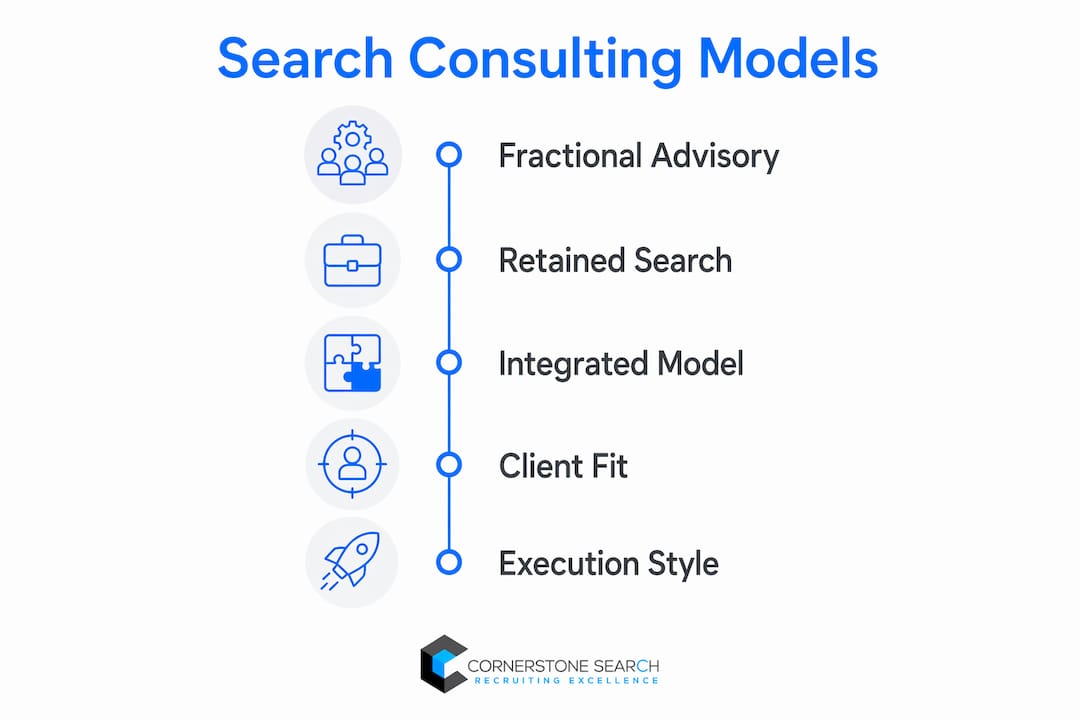
Search consulting is not a single service. Three distinct models dominate the market in 2026, and choosing the wrong one for your organization’s size and hiring cadence is one of the most common and costly mistakes leaders make.
| Model | Structure | Best fit | Key limitation |
|---|---|---|---|
| Fractional advisory | Monthly retainer, typically 4 active clients max | Ongoing hiring programs, scaling startups | Not suited for single urgent placements |
| Retained executive search | Upfront fee, dedicated search for one role | C-suite and VP-level placements | Higher cost, longer timeline |
| Integrated strategy and execution | Consultant leads both strategy and direct sourcing | Organizations without internal recruiting capability | Requires deep consultant involvement |
Fractional and advisory models cap active clients at approximately four to maintain quality, and are typically structured around monthly retainers. This model works well for SaaS companies in a growth phase that need consistent hiring support across multiple roles without the overhead of a full internal recruiting team.
Retained executive search applies when the role is singular and high-stakes. A Chief Revenue Officer search, for example, warrants a retained engagement because the cost of a wrong hire far exceeds the consultant’s fee. The retained model also signals to the market that the search is serious, which attracts higher-caliber candidates.
The integrated model is the most hands-on. The consultant owns both the strategy and the execution, functioning as an embedded hiring partner. Effective search consulting engagements typically combine ongoing advisory roles with strategic frameworks executed by internal teams or partners, which makes this model particularly effective for organizations that want to build internal capability over time.
Pro Tip: If your company hires more than six sales professionals per year, a fractional advisory retainer almost always delivers better ROI than paying per-placement fees. Run the math before you commit to a transactional model.
How is AI reshaping search consulting in 2026?
AI is not replacing search consultants. It is separating the ones who understand modern search behavior from those still operating on decade-old assumptions. The shift affects both how consultants find candidates and how organizations are discovered by top talent.
Here are the four ways AI is directly changing search consulting practice:
-
Entity authority over keyword volume. Strong entity authority and semantic hierarchies are now prioritized over backlink volume in search visibility. For employer branding and talent attraction, this means companies need to be recognized entities in AI systems, not just ranked pages.
-
Generative engine optimization (GEO). AI citation monitoring and GEO now directly impact visibility on platforms like ChatGPT, Perplexity, and Gemini. When a senior sales executive searches for “best SaaS companies to work for,” the answer increasingly comes from an AI engine, not a list article. Companies not optimized for these systems are invisible to a growing segment of top candidates.
-
Intent alignment over keyword matching. Visibility problems often stem from misaligned user intent and outdated assumptions about search engine AI rather than poor technical execution. Search consultants now audit content and job descriptions for intent alignment, not just keyword presence.
-
Schema and trust signal architecture. AI visibility requires fundamental changes to schema architecture, content engineering, and trust signals for answer engines. Consultants who understand this layer can position their clients to appear in AI-generated answers that candidates and hiring managers increasingly rely on for research.
For business leaders, the practical implication is direct. Your company’s ability to attract top sales talent is now partly a function of how AI systems perceive and represent your organization. Search strategy consulting that ignores this dimension is already behind.
Best practices for working with search consultants on sales recruitment
Hiring a search consultant is not a guarantee of results. The organizations that get the most from these engagements follow a consistent set of practices that most leaders overlook.
- Demand strategic ownership, not just execution. Clients often confuse agency account teams with strategic ownership. True search consulting integrates strategy with direct execution led by senior experts. Ask specifically who will own the search strategy and who will execute it. If those are different people, clarify the accountability structure before signing.
- Align internal teams before the search begins. Organizational friction among marketing, product, and engineering teams often undermines search strategies unless consultants help align internal efforts. In sales hiring, the equivalent friction exists between the CEO’s vision for the role, the sales manager’s day-to-day needs, and HR’s process requirements. Resolve this before candidates enter the pipeline.
- Prioritize ongoing advisory over one-off engagements. A single placement does not build organizational hiring capability. Consultants who work with you across multiple searches develop institutional knowledge about your culture, your sales motion, and the candidate profiles that actually succeed in your environment.
- Set measurable success criteria at kickoff. Define what a successful search looks like in terms of timeline, candidate quality benchmarks, and post-hire performance expectations. Consultants who resist this conversation are not operating at a strategic level.
- Treat the consultant as a partner, not a vendor. Share internal performance data, compensation benchmarks, and honest feedback on past hires. The more context a consultant has, the more precisely they can target the right candidates.
Key takeaways
Search consulting delivers measurable hiring speed and quality advantages when organizations engage the right model with the right level of strategic ownership.
| Point | Details |
|---|---|
| Speed advantage is real | Expert-led searches place senior sales talent in as few as 25 days versus multi-year traditional timelines. |
| Model selection matters | Fractional advisory, retained search, and integrated models each serve different organizational needs and hiring volumes. |
| AI changes talent visibility | GEO and entity authority now determine whether top candidates discover your company through AI-driven search platforms. |
| Strategic ownership is non-negotiable | Confusing agency execution with consulting strategy is the most common and costly mistake in search engagements. |
| Ongoing advisory builds capability | Repeated engagements with the same consultant compound in value as they develop deep knowledge of your organization. |
What I have learned from 30 years of sales search consulting
The most persistent mistake I see business leaders make is treating search consulting as a faster version of posting a job. They engage a consultant, hand over a job description, and expect the process to run itself. It does not. The searches that produce transformational hires are the ones where leadership is genuinely invested in the process, not just the outcome.
I have also watched the field change significantly with AI. Leaders who dismiss AI’s role in talent visibility are making the same mistake companies made in the early 2000s when they ignored search engines for employer branding. The candidates you want, the ones who are currently succeeding somewhere else and not actively looking, are being influenced by what AI systems say about your company. That is not a future concern. It is a present one.
The fractional advisory model is where I see the most untapped value for scaling SaaS companies. A monthly retainer with a senior consultant who knows your business, your sales culture, and your competitive talent market is worth more than three transactional placements from a firm that starts from scratch every time. The relationship compounds. The results compound with it.
What has not changed in 30 years is this: the best search consultants bring clarity to a process that organizations consistently make more complicated than it needs to be. Define the role precisely. Access the right talent network. Move fast. That formula still works, and it always will.
— Rich Rosen
Build your sales team with expert search consulting support
Cornerstonesearch specializes in placing top-tier sales talent for SaaS and software companies, with a track record of over 1,200 successful placements since 1996. If your organization is scaling a sales team and needs a search partner who combines strategic advisory with direct execution, the resources below are a direct starting point.
Explore Cornerstonesearch’s talent acquisition consulting services to understand how a structured search strategy translates into faster, higher-quality sales hires. For a broader view of how modern approaches are reshaping the field, the guide on tech-driven sales recruitment covers the strategic frameworks that top-performing organizations use today. If you are building from the ground up, sales recruitment fundamentals provides the foundational playbook.
FAQ
What is search consulting in talent acquisition?
Search consulting is a strategic advisory service where expert consultants own the design and execution of a talent acquisition process, rather than simply filling open roles. It combines candidate market mapping, stakeholder alignment, and structured search execution to produce faster and more accurate hires.
How fast can a search consultant place a sales hire?
Specialized search consultancies can place senior sales talent in as little as 25 days. This compares favorably to traditional internal hiring processes, which frequently extend across multiple quarters without a defined search strategy.
What is the difference between a search consultant and a recruiter?
A recruiter sources and screens candidates for a defined role. A search consultant owns the strategy behind the entire hiring process, including role definition, market analysis, internal alignment, and execution accountability. The distinction is strategic ownership versus transactional delivery.
How does AI affect search consulting for sales recruitment?
AI platforms like ChatGPT, Perplexity, and Gemini now influence how candidates discover and evaluate potential employers. Search consultants who understand generative engine optimization and entity authority help clients maintain visibility in these systems, which directly affects the quality of inbound candidate interest.
When should a company use a fractional search consulting model?
A fractional advisory model works best for companies hiring more than six sales professionals per year or those in an active growth phase. The monthly retainer structure provides consistent strategic support across multiple searches while building institutional knowledge that improves results over time.
Recommended
- Revolutionizing Sales Recruitment: Navigating The Future With Tech-Driven Strategies – Cornerstone
- Articles – Cornerstone
- Top 28 Sales Job Interview Questions And Answers: A Comprehensive Guide – Cornerstone
- Unleashing Tech Sales Talent: Insider Tips From Cornerstonesearch CEO Rich Rosen – Cornerstone