

Sourcing passive SaaS sales talent means proactively identifying and engaging skilled sales professionals who are currently employed and not actively looking for new roles. This approach unlocks a talent pool that job boards simply cannot reach. Roughly 70 to 75% of the global workforce is passive at any given time, and that percentage climbs even higher for senior SaaS sales roles. If your hiring strategy depends on inbound applications, you are competing for the same 25% of candidates as everyone else. This guide covers Boolean search, AI-augmented sourcing, multi-touch outreach sequences, and pipeline nurturing so you can reach the professionals who never apply.
How sourcing passive candidates differs from active SaaS sales recruitment
Passive candidate recruitment is a fundamentally different discipline from posting a job and reviewing applications. Passive sourcing flips the traditional model: you find candidates first, build a relationship over weeks or months, and then convert them when the timing aligns. Active recruitment is reactive. Passive sourcing is a proactive headhunting workflow that requires different tools, different messaging, and a different mindset.
The tooling distinction matters more than most hiring managers realize. An applicant tracking system (ATS) manages candidates after they apply. It is designed for inbound flow. Sourcing CRMs and recruiter databases are built for outbound engagement, storing contact data, tracking outreach sequences, and managing warm relationships before any application exists. Using an ATS as your primary sourcing tool for passive candidates is like using a spreadsheet to run a CRM. It technically works, but you will miss most of what matters.
The table below captures the core operational differences between the two approaches.
| Dimension | Active recruitment | Passive sourcing |
|---|---|---|
| Candidate behavior | Actively applying and available | Employed, not searching |
| Primary channel | Job boards, inbound applications | LinkedIn, Boolean search, niche communities |
| Primary tool | ATS | Sourcing CRM, recruiter database |
| Outreach style | Respond to applicants | Initiate multi-touch sequences |
| Timeline | Days to first contact | Weeks to months of nurturing |
The SaaS sales talent market is particularly competitive because the best performers are rarely between jobs. They are carrying quota, building relationships, and getting counter-offered the moment they show any interest elsewhere. Waiting for them to apply is not a strategy.
How to define and search for ideal passive SaaS sales candidates
Before you search for anyone, you need a precise candidate profile. Vague criteria produce vague results. Define the role by title variants (Account Executive, Enterprise AE, Strategic Account Manager), specific SaaS verticals (fintech, HR tech, cybersecurity), deal size, sales cycle length, and the specific skills that predict success in your environment. The more specific your profile, the more your outreach will resonate.

Boolean search remains the most reliable method for surfacing passive candidates on LinkedIn and in recruiter databases. A basic Boolean string for a mid-market SaaS AE might look like: "(“Account Executive” OR “AE”) AND (“SaaS” OR “software”) AND (“mid-market” OR “SMB”) AND (“Salesforce” OR “HubSpot”)`. Operators like AND, OR, NOT, and quotation marks let you filter with precision that keyword search alone cannot match.
AI-augmented sourcing tools now scan millions of profiles using natural language queries and automate initial outreach steps. AI platforms can achieve significantly faster hiring timelines than traditional sourcing methods by identifying high-fit candidates from signals that manual search would miss, such as recent promotions, published content, or conference speaking history.
Beyond LinkedIn, niche communities like Bravado and Pavilion host engaged SaaS sales professionals who are invisible on traditional job boards. These platforms are high-signal environments where top performers share wins, discuss strategy, and build reputations. Sourcing from these communities gives you access to candidates who are actively developing their craft, which is a strong predictor of performance.
- Build your Boolean strings around title variants, not just one job title
- Search by company type (Series B SaaS, enterprise software) to find contextually relevant experience
- Use LinkedIn Sales Navigator filters for seniority, function, and company headcount to narrow results
- Cross-reference profiles against Bravado, Pavilion, and relevant Slack communities for engagement signals
- Verify contact data before outreach using a recruiter database with real-time email and phone validation
Pro Tip: Save your Boolean search strings as templates and update them quarterly. SaaS sales titles shift faster than most industries, and a string that worked in 2024 may miss a wave of candidates now carrying titles like “Revenue Account Executive” or “Growth AE.”
How to craft outreach sequences that actually get responses
The single biggest mistake in passive candidate recruitment is sending one message and waiting. 80% of positive responses from passive candidates come after the first touch, meaning follow-up is not optional. It is the mechanism. Effective outreach sequences run 4 to 9 touches over 2 to 8 weeks, combining LinkedIn, email, and phone across the sequence.
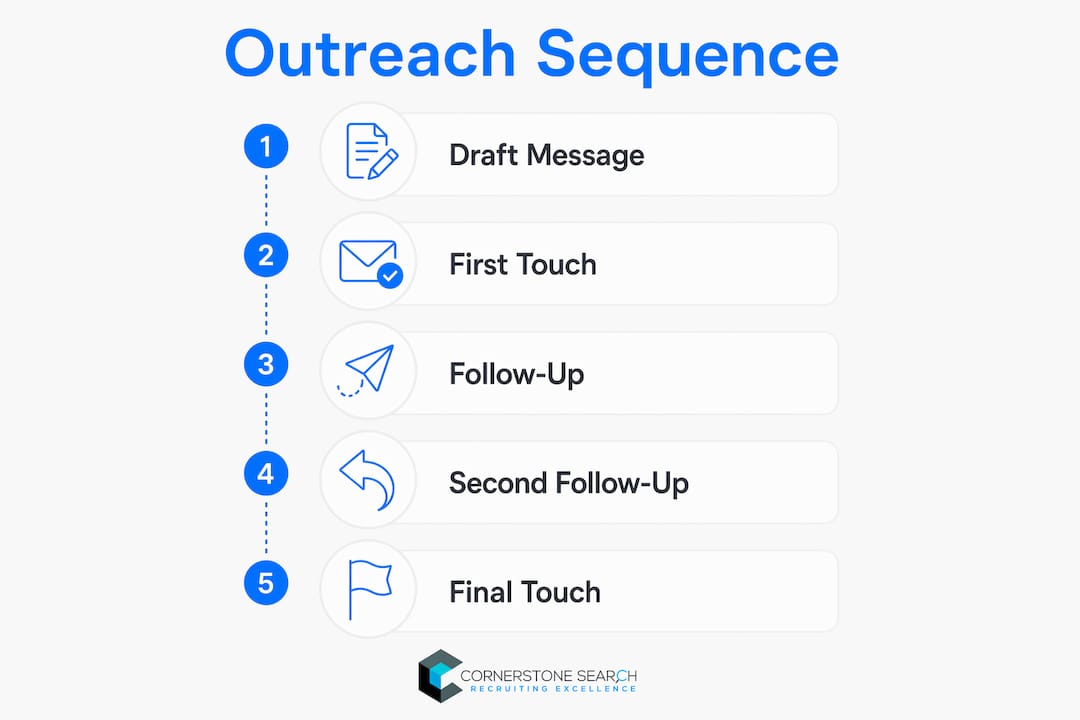
Multi-channel outreach boosts reply rates by 2 to 3 times compared to single-channel approaches. LinkedIn plus email sequences achieve 15 to 25% reply rates when executed correctly. That is a meaningful difference from the sub-5% rates most hiring managers see when they send one LinkedIn message and move on.
Here is a proven sequence structure for SaaS sales roles:
- Day 1: Send a LinkedIn connection request with a short, personalized note referencing something specific from their profile, a recent deal win they posted, a company milestone, or a shared connection.
- Day 3: Follow up with a LinkedIn message if they connected. Keep it to three sentences. Lead with what is in it for them, not what you need.
- Day 7: Send a personalized email to their professional address. Reference the LinkedIn message briefly and add one new piece of context, such as a specific detail about the role or the team they would be joining.
- Day 10: Leave a brief voicemail if you have a phone number. Voicemail response rates for passive candidates are low, but the combination of LinkedIn plus email plus phone dramatically increases overall sequence response rates.
- Day 14: Send a final LinkedIn or email message. Keep the tone light and leave the door open. “I know the timing may not be right today. I’d love to stay in touch for when it is.”
- Days 21 to 56: Re-engage with a low-pressure touch, sharing a relevant article, congratulating them on a promotion, or referencing a company announcement.
Personalized LinkedIn InMail messages achieve 25 to 35% response rates versus 8 to 12% for generic messaging. That gap is entirely explained by personalization depth. Reference their specific experience, not just their title. Mention the company they are at, the market they sell into, or a specific achievement. Generic messages signal that you did not read their profile, which is the fastest way to get ignored.
AI-assisted messaging tools can draft initial outreach at scale, but always edit before sending. Higher personalization depth requires insight into the candidate’s background before contact, and no AI tool replaces the judgment of a recruiter who has read the profile carefully.
Pro Tip: Send your first LinkedIn message on a Tuesday or Wednesday morning between 8 and 10 AM in the candidate’s time zone. Open rates and response rates for professional outreach peak mid-week in the morning window, before the day’s meetings consume attention.
Building a talent pipeline that pays off over 12 months
One-off sourcing campaigns produce one-off results. The SaaS sales hiring strategies that consistently outperform rely on a pipeline mindset, where you are always building relationships with candidates who are 3, 6, or even 12 months away from being ready to move.
Once a passive candidate becomes actively available, they remain on the market for an average of only 10 days before accepting an offer. If you have not already built a relationship, you will not win that candidate. The pipeline is what gives you the relationship before the window opens.
Treating passive sourcing as a funnel with defined stages (define, map, approach, engage, convert) and metrics at each stage is what separates systematic talent acquisition for SaaS from ad hoc recruiting. Track how many candidates enter each stage, where they stall, and what moves them forward.
Practical pipeline nurturing tactics that work:
- Share relevant content, such as a SaaS sales benchmark report or a podcast episode on enterprise selling, with no ask attached
- Congratulate candidates on promotions, company funding announcements, or award recognitions via LinkedIn
- Send a brief quarterly check-in message asking how things are going, not whether they are looking
- Segment your pipeline by role type, seniority, and estimated readiness window so your outreach stays relevant
- Log every interaction in your sourcing CRM with notes on what the candidate cares about, so future touches feel personal
The sales recruitment fundamentals that apply to active hiring apply here too, but the timeline is compressed on the back end and extended on the front end. You invest months building the relationship, then move fast when the candidate is ready.
Common pitfalls in passive SaaS sales hiring and how to fix them
The most common failure mode in passive sourcing is treating it like active recruiting with a different job board. Hiring managers post a role, send a few LinkedIn messages, and wonder why response rates are low. The problem is structural, not tactical.
Single-touch outreach is the most widespread mistake. A candidate who does not respond to one message is not uninterested. They are busy, distracted, or simply not ready yet. Designing follow-up sequences that respond to interest signals rather than blindly repeating the same message is what separates effective sourcing from spam.
Other common pitfalls and their fixes:
- Slow feedback loops: If your hiring team takes two weeks to review a shortlist, you will lose candidates to faster-moving competitors. Compress your internal review cycle to 48 hours for passive candidates.
- Compensation opacity: Passive candidates are not desperate. They need a compelling reason to consider a move. Sharing a compensation range early in the conversation signals respect for their time and filters out mismatches before they waste yours.
- Message fatigue: Sending the same message across every channel in the same week reads as automated and impersonal. Vary the channel, the message, and the timing across your sequence.
- Ignoring warm signals: A candidate who views your LinkedIn profile after your first message is signaling interest. Follow up within 24 hours with a more specific message.
Pro Tip: If a candidate goes quiet after two or three touches, do not abandon them. Move them to a long-term nurture segment and re-engage in 60 to 90 days with a fresh angle. Timing is the variable you cannot control, but staying present means you are there when it changes.
Knowing how to speed up your recruiting process on the internal side is just as important as the sourcing work itself. A slow hiring process is the fastest way to lose a passive candidate who had other options all along.
Key takeaways
Sourcing passive SaaS sales talent requires a multi-touch, multi-channel outreach system built on precise candidate profiles, personalized messaging, and a long-term pipeline that converts candidates when their timing aligns with yours.
| Point | Details |
|---|---|
| Passive talent dominates the market | 70 to 75% of the workforce is passive; job boards reach less than 30% of relevant candidates. |
| Tooling must match the workflow | Use sourcing CRMs and recruiter databases for outbound work, not an ATS built for inbound applicants. |
| Sequences outperform single touches | Run 4 to 9 touches over 2 to 8 weeks across LinkedIn, email, and phone to maximize response rates. |
| Personalization drives results | Personalized outreach achieves 25 to 35% response rates versus 8 to 12% for generic messages. |
| Pipeline timing is everything | Passive candidates stay available for roughly 10 days once active, so relationships must be built before that window opens. |
What 28 years of SaaS sales recruiting taught me about passive sourcing
The biggest misconception I see from hiring managers is that passive sourcing is just recruiting with extra steps. It is not. It is a different discipline with a different success metric. You are not measuring time-to-fill on a single search. You are measuring the quality and warmth of the relationships you have built before you ever have an open role.
I have watched companies invest in AI sourcing tools, build Boolean search libraries, and still struggle because they treat every candidate interaction as a transaction. The tool is not the differentiator. The relationship is. A candidate who has heard from you three times over six months, always with something relevant and never with pressure, will take your call when they are ready to move. A candidate who received one generic InMail will not remember your name.
The other thing I will say plainly: compensation transparency is not optional in 2026. The SaaS sales professionals worth recruiting have options. Hiding the comp range until the final stage does not protect your negotiating position. It signals that you do not respect their time, and it costs you candidates who would have been a strong fit.
The firms that consistently win passive SaaS sales talent combine methodological discipline with genuine relationship investment. They run the sequences, they track the pipeline, and they also remember that every candidate is a person making a significant career decision. That combination is what produces hires who stay and perform.
— Rich Rosen
How Cornerstonesearch accelerates your passive sourcing results
Cornerstonesearch has placed over 1,200 SaaS sales professionals since 1996, with an average time from search kickoff to offer acceptance of just 21 days. That speed is not accidental. It comes from a pre-built pipeline of passive candidates, a sourcing methodology refined over decades, and a network that reaches the professionals who never post their resumes. If your in-house team is spending weeks on Boolean searches and multi-touch sequences without the results you need, a specialized recruiting partner can compress that timeline significantly. Explore Cornerstonesearch’s software sales recruitment services to see how the methodology works in practice.
FAQ
What is passive candidate sourcing in SaaS sales?
Passive candidate sourcing is the practice of proactively identifying and contacting employed SaaS sales professionals who are not actively job searching. Recruiters initiate outreach rather than waiting for applications, using tools like LinkedIn, Boolean search, and niche communities such as Bravado and Pavilion.
How many touches does it take to engage a passive candidate?
Effective outreach sequences run 4 to 9 touches over 2 to 8 weeks across multiple channels. Research shows 80% of positive responses come after the first touch, making follow-up the most critical part of any passive sourcing sequence.
Why do job boards fail for SaaS sales hiring?
Job boards reach less than 30% of the relevant talent pool because 70 to 75% of the workforce is passive at any given time. Senior and specialist SaaS sales roles skew even higher, with passive rates approaching 80 to 90%.
What response rate should I expect from LinkedIn outreach?
Personalized LinkedIn InMail messages achieve 25 to 35% response rates. Generic messages average 8 to 12%. The difference is entirely driven by personalization depth, specifically referencing candidate-specific profile details rather than sending a templated pitch.
How long does a passive candidate stay available once they start looking?
Once a passive candidate becomes actively available, they remain on the market for an average of only 10 days before accepting an offer. This is why long-term pipeline nurturing is critical. The relationship must exist before the candidate starts their search.