

Most technical sales leader hires fail for one boring reason. Nobody decided what the job was before the search started. The founder wanted a closer, the board wanted a builder, the engineers wanted a translator. The candidate got hired to be all three. Twelve months later, everybody is surprised.
I’ve placed over 1,200 sales, presales and executive people since 1996. This is how I’d hire a technical sales leader today: pick the charter, set a profile you can defend, pay a real number, test the work, check references the hard way, and plan the first 90 days before the offer goes out.
TL;DR
- Define the job first. Demo support, proof-of-concept ownership and solution design are three different jobs with three different profiles.
- At an early stage, hire a player who can build and carry a number. A pure manager with no team and no process will struggle.
- Budget for total comp, not base. Published US benchmarks for senior sales leaders run well into six figures of OTE, plus equity.
- Replace “good vibes” interviews with working sessions and backchannel references.
- Plan the first 90 days before you make the offer. A bad hire is expensive, and a good hire with no runway looks the same.
Table of Contents
- What “technical sales leader” means at your company
- Founder-led sales first, then a leader
- Build the candidate profile
- What to pay a technical sales leader
- How to find and assess candidates
- References that mean something
- The mistakes that make this hire expensive
- Perspective: what I’d tell a founder over coffee
- The first 90 days decide the hire
- When to bring in a specialist recruiter
- FAQ
- Sources
What “technical sales leader” means at your company
The title covers a lot of ground. It might be a Head of Sales Engineering. It might be a VP Sales who can run a technical evaluation. It might be a first sales leader at a company where the product needs real engineering conversation to sell.
Don’t start with the title. Start with the work.
One guide to sales engineering hiring splits the technical sales function into three charters: demo support, proof-of-concept ownership and solution design. Pick one. That choice drives the job spec, the interview, who the person reports to and how you pay them.
Here’s how I’d translate that for a founder:
| Charter | What the leader owns | What you screen for |
|---|---|---|
| Demo support | Demos, discovery help, SE bench for AEs | Commercial instinct, enough depth to answer hard questions |
| POC ownership | Technical evaluations, trials, integration issues | Configuration skills, troubleshooting, project management |
| Solution design | Architecture-level answers, security reviews, RFPs | Deep technical knowledge, documentation discipline |
A public Head of Sales Engineering posting shows what a founding version looks like: hands-on deal leadership, demo environments, POC playbooks, hiring and coaching SEs, and tracking technical win rate and time-to-value. Notice what’s missing. There’s no “strategic visionary.” It’s a builder who also sells.
Write down the commercial problem
A good job description says what you sell, who buys it, how long the cycle runs and what this person owns. ARR Advice puts it bluntly: define the role before you meet candidates, or you’re shopping for hope.
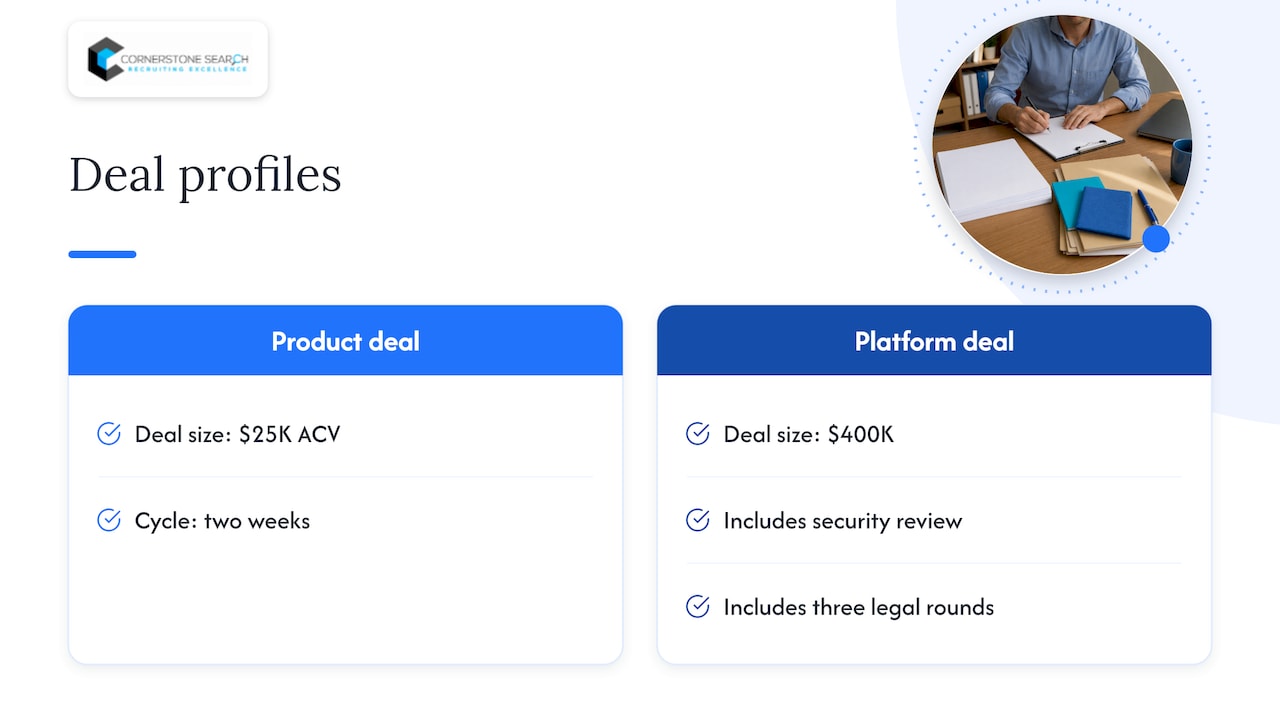
Deal size, cycle length, number of stakeholders and implementation complexity should decide whether you need a builder, a closer, a player-coach or a pipeline specialist. A $25K ACV product with a two-week cycle does not need the same person as a $400K platform deal with security review and three legal rounds.
If you’re stuck on whether you need a sales leader at all yet, read our piece on when to hire your first VP of Sales.
Founder-led sales first, then a leader
The first technical sales leader inherits something messy. Founder-led deals, a demo that only the CTO can run, a pipeline in three spreadsheets. BHL Strategy Group describes the hire as someone who must take over that process, formalize it, put systems in, recruit and develop people, and still carry a quota.
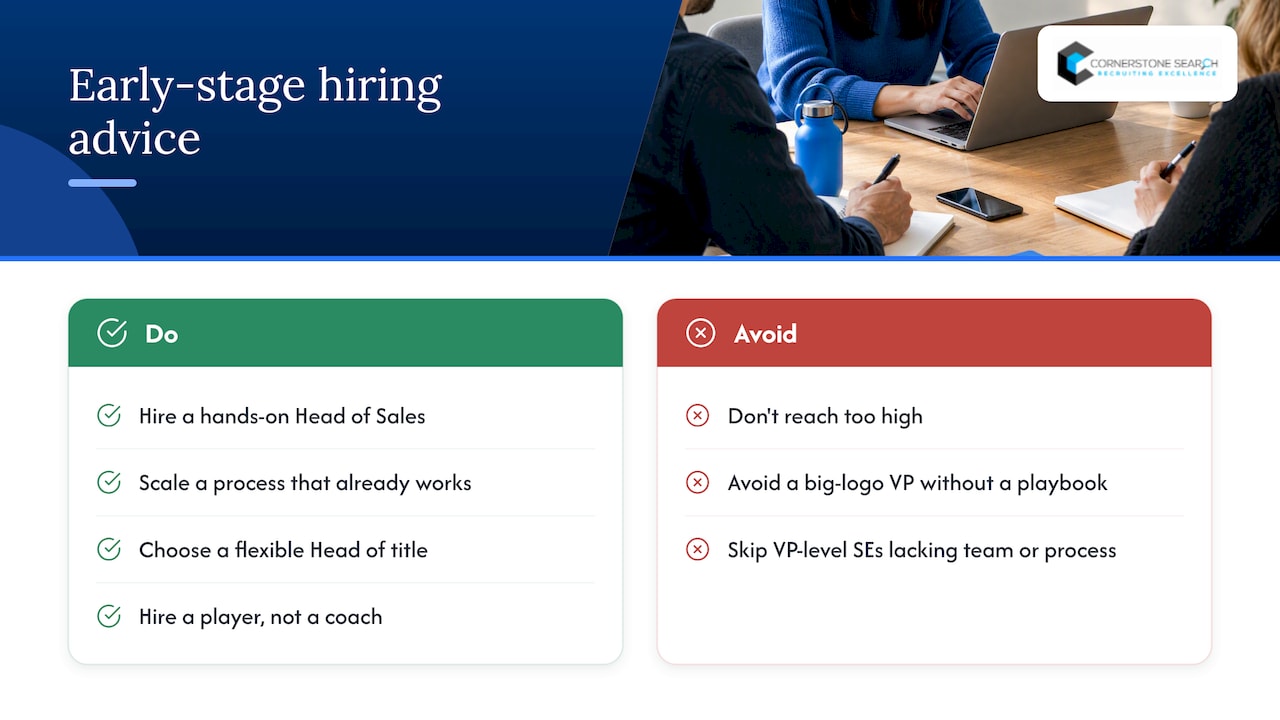
That’s a lot. So don’t reach too high. Bain Capital Ventures advises hiring a hands-on Head of Sales to scale a process that already works, instead of someone too senior. They also note that a flexible “Head of” title signals leadership without overcommitting on scope.
I see the same mistake over and over. A company with four reps and no playbook hires a big-logo VP with a 40-person org on the résumé. That VP has not made a cold call in eight years. They hire a chief of staff and start building decks. Meanwhile, the pipeline sits.
On the technical side it’s the same. A sales engineering advisory firm warns that a VP-level SE leader with no team and no process to run gets frustrated and costs a lot. At an early stage, you need a player, not a coach.
Permanent or fractional is a separate question. We wrote about it here: when to hire a permanent VP Sales, not a fractional one.
Build the candidate profile
Get specific about the minimum bar. Gia Scinto of The Cole Group says early-stage companies should set a minimum experience threshold covering industry, buyer type and company stage. Without it, the search turns bloated and aimless. Everyone gets an interview. Nobody gets an offer.
I’d split requirements three ways. Must understand. Must be able to do. Can learn. One founder guide to technical sales job descriptions recommends the same split, because it keeps you from shrinking the talent pool for no reason. Does the person need your exact stack, or do they need to be credible with your buyer’s engineers? Those are very different filters.
A sample profile for a first technical sales leader
- Has sold or supported complex B2B software to the same type of buyer you target.
- Has carried a number in the last three years, or run a team that did.
- Has built something: a demo environment, a POC playbook, a hiring process.
- Can talk to a CTO without a rep holding their hand.
- Is comfortable with ambiguity. No playbook. No enablement team. No CRM hygiene.
For scale, look at what bigger organizations ask. A large payments company’s sales manager posting asks for 10+ years in technology sales and 5+ in people leadership, plus complex or regulated product experience. That’s a late-stage bar. Don’t copy it for a 12-person startup and then wonder why nobody applies.
Want to see what separates great SaaS sales executives from the pack? Our traits of top SaaS sales executives guide goes deeper. And why SaaS sales hiring differs from traditional sales explains why a great enterprise hardware leader may flop at your company.
What to pay a technical sales leader
The pay conversation sinks more searches than anything else. Not because founders are cheap. Because they quote base and the candidate hears OTE.
Two data points, with the caveat that they come from public sources and your stage changes everything:
- Bain Capital Ventures puts total compensation for a first Head of Sales at $350,000 to $500,000 OTE, with equity often between 0.5% and 1.5% depending on seniority and stage.
- A US Director of Sales Engineering posting lists a base of $200,000 to $225,000, with a possible annual bonus or commission. It covers technical discovery, demos, workshops, POCs, proposals, RFPs and security reviews.
So a technical sales leader below the CRO level sits in a wide range. The base number alone tells you nothing. Ask these questions before you post the job:
- What’s the real OTE, and what’s the split between base and variable?
- Is the variable tied to team quota, personal quota or technical win rate?
- How much of the quota is realistic in year one, given your ramp?
- What equity are you offering, and what’s the vesting and cliff?
That last one gets people tangled. We laid it out in how to structure sales exec equity compensation. Pricing also shapes who you can hire, since deal size feeds quota and commission. See how SaaS pricing affects sales hiring.
One more thing. Good candidates know what their last quota looked like. If your plan has them hitting a number nobody has ever hit at your company, they’ll see it in about four minutes.
How to find and assess candidates
Here’s where most searches go sideways. The résumé says “exceeded quota 5 years running.” The interview goes great. The person is charming. Three months in, nothing is moving.
Don’t trust charm. Trust evidence.
Where good candidates come from
The best ones are rarely applying. They’re employed, quietly doing well and getting calls. SaaStr’s account of how one fast-growing AI company hired says over 90% of its 73 go-to-market hires were sourced directly by leadership, many from leaders’ earlier networks. Network matters. If yours is thin, that’s the case for a recruiter who lives in this market every day.
We also wrote about why the SaaS sales talent market is so competitive. Short version: the people you want have options.
Assess with work, not vibes
Bain Capital Ventures recommends working sessions that go beyond résumé review and good vibes, so you can see how a candidate thinks, prioritizes and collaborates. Their examples: a 30-60-90 plan or a basic AE onboarding program.
Here’s what I’d run for a technical sales leader:
- Claim check. Take five numbers from the résumé and ask for the story behind each. Team quota attainment, ramp time, forecast accuracy, deal size, cycle length. Vague answers tell you plenty.
- Live technical evaluation. Give them a real, anonymized deal. Ask how they’d run the POC, who they’d pull in, what would kill it.
- Coaching retry. Watch them run a demo or a call review. Give feedback. Have them try again. Pitstop’s evidence-based hiring paper makes the case for judging coachability by focused feedback followed by a retry, not by opinion.
- Plan presentation. A 30-60-90 for your company, built on a short briefing and one call with you.
- Rubric scoring. Score each interviewer’s notes against the same criteria, written before the first interview.
Self-promotion is cheap. For a view on what hiring managers weigh in senior candidates beyond the paper, see what hiring managers look for in executives.
Greenhouse’s guidance on sales leader evaluation points to role-related evidence such as team-wide quota attainment, ramp time and forecast reliability. I like that. Team-wide attainment matters most. Anyone can have one star rep.
References that mean something
The reference list a candidate hands you is a gift basket. Everyone in it likes them.
Do backchannel work instead. Gia Scinto suggests 360-degree checks across former peers, managers and reports, so you learn where the leader needs support. I’d add specifics to every call:
- What was the team’s quota attainment under this person, not just their own?
- How many of their hires were still there 12 months later?
- How accurate was their forecast two quarters out?
- Would you hire them again? Into what role?
- What did they need from their boss to succeed?
Ask the peers in product and engineering too. A technical sales leader who can’t work with product will lose deals to the roadmap.
Use judgment with backdoor references. Talking to people the candidate didn’t name is fair. Calling their current boss without permission is a good way to get them fired. Ask first, or wait until the final stage with a signed offer contingent on references.
The mistakes that make this hire expensive
The numbers are ugly. BHL Strategy Group says a sales leadership mis-hire typically costs 5x the hire’s annual salary once you count pay, missed deals, customer impact, recruiting and lost time. The same source says 70% of first VP Sales hires at SaaS companies don’t make it to 12 months. Treat these as directional, since they come from one firm’s analysis. The pattern matches what I’ve seen.
For a lower-end view, here’s what a bad sales hire can cost even at the rep level.
The repeat offenders:
- Hiring too senior. A leader with no team and no process to run.
- No charter. The role is “whatever we need.”
- Hiring on pedigree. A big logo on the résumé says the company was good, not the person.
- Hiring late. The best sales executives fill open requisitions slightly ahead of the plan date, as For Entrepreneurs notes. If you wait until the quota is missed, you’ve already missed it.
- No help from the founder. You hired a leader to take over. Then you kept every deal.
Still treating this as an HR task? Some of the best founder-led hires happen without an HR team. We covered how in sales hiring without an HR team.
Perspective: what I’d tell a founder over coffee
We’ve been doing this since 1996, and every search we run is personally led by the founder, not handed to a junior. Here’s what 1,200+ placements teach you.
The hire is rarely the problem. The brief is. When a founder can say in two sentences what this person must do in the first six months, we usually fill the search fast, in about three weeks from kickoff to offer on average. When the brief is “a rockstar who can do everything,” we spend a month rewriting it with them.
Second, speed and precision aren’t opposites. Speed comes from knowing who’s actually good, before the search starts. Precision comes from a proper intake and a candid conversation about comp and scope. Skip those and you’ll move fast to the wrong person. About 93% of our placements are still in seat a year later, and that number comes from the intake, not the closing.
Third, don’t buy a story. I’ve seen candidates who crushed it at a company that was a rocket ship. I’ve seen others who did well at a company that was falling apart. You have to ask what they did, not what the company did.
If you want a look at how a search actually runs, our stages of the executive sales search process guide has it.
— Rich Rosen
The first 90 days decide the hire
Great hire, bad onboarding. Seen it more than once.
Gia Scinto’s advice is to agree on a quick win, help the new leader build internal relationships, clarify priorities and support a realistic ramp into ownership. Here’s how I’d lay it out:
| Window | Goal |
|---|---|
| Days 1 to 30 | Joint customer calls, product and engineering relationships, pipeline and deal review |
| Days 31 to 60 | One quick win shipped, such as a POC playbook or demo environment, and a draft hiring plan |
| Days 61 to 90 | Leader runs calls solo, owns the forecast, and has hiring or process changes underway |
On joint calls, For Entrepreneurs suggests the founder leads at first while the new hire listens, then the new hire gradually takes over. After each call, debrief with three questions: what went well, what didn’t, and what can we blueprint. Simple. It works.
Same source, different post: don’t rely on shadowing senior reps, whose styles may confuse a new hire. Build a playbook, hands-on practice and certification instead.
Set the ramp in writing. If you don’t, the first missed month looks like a failure instead of a ramp.
When to bring in a specialist recruiter
You can run this search yourself if you have time, a network and a clear brief. Most founders have two of three.
Our software sales recruitment and executive search work cover VP Sales, CRO, sales engineering leaders and full executive teams for SaaS and software companies. We run contingent and retained searches. If you’re deciding between the two, here’s how retained search differs from contingency. Fees are scoped per search, so talk to us about your role.
FAQ
How long does it take to hire a technical sales leader?
For a company that has a clear charter and a decisive process, a few weeks to a couple of months from kickoff to offer is realistic. Our average from search kickoff to accepted offer is about three weeks. Slow processes, with six interviews and no rubric, are what stretch it to six months.
Should my first technical sales leader be a player-coach?
Usually yes. Early on, the company needs someone who can run deals, build the demo and POC process, and hire the first few people. A pure manager has no team to manage and no process to run yet.
What should I pay a technical sales leader?
Think in OTE, not base. Public benchmarks for a first Head of Sales run from $350,000 to $500,000 OTE plus equity, while a Director of Sales Engineering posting listed a base of $200,000 to $225,000. Your stage, deal size and location move these numbers.
What’s the best way to check a candidate’s claims?
Use working sessions and backchannel references. Ask for team-wide quota attainment, ramp times and forecast accuracy, then confirm with former peers, managers and reports.
Sources
- BCV Field Guide: How to hire your first Head of Sales
- Head of Sales Engineering posting
- Sales engineering hiring: technical depth vs commercial
- Tech sales job description founder guide
- ARR Advice: making the first sales hire count
- BHL Strategy Group: first sales leader hire
- Building an SE team from scratch
- Building GTM teams with Gia Scinto
- Sales Manager posting, Product Issuing and Treasury
- Director, Sales Engineering posting
- How a billion-dollar AI company built its sales machine
- Sales hiring assessments
- The case for evidence-based sales hiring
- What hiring managers look for in executives
- A shockingly common way that sales misses plan
- Onboarding your first sales hire as an entrepreneur
- Inside sales best practices case study