

Base salary for a VP of Sales typically lands between $160,000 and $250,000+ depending on stage, and modeled OTE runs roughly $279,000 to $420,000 once you apply standard splits. Start with a 60/40 base to variable mix. Go 50/50 if you need an aggressive stretch play at an early-stage company, or 70/30 if you’re enterprise and stability matters more than upside. Equity changes the whole math, so don’t skip it.
TL;DR:
- In early-stage companies with under $5 million ARR, a 50/50 base-to-variable split with a $180,000 base and a $360,000 OTE is typical to encourage shared risk.
- Most companies should use the 60/40 split around a $210,000 base and $350,000 OTE, tying variable pay to team performance rather than personal deals alone.
- Equity stakes vary by stage, with seed-stage VPs receiving 1-2%, and late-stage VPs typically getting 0.1-0.3%, always with standard four-year vesting and a one-year cliff.
- Quotas should be based on a company’s revenue goals and realistic pipeline coverage (3x to 4x), modeling variable pay on achievable attainment levels, not perfect 100% success.
- Candidate offers must be at least 75th percentile and backed by clear, written equity and quota details, with legal and transparency considerations fully addressed upfront.
Table of Contents
- What Does VP Sales Compensation Actually Look Like By Stage?
- Which VP Sales Comp Template Should You Use?
- How Much Equity Should A VP Of Sales Get?
- How Do You Set A Fair VP Sales Quota?
- What Should You Ask Before You Sign A VP Sales Offer?
- What Do Real VP Sales Placements Look Like?
- What Legal And Compliance Issues Affect VP Sales Comp?
- How Do You Align VP Comp With Company Revenue Goals?
- Where Is VP Sales Compensation Headed?
- Author Perspective: The Three Rules I Won’t Bend On
- Ready To Fill Your VP Sales Seat The Right Way?
- Sources
What Does VP Sales Compensation Actually Look Like By Stage?
Here’s the thing nobody tells first-time founders: the “market rate” for a VP of Sales isn’t one number. It moves by stage, by motion, and by zip code. I’ve watched founders lowball a Series B candidate using Series A numbers, then wonder why the search dragged on for five months.
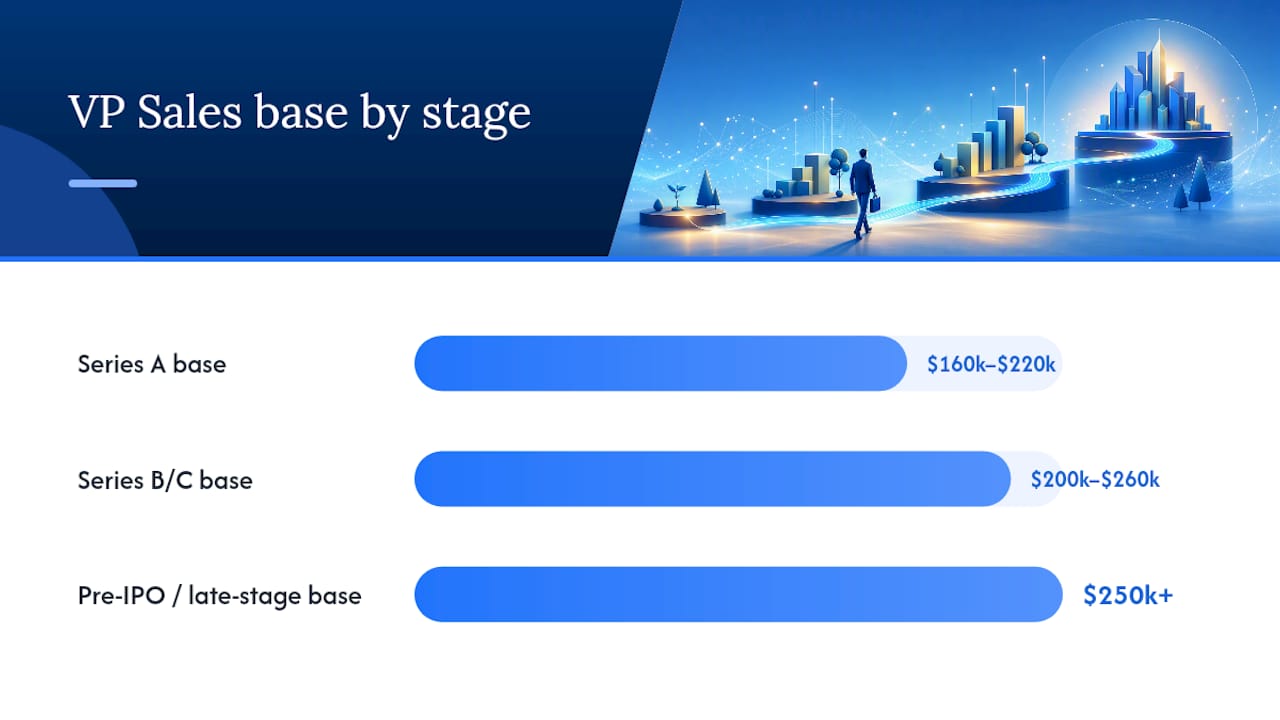
Series A companies typically pay a base in the $160,000 to $220,000 range. Series B and C push that toward $200,000 to $260,000. Pre-IPO and late-stage companies often clear $250,000 base, sometimes higher if the ARR is real and the board wants a proven operator, not a first-timer.
Modeled OTE can be estimated by multiplying base by the pay mix split, with variations depending on whether the split is more base-heavy or variable-heavy. Splits aren’t decoration. They change the number candidates see on the offer letter.
San Francisco or New York hires often command a premium on top of these figures. Remote hires outside those metros often land at a discount, but don’t get greedy about it, good VP candidates compare notes and they know what a Bay Area offer looks like even from Denver.
The methodology here isn’t fancy. It’s base times a standard multiplier, pulled from posted salary aggregator data and cross-checked against real search outcomes. If your internal number is way outside these bands, something’s off, either your stage assumptions or your comp philosophy needs a second look.
Which VP Sales Comp Template Should You Use?
Stop building comp plans from scratch every time you hire. Use a template, tweak the inputs, move on. Here are the three that actually work in the field.
- 50/50 (stretch/startup). Base $180,000, variable $180,000, OTE $360,000. Quota might be $4M in new ARR with a coverage ratio built in. This is for a hungry, early-stage motion where you need the VP betting on upside right alongside the founders. The 50/50/25+ structure that SaaStr popularized adds a stretch tier on top, paying out extra above 125% attainment.
- 60/40 (default). Base $210,000, variable $140,000, OTE $350,000. This is where most companies should land unless there’s a specific reason not to. Tie a chunk of the variable to team-level bookings, not just personal deals, because a VP who only chases their own number isn’t managing a team, they’re just another rep with a title.
- 70/30 (stability/enterprise). Base $260,000, variable $111,000, OTE $371,000. Use this when the sales cycle is long, the motion is complex, and you need someone focused on building process rather than closing personal deals every quarter.
How do you pick? A few rules of thumb:
- If ARR is under $5M and the motion is unproven, lean 50/50. You want shared risk.
- If ARR is $5M to $30M and you’ve got a repeatable playbook, go 60/40.
- If ARR is $30M+ or the sales cycle runs 9+ months, 70/30 keeps good people from bailing during a slow quarter.
How Much Equity Should A VP Of Sales Get?
Base and OTE get all the attention, but equity is where the real founder mistakes happen. I’ve seen founders lowball equity because “the salary’s already generous,” and watch a great candidate walk because the equity felt like an afterthought.
Rough guardrails by stage:
- Seed: 1% to 2%
- Series A: 0.5% to 1.5%, aligned with typical Series A equity grants
- Series B: 0.3% to 0.75%
- Series C and later: 0.1% to 0.3%
Standard vesting is four years with a one-year cliff. Don’t deviate from this without a strong reason, candidates know the standard and anything shorter looks desperate.
Be straight with candidates about dilution and expected value. Don’t wave your hands at “this could be worth millions” without walking through the cap table math. Smart VP candidates will ask, and if you can’t answer, that’s a red flag about you, not them.

Refresh grants matter more than founders think. A VP who’s two years into a four-year vest with no refresh on the table is a flight risk, especially if a competitor comes calling with a fresh package. Milestone grants tied to specific revenue targets work well as a retention lever without blowing up your cap table.
Pro Tip: Present equity as a range with real dollar scenarios at conservative, base, and upside valuations. A vague percentage means nothing to someone who’s never seen a term sheet.
For founders who need language and structure on this, our equity compensation guide breaks down how to present equity so it lands instead of confuses.
How Do You Set A Fair VP Sales Quota?
Quota math is where a lot of comp plans quietly fall apart. Founders back into a number from the revenue target, hand it to the VP, and hope for the best. That’s not a plan, that’s a wish.
- Start with your company revenue goal, then divide it into what the VP’s team needs to carry after accounting for existing book, expansion revenue, and any non-quota-carrying contribution.
- Set a coverage ratio, typically 3x to 4x pipeline coverage against quota, so the number isn’t just aspirational.
- Build the VP’s personal quota (if any) as a smaller slice layered on top of team attainment, not a separate competing number.
- Model OTE against realistic attainment, not 100%. Most sales orgs see average attainment well below plan, so if your model assumes everyone hits 100%, you’re setting up a credibility problem on day one.
Accelerators should kick in above 100% attainment, commonly 1.5x for 100% to 120% and 2x beyond that, per standard plan mechanics. Don’t cap commissions. A cap tells your best performer to stop selling in November because they’ve already hit the ceiling. That’s insane, and yet companies still do it.
Pay quarterly with an annual true-up. Use a guaranteed draw for the first two to three months of ramp, and be explicit about clawback terms if a deal unwinds. Nobody signs a comp plan expecting to get clawed back, but everybody respects a plan that spells it out up front.
What Should You Ask Before You Sign A VP Sales Offer?
You can build the perfect comp plan and still hire the wrong person if you skip the diligence. Here’s what actually separates a good VP hire from an expensive mistake.
- Ask for specific quota numbers and attainment percentages, by year, not “I usually crush it.”
- Ask how their team performed, not just their personal number, since VP roles are about leverage, not solo selling.
- Check references for pipeline discipline, not just closing ability. Anyone can tell you about the big deal they closed. Fewer can tell you how they built a forecast that didn’t lie to the board.
Red flags I’ve learned to catch fast: no quota history they can articulate clearly, vague answers about “the team did well” with no numbers attached, and any hesitation talking about a team member who didn’t work out. Sales leadership means making hard calls on people. If they can’t talk about that, they haven’t done it.
Negotiation levers that close top candidates without blowing your budget: a guaranteed ramp draw for the first 90 days, staged equity refreshes tied to tenure milestones, and accelerators triggered by specific team outcomes rather than pure base bumps.
Pro Tip: Send the full offer packet, base, OTE, equity with real numbers, vesting schedule, and quota expectations, in one document. Piecemeal offers create room for a competing offer to sneak in and steal your candidate.
If you want a structured list to run every interview against, our SaaS sales interview questions guide covers the comp-adjacent questions that trip up weak candidates fast.
What Do Real VP Sales Placements Look Like?
Numbers on a page are one thing. Watching a search actually close is another.
We’ve run VP searches where the winning company wasn’t the highest bidder. It was the one that had base, OTE, equity math, and quota expectations locked before the final interview, so there was nothing left to negotiate except start date. Speed matters here because top VP candidates are usually fielding two or three conversations at once, and the average time from search kickoff to offer acceptance runs about 21 days when the process is tight.
The takeaway for hiring managers: build your comp packet before you’re in final rounds, not after. Waiting to figure out equity while a candidate is deciding between you and someone else is how you lose them. See more in our placement examples.
What Legal And Compliance Issues Affect VP Sales Comp?
Comp plans aren’t just a math exercise, they’re a legal document once signed. A few things founders routinely miss.
Pay transparency laws in states like California, Colorado, New York, and Washington require salary ranges in job postings for many roles, VP Sales included. Get your range locked before you post, not after a candidate calls out the omission.
Commission plans need to be documented in writing and, in several states, signed by the employee before work begins. California in particular requires a written commission agreement under state labor law. Skip this and you’re exposed if a dispute over unpaid commissions ends up in front of a labor board.
Clawback provisions have to be clearly stated in the plan document, not implied. If you plan to claw back commission on a deal that unwinds within 90 days, say so in writing, with the exact mechanism, before the VP starts closing deals.
Classify the role correctly. VP of Sales is almost always exempt under FLSA rules given the salary level and duties test, but don’t assume, confirm it with employment counsel if your structure is unusual, like a heavily commission-weighted plan with a low base.
None of this replaces a lawyer. But knowing where the landmines sit means you don’t discover them during a dispute.
How Do You Align VP Comp With Company Revenue Goals?
Your comp plan should be a direct translation of the board deck, not a separate document that happens to exist in the same company.
Start with the annual revenue target and work backward. If the board wants $20M in new ARR, and the VP’s team is expected to carry 70% of that, the quota math flows from there, not from what feels like a “fair” number in isolation.
Tie a real chunk of variable comp to metrics that matter to the business right now, not generic “close deals” targets. If net revenue retention is the priority this year, weight some variable comp to expansion and renewal outcomes, not just new logos. If the board is watching CAC payback, build in a component tied to deal efficiency, not just volume.
Revisit the plan annually, tied to the planning cycle, not whenever it feels convenient. A comp plan built for last year’s motion will quietly misalign incentives if your go-to-market shifts and nobody updates the math.
The best comp plans I’ve seen make the VP feel like a co-owner of the number, not a contractor executing someone else’s spreadsheet. That’s a design choice, not an accident.
Where Is VP Sales Compensation Headed?
A few shifts are worth watching if you’re building a package this year.
Equity packages are getting more scrutiny from candidates who watched paper wealth evaporate during down rounds over the past few years. Expect more questions about liquidation preferences and last valuation, not just percentage ownership.
Team-based metrics are creeping into VP plans more aggressively. Fewer companies are paying VPs purely on their old-school personal number, more are weighting toward net revenue retention, team quota attainment, and forecast accuracy.
Base salaries have crept up relative to variable in several segments as companies compete on cash certainty in a tighter executive labor market, particularly for candidates coming off layoffs who want more predictability. That’s part of why positioning your offer competitively, ideally near the 75th percentile rather than the median, matters more now than it did five years ago.
Expect more transparency pressure generally. Pay range disclosure laws are expanding state by state, and candidates increasingly compare notes across companies before final rounds. A comp plan that can’t survive a Glassdoor comparison isn’t a good plan.
Author Perspective: The Three Rules I Won’t Bend On
Three rules, no exceptions. One, never make an offer below the 75th percentile for a candidate you actually want, cheap offers attract cheap talent. Two, put equity math in writing with real dollar scenarios, vague percentages kill deals. Three, document quota and accelerators before the offer goes out, not after the VP starts asking questions.
I’ve watched founders lose great candidates over all three. Use the templates above as your floor, not your ceiling.
— Rich Rosen
Ready To Fill Your VP Sales Seat The Right Way?
Cornerstonesearch is the direct route for SaaS and software companies that need a VP of Sales hired right, not just hired fast. We’ve placed over 1,200 sales, presales, and and executive candidates since 1996, and our average time from search kickoff to offer acceptance runs about 21 days, which matters because every extra week a VP seat sits open is a quarter of missed pipeline.

We build the comp conversation into the search from day one, so you’re not scrambling to justify OTE math to a finalist candidate three weeks in. If you’re staring at a comp template wondering whether your numbers actually compete, our sales recruitment guide walks through what a competitive package looks like before you post the role. Reach out and let’s talk about the search, we’ll tell you straight if your comp plan needs work before we even start sourcing.
Sources
For deeper benchmark data, check the CRO Report’s OTE breakdown, SaaStr’s comp structure post, and Prolifiq’s full VP comp guide. For candidate positioning insight, see Alloquy’s executive portfolio breakdown. For hiring support, browse our software sales recruitment service.