

A VP Sales search goes wrong before the first call. Founders hire from a gut feeling, a friend’s friend, or a résumé with a famous logo on it. Then the number is missed, and everyone is surprised. The process below is the one I would run for a SaaS company: diagnose the revenue problem, write a scorecard, map the market, screen hard, interview on real work, check references like it matters, and close fast. Run it right and a search takes weeks, not quarters.
TL;DR
- Open a VP Sales search when you have a repeatable sales motion to scale, not when you need someone to invent one.
- Define the revenue problem and 12-month success measures before you write a job description.
- Test what a candidate built: who they recruited, who they developed, what those people delivered.
- Call six to nine references. Treat them as a real part of the decision, not paperwork.
- Speed wins. The best candidates are employed, in demand and talking to other companies, so a slow process loses them.
Table of Contents
- Before you open the search: are you ready?
- Step 1: Name the revenue problem
- Step 2: Write the scorecard, not a wish list
- Step 3: Map the market and approach the right people
- Step 4: Screen before anyone meets the founder
- Step 5: Interview on real work
- Step 6: Reference checks that mean something
- Step 7: Close fast and close clean
- How long a VP Sales search takes
- What the new VP should do in the first 90 days
- Perspective
- Want a partner on your VP Sales search?
- FAQ
- Sources
Before you open the search: are you ready?
The most expensive VP Sales mistake is hiring one too early. Gartner’s startup research warns that hiring before the company is ready to scale can waste time and revenue, and that founders often hire too senior and too early. Its advice: train your salespeople, document the sales process and confirm product-market fit first.
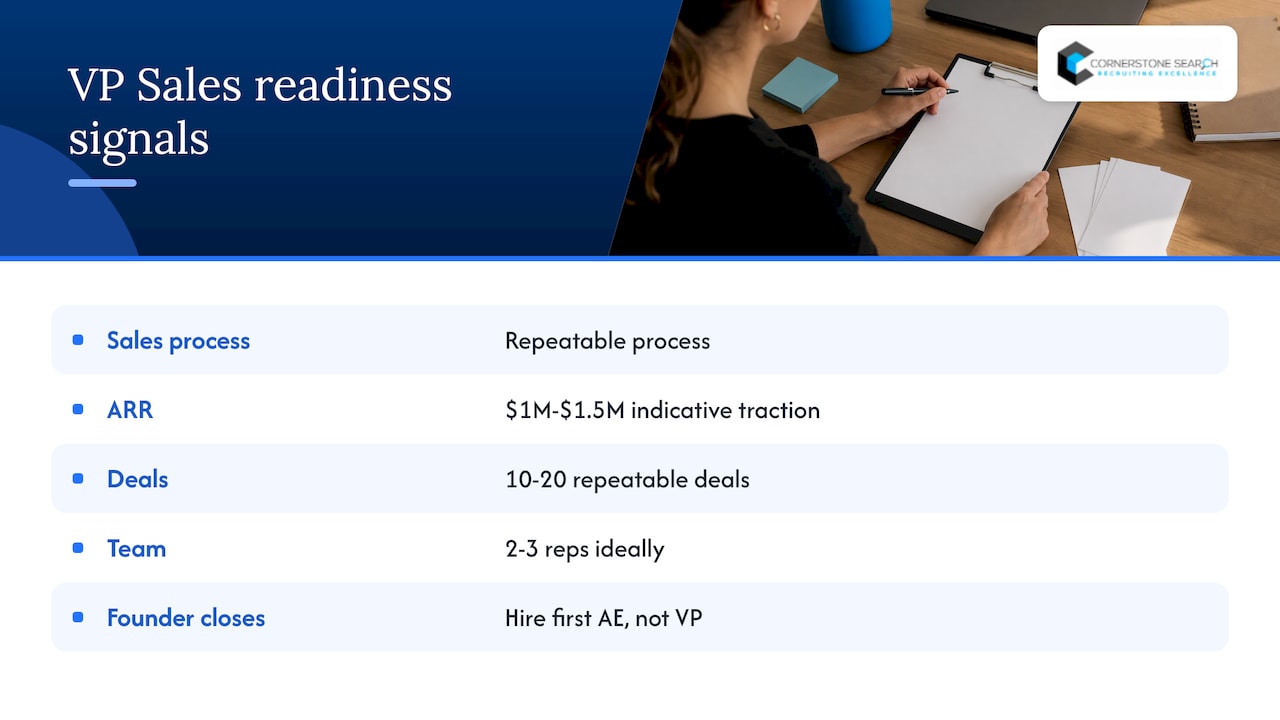
There are rough markers. SaaStr guidance says a startup should generally wait for a repeatable process or at least two performing reps, with about $1M to $1.5M in ARR as an indicative traction point. One venture firm’s checklist adds a clear ideal customer profile and roughly 10 to 20 repeatable deals, ideally with two or three reps in place. These are rules of thumb, not laws. ARR alone does not tell you.
The logic holds up in the field. A VP Sales scales a proven, repeatable process. They are not hired to create the first sales from nothing. If the founder still closes every deal, you need a great first AE or a founder who coaches, not a VP.
A quick gut check before you spend a dollar: look at where deals actually die. If the leak is in follow-up and conversion, fix that first. A practical playbook on how to improve sales conversion helps you see whether the gap is leadership or the funnel. If the pipeline is healthy and the team is stuck, you probably need the VP.
Not sure about timing? Our own piece on when to hire your first VP of Sales goes deeper. And if you are torn between a permanent hire and a part-timer, read when to hire a permanent VP Sales instead of a fractional one.
Step 1: Name the revenue problem
Do this before any job description exists. Write down, in plain words, what is broken.
- Is pipeline thin?
- Is conversion weak?
- Are reps ramping too slowly?
- Is the forecast a coin flip?
- Are you moving upmarket and the team has never sold to that buyer?
Each problem calls for a different VP. A builder who loves recruiting and coaching is not the same person as a forecast-and-process operator. Hire the wrong type and you will spend nine months finding out. I have seen founders sign off on a “strategic leader” when the company needed someone to run a weekly pipeline review and fire two reps. Be honest about it.
Also be honest about the sales motion. Inside or field? SMB or enterprise? Land and expand, or one big deal at a time? Experience matters here. One venture firm notes that an SMB seller may fit a small-business product better than an enterprise seller used to long sales cycles. A candidate who ran $400K deals with nine-month cycles will struggle in a $12K ACV motion where volume is the game. That is not a flaw in the person. It is a bad match.
Step 2: Write the scorecard, not a wish list
A scorecard is one page. It covers:
- The mandate. Why does this role exist now?
- 12-month outcomes. Three or four numbers, such as new ARR, quota attainment and pipeline coverage. Keep it short.
- Scope. Segments, territories, team size, who they report to.
- Must-have experience. Stage, ACV range, motion, and whether they have built a team before.
- Package. Base, variable, equity, and how OTE is defined.
For reference on scope, one company’s public handbook gives the VP Sales ownership of repeatable sales processes, revenue growth, customer adoption and partnerships, measured on things like bookings growth, pipeline coverage, forecast accuracy and retention. You do not need every metric. Pick the few that matter at your stage.
On money: OTE means on-target earnings, base plus the variable pay a person earns when they hit plan. Equity usually sits on top, separate from OTE. Decide the range before you talk to anyone. Candidates at this level know the market, and a lowball in the first call ends the conversation. Our VP Sales compensation benchmarks and templates lay out how to build the package.
One more thing on the scorecard. Agree on it with your board or lead investor before the search starts. If your CEO wants a hunter and your lead investor wants a process person, you will interview forever.
Step 3: Map the market and approach the right people
Here is the part most founders skip. The strongest VP Sales candidates are not on job boards. They have jobs. They are hitting numbers. A job post gets you people between jobs, and some of them are great. Most are not.
A real search starts with a map: the companies that sell to your buyer, at your stage or one step ahead, with your kind of motion. Then you find the sales leaders inside them, and you call them. Some will say no. Some will say not now. A few will say tell me more.
That is where a network matters. Referrals from the people you know are a start, and they come with a trap. SaaStr’s playbook notes that founders lean hard on investor and friend referrals when they run this search. That pool is small and biased toward people your friends like, not people who can do the job.
Our take on why this market is so tight is in why the SaaS sales talent market is so competitive. Short version: the people you want have options.
Step 4: Screen before anyone meets the founder
Your time is the scarcest thing in the building. Do not spend it on a first-round call with someone who looks good on LinkedIn.
Screen for four things:
- Fit with your motion. Same buyer, similar deal size, similar cycle.
- Real numbers. Ask for quota, attainment and team results by year. Not “I crushed it.” The actual figures.
- Team-building. Did they hire? Did the hires stick? Did they fire anyone, and why?
- Why now. What do they want, and does it match what you are offering?
A résumé shows titles. It does not show whether the team hit plan because of this person or in spite of them. A VP who joined a rocket ship in year two and left in year three has a great logo and an unknown skill set. Ask what was true when they arrived and what was true when they left.
Watch for the candidate who talks only about their own big deals. A VP does not close deals. A VP builds people who do. SaaStr’s guidance says to test whether candidates actually recruited and developed quota-carrying reps, and to ask whom they recruited and what those hires achieved. That is the question. Ask it early.
Step 5: Interview on real work
Three rounds is plenty. More than that and your best finalist takes another offer.
Round one: the founder or CEO. Mutual fit. Walk through the scorecard. Ask behavioral questions about things the person did, not what they would do in theory. “Tell me about the last rep you let go and how you knew” beats “What is your management philosophy?” every time.
Round two: the working session. Give them real data: your pipeline, your funnel, your comp plan. Ask them to tell you what they see and what they would do in the first 30 days. A live case or role-play also helps you test strategic thinking and selling under pressure. You will learn more in 90 minutes here than in three rounds of conversation.
Round three: the team and the board. Let a couple of your best people talk to the finalist without you in the room. Then let a board member or investor meet them. Keep it a conversation, not a trial.
Some questions worth asking every finalist:
- What was your hiring bar for AEs, and what did you miss?
- Show me your forecast accuracy over the last four quarters.
- When did you last miss plan, and what did you change?
- What did you inherit, and what did you leave behind?
- What would you not do in the first 60 days?
If you want a ready-made evaluation frame, see how we score VP Sales candidates on five dimensions.
Step 6: Reference checks that mean something
Backdoor references and polite references are both useless in different ways. Backdoor calls are a gossip casino: you roll the dice and hope the person you reach has no axe to grind. Polite references are the three people the candidate picked to say nice things.
Do it in a structured way. One well-known venture firm recommends six to nine references: two managers, two direct reports, two peers, and extra external references. It estimates each conversation at 20 to 30 minutes. It also treats references as a parallel decision tool, not a last-minute formality, because they verify claims and expose weak spots.
Talk to people who reported to the candidate. That is where the truth is. Ask them:
- What did this person do for your growth?
- How did they handle a bad quarter?
- Would you work for them again?
- What should I know before I hire them?
Get the candidate’s permission first. It protects the relationship and, honestly, it tells you something about them if they hesitate.
Step 7: Close fast and close clean
Strong candidates are interviewing in several places. Slow feedback reads as low interest. Get to an offer within days of the last round, not weeks.
Before the offer, check the basics:
- Base, variable and OTE are written down and match what you said in the first call.
- The equity grant, vesting and any acceleration are clear.
- Quota, territory and the comp plan are defined, in writing.
- Start date, reporting line and board involvement are agreed.
Then call them. Do not email an offer cold. Tell them why you want them, what you need and what you will give them to do the job. Be ready for a counter and know your ceiling before you pick up the phone.
How long a VP Sales search takes
Short answer: longer than founders hope. One widely used hiring guide tells executives to plan for an average of 130 days, with some searches running six months or more. A well-designed process shortens that, and in-demand candidates interviewing elsewhere can stretch it.
What slows a search down:
- A vague scorecard that changes mid-search.
- Too many interviewers and no decision maker.
- Slow feedback between rounds.
- Comp that does not match the market.
- Starting with the wrong profile and having to restart.
What speeds it up: a locked scorecard, a mapped market, a short interview loop and a founder who answers the same day. Our executive search timeline shows the milestones, and the stages of the executive sales search process break down each phase.
If you need someone in seat while the search runs, interim sales leadership is one way to cover the gap.
What the new VP should do in the first 90 days
The search does not end at the offer. The first three months set the tone. A common plan splits it like this, per one 30-60-90 plan for a VP of Sales:
| Period | Focus | Typical work |
|---|---|---|
| Days 1 to 30 | Diagnose and align | Review the forecast and P&L, map the process, meet the CEO, CFO and board, agree early success metrics |
| Days 31 to 60 | Strategize | Build territory and quota models, set forecast governance, assess talent gaps |
| Days 61 to 90 | Execute | Hold a 90-day board review, run QBRs, launch one or two high-impact initiatives, re-forecast |
Do not expect quota miracles in 90 days. Expect a clear read on the team, a plan you believe and a few early wins. If your VP cannot tell you what is broken by day 30, that is a signal.
Perspective
I have been placing sales leaders in SaaS since 1996, more than 1,200 of them. The same mistake shows up again and again. A founder rushes, hires on charm, and finds out a year later what the person could not do.
That is why we run every search personally, and why the intake is founder-led. Before we call a single candidate, we want to know what is broken, what the motion looks like and what the board expects. That one conversation decides whether the search lands or drifts.
Speed matters too. Our average from search kickoff to accepted offer is about three weeks. We get there because the market map, the network and the screening are done up front, not bolted on after the first batch of résumés disappoints.
Our one-year retention rate is 93%. I care about that number more than the 21 days. A fast hire who leaves in nine months is just a fast mistake.
If you are going to run this search yourself, use the steps above. They work. If you want a recruiter who has done it for three decades and will call the people you cannot reach, that is what we do.
Rich Rosen
Want a partner on your VP Sales search?
We run contingent and retained searches for SaaS and software companies, with a focus on sales leaders: VP Sales, CRO, account executives, sales engineers and customer success heads. Our Software Sales Recruitment service is built for exactly this search. If the role is more senior or board-facing, look at Executive Search Recruitment. Not sure which fits? Start with how retained search differs from contingency.
Tell us what is broken in your sales org and we will tell you what kind of leader fixes it. You can reach us through cornerstonesearch.com.
FAQ
When should a startup hire its first VP of Sales?
When you have a repeatable sales process to scale, usually evidenced by product-market fit, a clear ideal customer profile and at least two reps who perform. SaaStr’s guidance points to roughly $1M to $1.5M ARR as an indicative point. Earlier than that, a strong first AE or a coaching founder is usually the better move.
How long does a VP of Sales search take?
A common benchmark for an executive search is about 130 days, and some run past six months. A locked scorecard, a short interview loop and quick feedback cut that down. Our own average from kickoff to accepted offer is about three weeks.
What should I look for in a VP of Sales candidate?
Look for experience selling to your buyer at your deal size, a record of recruiting and developing reps who hit quota, and real numbers by year. Titles and logos tell you very little. Ask whom they hired and what those people delivered.
How many references should I check?
Aim for six to nine: two managers, two direct reports, two peers and a few external contacts, as one venture firm’s hiring guide recommends. Direct reports tell you the most. Get the candidate’s consent first.
Should I use a recruiter for a VP Sales search?
If you have the network, the time and a clear scorecard, you can run it yourself. If you do not, a specialist who knows SaaS sales leaders brings a mapped market and faster access to people who are not looking. That is what we do at Cornerstone.
Sources
- Gartner: Startup Tech CEO, Don’t Hire a VP of Sales Until You’re Ready
- SaaStr: How Do I Hire a Great VP of Sales?
- True Ventures: When to Hire a VP of Sales for Your SaaS Business
- RTP Global: Why Your First VP of Sales Is Critical
- FlowFuse Handbook: VP of Sales
- Andreessen Horowitz: The Hiring Process
- Elephant Edge: Hiring a VP of Sales for a SaaS Startup
- Everstage: 30 60 90 Sales Plan for VP of Sales