

A sales team structure defines who owns which stages of the revenue process, how reps report up, and how territory or accounts get divided. Get it wrong and you get finger-pointing, blown handoffs, and reps who don’t know what they own. Get it right and pipeline moves faster, coaching gets sharper, and quota becomes predictable.
Here is the fast answer by company stage:
- Island (full-cycle): Under 10 reps. One rep owns prospect-to-close. Use this when your motion is still being figured out and you need reps who can do everything.
- Assembly line (SDR → AE → CSM): A midsize team with a repeatable, predictable funnel. Specialize roles once you know your conversion rates cold.
- Pod (cross-functional teams): larger teams or complex enterprise deals with high ACV. Group SDR, AE, SE, and CSM together around a segment or vertical.
Most B2B sales teams end up running a hybrid. The model you pick should match your motion, not what your competitor is doing.
Table of Contents
- What are the three core sales team models?
- Who does what: roles, KPIs, and ratios
- What structural variations should you layer on top?
- How do you choose the right structure for your stage?
- How many managers do you need as you scale?
- How do you transition between models without blowing up the team?
- What are the most common pitfalls when redesigning a sales team?
- When should you bring in a specialist recruiter?
- Key Takeaways
- What most sales leaders get wrong about structure
- Need the right people to fill these roles?
- Useful sources and further reading
What are the three core sales team models?
The three dominant structures are island, assembly line, and pod. Most companies start with one and drift toward a hybrid as they scale. Choosing based on context, not trend, is what separates teams that scale cleanly from ones that reorganize every 18 months.
Island (full-cycle)
Every rep handles the full sales cycle: prospecting, discovery, demo, negotiation, close. No handoffs. No shared pipeline.
Pros: Simple to manage. Reps own their number completely. Easy to hire for early-stage when the motion is undefined. Great for founder-led selling before you have a playbook.
Cons: Hard to coach because every rep does it differently. Ceiling on individual output. No specialization means no leverage. When a rep leaves, their pipeline walks out with them.
Best for: Seed-stage SaaS, founder-led sales, or niche enterprise deals where the buyer relationship is everything.
Assembly line (specialized roles)
Roles are split by stage: SDRs prospect and qualify, AEs run discovery and close, CSMs own onboarding and renewal. Each person gets very good at one thing.
Pros: Faster ramp per role. Easier to coach and measure. Scales volume without proportionally scaling headcount. Predictable funnel math.
Cons: Handoff risk is real. If SLAs are loose, leads fall through the cracks. Reps can develop tunnel vision and stop caring about stages they don’t own.
Best for: High-velocity SMB SaaS, moderate ACV, inbound-heavy motions, midsize teams with a defined playbook.
Pod (cross-functional team)
A small, self-contained unit: typically one SDR, two or three AEs, one SE, and one CSM. The pod owns a segment, vertical, or named account list end-to-end.
Pros: Tight collaboration. Buyer gets a consistent team experience. Easier to run account-based motions. Pods compete with each other, which drives performance.
Cons: More management overhead. Harder to hire because you need complementary skills in one unit. Compensation design gets complicated fast.
Best for: Enterprise-level deals with complex multi-stakeholder sales, ABM motions, larger sales teams.
Model comparison
| Dimension | Island | Assembly Line | Pod |
|---|---|---|---|
| Best for (stage/motion) | Startup, founder-led, undefined motion | Growth-stage, high-velocity SMB | Enterprise, ABM, complex deals |
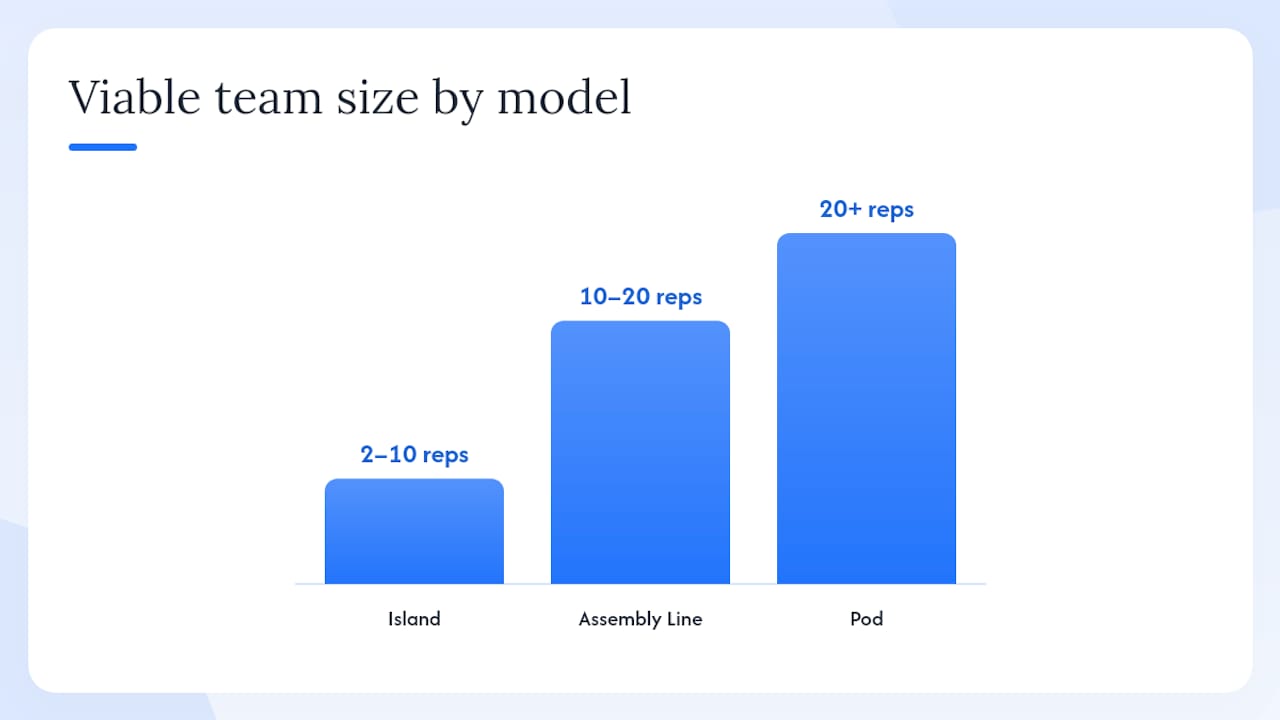
| Viable team size | 2–10 reps | 10–20 reps | 20+ reps |
| Deal cycle / ACV fit | Short cycle, low-to-mid ACV | Short-to-mid cycle, around $10K ACV | Long cycle, $100K+ ACV |
| Management overhead | Low | Medium | High |
| KPIs most affected | Win rate, ramp time | Pipeline velocity, SDR-to-AE conversion | NRR, win rate, account expansion |
Who does what: roles, KPIs, and ratios
Knowing the model is step one. Knowing who fills each seat, what they own, and what good looks like is what lets you hire and coach with precision. Here is a practical reference for the most common SaaS sales roles.
| Role | Owns (stage) | Primary KPIs | Ratio / quota guidance |
|---|---|---|---|
| SDR/BDR | Prospecting, qualification, booked meetings | Meetings held, qualified pipeline created, sequence reply rate | Typical ratio is roughly one SDR per a few AEs depending on inbound or outbound focus |
| Account Executive (SMB) | Discovery through close | Quota attainment, win rate, average deal size, sales cycle length | Common quotas vary widely based on company and market |
| Account Executive (Enterprise) | Complex multi-stakeholder close | Pipeline coverage, win rate, ACV per deal | Quotas and ramp periods depend on deal complexity and company specifics |
| Sales Engineer (SE) | Technical validation, proof of concept | POC win rate, technical close rate | Ratios vary by company size and deal type |
| Customer Success Manager (CSM) | Onboarding, adoption, renewal, expansion | NRR, churn rate, expansion ARR, health scores | Typical coverage varies depending on customer touch model |
| Sales Manager | Coaching, pipeline review, forecast | Team quota attainment, rep ramp time, forecast accuracy | Typical spans vary by company and sales role |
Pro Tip: Comp structure should mirror the model. If your AEs are supposed to close and your CSMs are supposed to expand, make sure the variable pay reflects that split. Paying AEs on renewals they don’t control, or CSMs on new logos they can’t influence, breaks both roles. Align OTE to the stage each person owns. For more on how pricing affects these comp decisions, see SaaS pricing and sales hiring.
What structural variations should you layer on top?
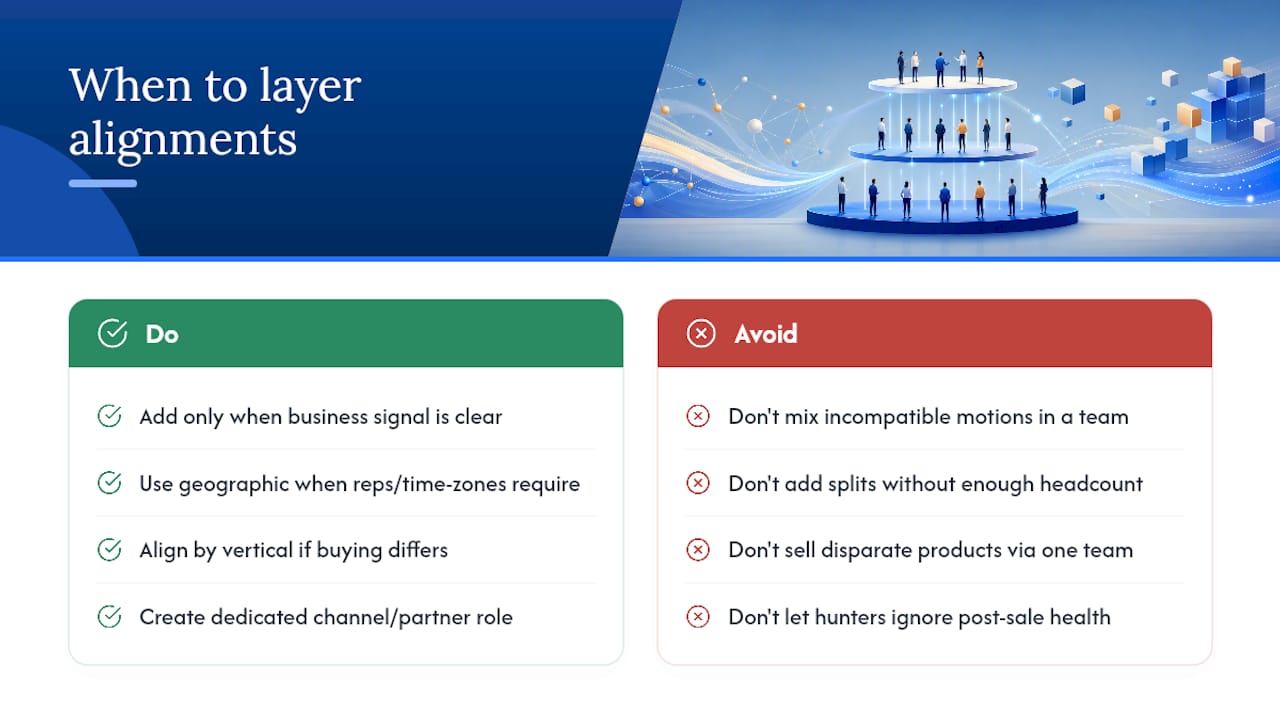
Once you have a base model, you can layer alignment variations on top. Each one adds specificity. Each one also adds complexity. Add them only when the business signal is clear.
Geographic/territory alignment makes sense when you have enough reps to cover distinct regions and when travel or time-zone coverage matters. With roughly a third of eligible U.S. workers now fully remote, pure geographic splits are less automatic than they used to be. Factor remote coverage into your territory math before you draw lines on a map. For remote-specific hiring considerations, the remote SaaS sales hiring guide covers the nuances.
Vertical/market alignment works when your buyers in different industries have genuinely different buying processes, procurement cycles, or compliance requirements. Healthcare SaaS and fintech SaaS are not the same sale. If your reps are losing deals because they can’t speak the buyer’s language, vertical alignment is worth the overhead.
Product alignment fits when you have multiple products with distinct buyer personas or meaningfully different sales motions. Selling a $15K/year SMB product and a $500K enterprise platform through the same team is a recipe for the enterprise deals getting ignored.
Channel/partner alignment adds a layer for companies with a significant reseller or SI partner motion. This requires a dedicated channel AE or partner manager role, not just a checkbox on an existing AE’s job description.
Hunter/farmer splits separate new logo acquisition (hunters) from account expansion and renewal (farmers). This works well when your expansion motion is large enough to justify dedicated headcount. The risk: hunters stop caring about post-sale health, and farmers stop generating urgency.
Customer-success-led growth flips the model so CSMs own expansion ARR as a primary metric, not just a secondary one. This works in product-led growth companies where usage drives upsell signals.
One hard rule: do not mix incompatible motions in the same pod or team. High-volume transactional selling and high-touch enterprise ABM require different hiring profiles, different comp plans, and different coaching cadences. Forcing them together breaks both.
How do you choose the right structure for your stage?
The right structure follows the motion, not the org chart. Here are the numeric triggers that tell you when to move.
Under 10 reps: Stay on the island. Full-cycle reps give you the most information about what works. You are still learning your ICP, your objections, and your close rate. Specializing before you have a repeatable motion is premature. Stage-based thresholds consistently point here.
A midsize team with predictable conversion rates: The SDR/AE split can become viable once you have reliable funnel data and clean processes. Without those numbers, your SDRs will burn leads and your AEs will starve.
Larger teams or high ACV deals: Pods or a hybrid assembly line with pod elements for enterprise. At this scale, management layers become important.
Readiness checklist before splitting roles:
- Funnel conversion rates are stable across at least two quarters
- CRM data is clean enough to run pipeline reports you trust
- You have defined qualification criteria (MEDDIC, SPICED, or your own framework) that reps apply consistently
- You can write an SLA for the SDR-to-AE handoff and actually enforce it
- You have a manager or ops person who can run the handoff process
Forrester’s analysis makes the point clearly: RevOps readiness and clean data are prerequisites to successful specialization. Without them, specialized roles fail to create pipeline regardless of how well you hire.
How many managers do you need as you scale?
Management layers are where most founders get it wrong. They either promote their best rep too early, or they wait too long and watch coaching quality collapse under span-of-control pressure.
Span-of-control benchmarks
| Role | Ideal span | Maximum span |
|---|---|---|
| SDR manager | 8–10 SDRs | 12 |
| AE manager (SMB) | 7–8 AEs | 10 |
| AE manager (mid-market) | 6–8 AEs | 9 |
| AE manager (enterprise) | 4–6 AEs | 7 |
| Sales director | 3–4 managers | 5 |
| VP Sales | 5–7 direct reports | 8 |
These span-of-control benchmarks reflect coaching load, not just headcount. Enterprise AE managers carry fewer reps because each deal requires deeper inspection. SDR managers can carry more because the coaching is more repetitive and process-driven.
Sample org topologies
10-rep team: One VP Sales or player-coach manager. No layers. All reps report directly. RevOps is probably one person wearing multiple hats.
40-rep team: VP Sales with two or three frontline managers (one SDR manager, one or two AE managers split by segment). A dedicated RevOps analyst. CSM lead if you have a renewal motion.
200+ sellers: VP Sales or CRO at the top. Directors of each segment (SMB, mid-market, enterprise). Frontline managers under each director. Dedicated RevOps team, enablement function, and a CS leader. At this size, team composition research shows that span-of-control overload directly increases burnout and attrition. Every layer you add costs payroll and communication overhead. Every layer you skip costs coaching quality.
How do you transition between models without blowing up the team?
Most reorganizations fail not because the new model is wrong, but because the migration is rushed. Here is a migration path that works.
Step 1: Validate the motion. Before you split any roles, confirm your funnel math is stable. Two consecutive quarters of consistent conversion rates is the minimum bar.
Step 2: Pilot the split. Pick two or three reps and run the new model in parallel with the old one. Measure handoff quality, pipeline velocity, and rep satisfaction before rolling it out to the whole team.
Step 3: Define SLAs and handoffs. An SDR-to-AE handoff without an SLA is just a hope. Define: what qualifies a lead for handoff, what the AE response time expectation is, and what happens when a lead gets bounced back.
SDR-to-AE handoff SLA checklist:
- Lead meets ICP criteria (company size, industry, tech stack)
- Pain or trigger event identified and documented in CRM
- Decision-maker or champion confirmed
- Budget conversation initiated or budget range confirmed
- AE accepts or rejects within 24 hours with documented reason
Step 4: Hire the missing roles. Do not split SDR and AE roles and then ask your existing AEs to also do SDR work while you recruit. That is a morale killer. Have the new hire ready before the split goes live.
Step 5: Measure and iterate. Track pipeline velocity, SDR-to-AE conversion, and AE win rate for 90 days post-transition. If conversion drops, the problem is usually the handoff criteria, not the reps.
Common transition scenarios:
Founder-led to first AE: Hire a closer first, not an SDR. The founder is already generating pipeline. The constraint is closing capacity, not lead volume. Hire an SDR only after the AE is ramped and pipeline volume is the actual bottleneck.
AE-only to AE+SDR split: Only viable when your AEs are spending more than 30% of their time on prospecting and you have enough inbound or outbound signal to keep SDRs busy. If lead volume is thin, SDRs will churn fast.
Assembly line to pods for enterprise: Requires restructuring comp, redefining territories, and rewriting job descriptions. Give yourself a full quarter to plan before you announce anything.
What are the most common pitfalls when redesigning a sales team?
Reorganizations are where good intentions go to die. Here are the traps that show up most often.
- Hiring SDRs before a closer. SDRs book meetings. If there is no one to run them, you burn leads and burn out your SDRs. Hire the AE first.
- Grey ownership between roles. When it is unclear whether the SDR or AE owns a stalled deal, nobody owns it. Define handoff criteria in writing before you split roles.
- Misaligned comp plans. Paying AEs on metrics they do not control, or CSMs on new logo revenue, creates resentment and gaming. Comp should map to the stage each role owns.
- Overcomplicated territories. Splitting territories by zip code, industry, company size, and product line simultaneously creates coverage gaps and rep confusion. Start with one alignment dimension.
- Promoting your best rep to manager. The skills are different. A rep who closes well does not automatically coach well. Promote for coaching instinct, not quota rank.
- Reorganizing before the motion is proven. If your win rate is below 15% and your cycle length is inconsistent, a new org chart will not fix it. Fix the motion first.
- Ignoring ramp time in headcount planning. A new AE is not productive for 3–6 months. Plan headcount for where you need to be in six months, not where you are today.
Pre-restructure red flag checklist:
- Win rate below 15% with no clear root cause
- CRM data you would not trust to run a board forecast
- No documented qualification criteria
- Reps who cannot articulate the ICP
- No defined onboarding or ramp program
If three or more of those are true, fix the foundation before you touch the org chart.
When should you bring in a specialist recruiter?
Not every role needs a recruiter. But some do, and waiting too long costs more than the fee.
Promote internally when: You have a rep with clear management instinct, documented coaching behavior, and the respect of the team. Frontline SDR team leads often fit this path.
Recruit externally when: You need a VP Sales, CRO, or enterprise AE with a specific ICP background, a proven quota history at a comparable ACV, and a network in your target segment. These hires are hard to find and easy to get wrong.
When to use a recruiter: When the role is senior, when speed matters, or when your network does not reach the candidate pool you need. A bad VP Sales hire costs you 12–18 months of momentum. A recruiter who specializes in SaaS sales pays for themselves on the first placement.
Brief for your recruiter (minimum viable version):
- Role title and reporting line
- OTE range and equity (if applicable)
- Quota expectation and ramp timeline
- ICP the rep will sell into (company size, industry, tech stack)
- Must-have prior experience (ACV range, sales motion, tools used)
- Deal-breakers (no enterprise experience, no SaaS background, etc.)
Use a SaaS sales job description template to make sure you are not missing critical role criteria before you brief anyone.
Time-to-hire benchmarks: For IC roles (AE, SDR, SE), expect 4–8 weeks from kickoff to offer. For VP Sales or CRO, expect 6–12 weeks if you are running a thorough process. Cornerstonesearch’s average from search kickoff to offer acceptance is 21 days, which matters when a vacant quota-carrying seat is bleeding pipeline every week.
For roles where you are unsure whether to promote or hire externally, the benefits of specialized sales recruiters article walks through the decision criteria in detail.
Key Takeaways
The right sales team structure is the one that matches your current motion, headcount, and ACV, and the fastest way to get the wrong hire out of a key seat is to skip the recruiter brief.
| Point | Details |
|---|---|
| Match model to stage | Under 10 reps use island; 10–20 with predictable funnel use assembly line; 20+ or high ACV use pods. |
| Validate before splitting | Stable conversion rates across two quarters are the minimum bar before splitting SDR and AE roles. |
| Span-of-control matters | Enterprise AE managers should carry 4–6 reps; SDR managers can handle 8–10 before coaching quality drops. |
| Hire the closer first | At early stage, hire an AE before an SDR; the constraint is closing capacity, not lead volume. |
| Cornerstonesearch for fast hiring | Cornerstonesearch places SaaS sales professionals with an average 21-day search-to-offer timeline, reducing vacant-seat pipeline loss. |
What most sales leaders get wrong about structure
Here is the thing nobody says out loud: most sales reorganizations are a distraction from a harder problem. The structure is not broken. The hiring is.
I have seen founders redraw the org chart three times in two years while the real issue was that their VP Sales could not coach, their AEs could not qualify, and their SDRs were booking meetings with the wrong ICP. A new org chart does not fix a rep who cannot run discovery. It just gives everyone new boxes to hide in.
The other mistake I see constantly is confusing a model with a motion. The assembly line is not a magic pipeline machine. It is a structure that amplifies whatever motion you already have. If your motion is broken, specializing it just breaks it faster and at higher cost.
Three things I would tell any founder or CRO right now:
- Hire for player instincts, not resume logos — A rep who closed $2M at a company you have heard of is not automatically the right hire. Ask about their pipeline generation habits, their qualification discipline, and what they do when a deal goes quiet.
The skills enterprise AEs need to win are specific and learnable, but only if you hire someone with the raw instincts to build on. Structure sets the stage. Hiring fills it.
Need the right people to fill these roles?
Cornerstonesearch specializes in placing SaaS sales professionals who are already operating at the level your structure requires. Not candidates who look good on paper and struggle to ramp. Actual quota carriers with the ICP experience, the motion familiarity, and the comp history that matches your open seat.
Over 1,200 placements since 1996. Average time from search kickoff to offer acceptance: 21 days. Contingent and retained options depending on the urgency and seniority of the role.
- Screened candidates matched to your ACV, motion, and ICP
- Role-fit assessment against your quota, ramp, and comp structure
- Fast turnaround that keeps vacant quota-carrying seats from bleeding pipeline
If you are building or rebuilding a sales team and need to get the right people in the right seats fast, start the conversation here.
Useful sources and further reading
These are the sources behind the rules of thumb in this article, plus Cornerstonesearch resources for readers who want to go deeper.
-
Sales Org Structure Guide: Pod, Island, and Assembly Line | CRO Report — The clearest breakdown of the three core models with span-of-control benchmarks and stage-based guidance. Start here.
-
Sales Team Structure: The Models That Actually Work — Practical headcount and ACV thresholds for deciding when to move between models. Good for founders at the 10–20 rep inflection point.
-
B2B Sales Team Structure: The Best Org Models | SyncGTM — Covers how model choice shapes pipeline velocity and forecast accuracy, with hybrid model guidance for $20M–$100M ARR companies.
-
Sales Team Structure for Startups | Helmsend — The best resource on early-stage hiring sequence: founder-led to first AE to SDR. Required reading before you make your first sales hire.
-
Is Your Sales Organization Ready to Scale? | Forrester — Forrester’s take on RevOps readiness as a prerequisite for specialization. Useful for leaders who think they are ready to split roles.
-
Team Composition and Organizational Outcomes | PMC — Academic research on how team composition affects performance and burnout. Relevant for span-of-control decisions and manager load planning.
-
SaaS Sales Job Description Template: 2026 HR Guide | Cornerstonesearch — A practical template for writing role descriptions that attract the right candidates. Use it before you brief a recruiter or post a job.
-
Cornerstone Search Associates — Cornerstonesearch’s home base. Contingent and retained SaaS sales recruiting with 1,200+ placements and a 21-day average time to offer. Also check XL Roleplay for sales coaching simulations that help new hires ramp faster once they are in seat.