

Talent due diligence is a systematic, multi-dimensional assessment of an organization’s key human capital to identify strengths, risks, and gaps before a hire or acquisition closes. Unlike a standard background check, the talent due diligence process evaluates leadership capability, retention risk, cultural fit, and organizational dependencies in a structured sequence. Human capital represents 30 to 60% of enterprise value in knowledge-intensive firms, which means a single misjudged executive hire or overlooked key-person dependency can destroy value faster than any market shift. For HR professionals and business leaders, understanding this process is the difference between a hire that accelerates growth and one that triggers a costly rebuild.
What is a talent due diligence process, step by step?
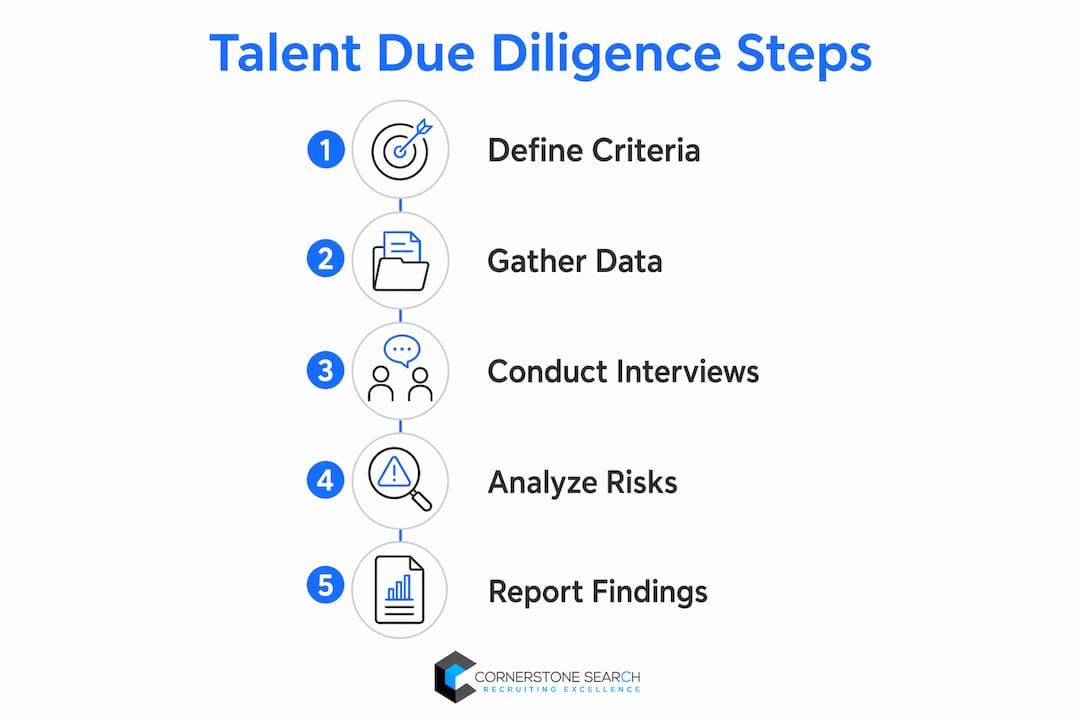
A talent due diligence process follows a defined sequence, not a checklist you complete in an afternoon. Comprehensive projects span 4 to 8 weeks, with initial risk triage starting within the first three days of a search or deal kickoff. That timeline discipline matters because the earlier you surface a red flag, the cheaper it is to address.
Here are the core talent due diligence steps in sequence:
- Initial risk triage. Identify key-person dependencies, revenue concentration in specific individuals, and roles with no clear succession path. This step answers one question: who, if they left tomorrow, would cause the most damage?
- Legal and litigation review. Pull employment litigation history, regulatory violations, and any active or pending legal matters tied to the individual or their prior employers.
- Employment history and contract verification. Confirm titles, tenures, compensation structures, non-compete clauses, and any garden-leave provisions that could delay a start date or restrict the candidate’s scope.
- Reference verification. Conduct structured reference calls using behavioral questions, not open-ended conversations. The goal is pattern recognition across multiple sources, not a single endorsement.
- Reputation audit and open-source intelligence. Social media forensics and AI-aware OSINT have become standard in modern reputation audits for high-profile hires. Employee review platforms and digital footprints provide leading indicators for attrition risk that traditional methods miss entirely.
- Retention mechanism assessment. Evaluate existing equity, option vesting schedules, retention bonuses, and contractual obligations that either lock talent in or create flight risk after a transaction closes.
- Integration and escalation gates. Define clear decision points where findings escalate to deal principals or hiring committees. Talent diligence without escalation gates produces reports that nobody acts on.
Pro Tip: Set a hard escalation gate at day five of triage. Any finding that scores high on revenue dependency or replaceability risk should reach the decision-maker before the process moves to deeper assessment. Waiting until the final report wastes time and money.
Why talent due diligence protects organizational value

The importance of talent due diligence becomes concrete when you look at what happens without it. Over 90% of private equity professionals report negative impact on portfolio performance from delays in addressing talent-related issues. That figure applies equally to growth-stage SaaS companies that promote the wrong VP of Sales and spend 18 months recovering.
The risks that talent diligence surfaces fall into four categories:
- Key-person concentration. A single executive who owns the majority of customer relationships, institutional knowledge, or technical architecture creates a fragile organization. Structured diligence scores this risk using four dimensions: revenue dependency, knowledge monopoly, replaceability, and retention likelihood.
- Cultural misalignment. A leader who performed well in a 500-person enterprise may fail in a 40-person startup. Diligence maps behavioral patterns against the actual operating environment, not the idealized job description.
- Retention flight risk. Unvested equity, dissatisfaction signals from review platforms, and compensation gaps all predict post-hire or post-acquisition attrition. Finding these signals before closing gives you time to structure protections.
- Leadership capability gaps. A candidate’s track record in their last role does not guarantee performance in the next one. Diligence evaluates future-fit capability against the specific value-creation plan, not just past titles.
“Proactive, rigorous talent diligence is a key differentiator that can accelerate value creation and reduce costly mid-hold talent disruptions.” — Hunt Scanlon Media
The cost of skipping this work is not theoretical. Leadership gaps and talent-related deal failures consistently rank among the top reasons acquisitions underperform their investment thesis. For HR leaders in SaaS and software firms, the same logic applies to every senior sales hire: the wrong person in a revenue-critical role compounds losses every quarter they stay.
How talent diligence differs from standard hiring assessment
Standard hiring assessment is collaborative and narrative-driven. A candidate presents their story, interviewers respond to it, and the process moves toward consensus. Talent due diligence is adversarial and systematic. It challenges the narrative with independent data.
| Dimension | Standard hiring assessment | Talent due diligence |
|---|---|---|
| Data sources | Resume, interview, references provided by candidate | OSINT, litigation records, independent references, psychometrics |
| Bias risk | High: single-perspective narrative | Lower: multi-source triangulation |
| Scope | Past performance and cultural impression | Future-fit capability against specific value-creation plan |
| Output | Hire or no-hire decision | Development plan, risk score, retention strategy |
| Timeline | Days to weeks | 4 to 8 weeks with defined escalation gates |
Typical pitfalls include over-reliance on management narratives and treating assessment as a box-checking exercise rather than a bespoke planning process. When diligence simply validates what the hiring manager already believes, it adds no value. Real diligence occasionally contradicts the deal thesis or the hiring committee’s preference. If your process never produces an uncomfortable finding, it is not rigorous enough.
Combining psychometrics, structured interview data, and contextual leadership profiles yields more predictive insight than any single method. Psychometrics alone cannot account for context. Structured interviews alone cannot surface litigation history. The combination produces a picture that a resume never could.
Pro Tip: Build your leadership success profile before you start evaluating candidates. Define the specific behaviors, decision-making patterns, and operating contexts that predict success in this exact role, at this exact stage of company growth. Matching candidates against a generic leadership ideal produces generic results.
What retention strategies should follow talent due diligence?
Diligence findings are only useful if they inform what happens next. For HR leaders and deal teams, the output of a talent assessment process should directly shape the retention architecture built around key hires.
The most effective retention mechanisms, ranked by durability, include:
- Equity and option schemes. Multi-year vesting schedules with cliff periods align individual incentives with organizational outcomes over a 3 to 5 year horizon. They work best when the equity is meaningful relative to the candidate’s total compensation.
- Management incentive plans and performance earn-outs. In acquisition contexts, earn-outs tied to specific revenue or EBITDA milestones keep founders and key operators engaged through the integration period.
- Retention bonuses with contractual safeguards. Cash retention bonuses with clawback provisions covering 12 to 24 months provide a short-term bridge while longer-term incentives vest. Non-compete and non-solicitation clauses add a structural layer of protection.
- Operational autonomy. Talent diligence frequently reveals that high performers leave not for money but for loss of control. Preserving decision-making authority within defined boundaries is a retention driver that no equity scheme replaces.
- 100-day integration plans. For acquisitions and senior hires alike, a structured first 100 days with defined milestones, executive sponsorship, and clear role scope reduces the ambiguity that drives early attrition.
Deal structuring can embed talent protections through management incentive plans, warranties, indemnities, and formal integration plans. The firms that execute this well treat retention architecture as a direct output of diligence findings, not an afterthought negotiated at closing.
For SaaS and software companies specifically, the high stakes of senior hiring mean that a VP of Sales who exits within 12 months of joining resets an entire revenue motion. Retention planning is not a nice-to-have. It is a financial protection strategy.
A bespoke leadership development plan emerging from diligence sets a strategic roadmap that prevents costly leadership rebuilds during the investment or growth hold period. When leaders see diligence as a developmental investment rather than a screening hurdle, engagement increases and early attrition drops.
Key takeaways
Talent due diligence is the most cost-effective risk management tool available to HR leaders and deal teams, because it surfaces people-related threats before they become organizational crises.
| Point | Details |
|---|---|
| Define the process early | Start risk triage within three days of search kickoff to surface critical findings before they become deal-blockers. |
| Human capital drives value | In knowledge-intensive firms, 30 to 60% of enterprise value ties directly to people, making diligence a financial imperative. |
| Go beyond the resume | Combine psychometrics, OSINT, structured references, and litigation checks to build a multi-source picture of each candidate. |
| Build retention into the findings | Use diligence output to design equity schemes, earn-outs, and 100-day plans that protect key talent from day one. |
| Challenge the narrative | Diligence that never contradicts the hiring committee’s preference is not rigorous. Uncomfortable findings are the point. |
Why I think most organizations treat talent diligence as an afterthought
After placing over 1,200 sales professionals across SaaS and software firms since 1996, I have watched the same pattern repeat itself. A company moves fast, falls in love with a candidate’s narrative, and skips the systematic evaluation because the timeline feels tight. Six months later, they are rebuilding the sales team from scratch.
The uncomfortable truth is that most organizations treat talent diligence as a compliance step rather than a strategic one. They run a background check, call two references the candidate selected, and call it done. That is not diligence. That is confirmation bias with paperwork.
What actually works is treating the process as a developmental conversation, not an interrogation. Positioning leadership diligence as a mutual developmental benefit increases leader engagement and produces better data. When a candidate understands that the assessment will inform their onboarding plan and development roadmap, they participate more honestly. You get better signal, and they get a clearer picture of what success looks like in the role.
The other mistake I see consistently is treating diligence as a one-time event. The best organizations I work with build continuous monitoring into their talent strategy. They revisit retention risk at 90 days, 6 months, and 12 months post-hire. They track the leading indicators that diligence surfaced and adjust their retention architecture accordingly. That kind of ongoing discipline is what separates firms that build durable sales organizations from those that are always in reactive hiring mode.
Talent diligence is not a gate to pass through. It is the foundation of a talent acquisition strategy that compounds over time.
— Rich Rosen
How Cornerstonesearch supports your talent due diligence strategy

Cornerstonesearch has spent nearly three decades placing top-tier sales talent inside SaaS and software firms, with an average time from search kickoff to offer acceptance of just 21 days. That speed does not come at the cost of rigor. Every search integrates the core elements of talent evaluation: structured assessment, independent reference verification, and retention risk analysis built into the placement process. If your organization needs expert support in building a winning sales team or embedding diligence discipline into your hiring strategy, Cornerstonesearch’s talent acquisition consulting services are built exactly for that challenge. Reach out to start a conversation about your next critical hire.
FAQ
What is a talent due diligence process in simple terms?
A talent due diligence process is a structured evaluation of key individuals within an organization to assess their capabilities, retention risk, and potential impact on a hire or acquisition outcome. It goes well beyond a background check to include psychometrics, reference triangulation, legal review, and cultural fit analysis.
How long does a talent due diligence process take?
Comprehensive talent due diligence typically spans 4 to 8 weeks, with initial risk triage beginning within the first three days. Timeline varies based on the number of individuals assessed and the complexity of the legal and contractual review.
What are the most important elements of talent due diligence?
The core elements include key-person risk scoring, employment history verification, litigation review, reputation audits using open-source intelligence, psychometric assessment, and retention mechanism evaluation. Each element addresses a different category of risk.
How does talent diligence differ from a standard background check?
A background check confirms factual history. Talent diligence evaluates future-fit capability, cultural alignment, retention likelihood, and leadership gaps against a specific value-creation plan. The output is a development roadmap and risk score, not a pass or fail decision.
Why is talent due diligence especially critical for SaaS and software companies?
In SaaS and software firms, revenue growth depends heavily on a small number of sales and product leaders. A single wrong hire in a revenue-critical role can reset an entire go-to-market motion, making rigorous pre-hire evaluation a direct financial protection strategy.