

Hire a CRO when your revenue engine has outgrown the person running sales, and not one day before. That usually means you have a repeatable sales motion, a real team, and problems that cross sales, marketing and customer success. If your reps are missing quota, you don’t have a CRO problem. You have a sales management problem. Most founders get this backwards, and it gets expensive fast.
I’ve spent 30 years recruiting SaaS sales leaders and have placed more than 1,200 sales, presales and executive candidates. I’ve seen the CRO hire work beautifully. I’ve also seen it blow up in under a year. The difference is almost always timing.
TL;DR
- Hire a CRO when you need one leader to own sales, marketing alignment and customer success revenue, and the current sales leader can’t stretch that far.
- If you’re still figuring out your ICP, value proposition or sales process, you’re too early.
- Missed quota, slow ramp and thin deal inspection point to a VP of Sales fix, not a CRO fix.
- Hiring a CRO who has only worked at big, established companies is a classic way to burn a year.
- Vet for what the person built, not the title they held.
Table of Contents
- What a CRO actually does
- The signs you’re ready for a CRO
- The signs you’re too early
- A quick gut check: CRO, VP of Sales or something in between?
- What this looks like in the real world
- Perspective
- How to hire a CRO once you’re sure
- What about the cost of getting it wrong?
- Work with us on your next revenue leader
- FAQ
- Sources
What a CRO actually does
A CRO owns the whole revenue process. Not just the sales team. Sales, marketing and customer success all roll up to one person who answers for the number.
Andreessen Horowitz describes the CRO’s main levers as hiring and retaining talent at scale, developing salespeople, and building rigorous, data-driven forecasting. Notice what’s missing from that list: closing deals personally.
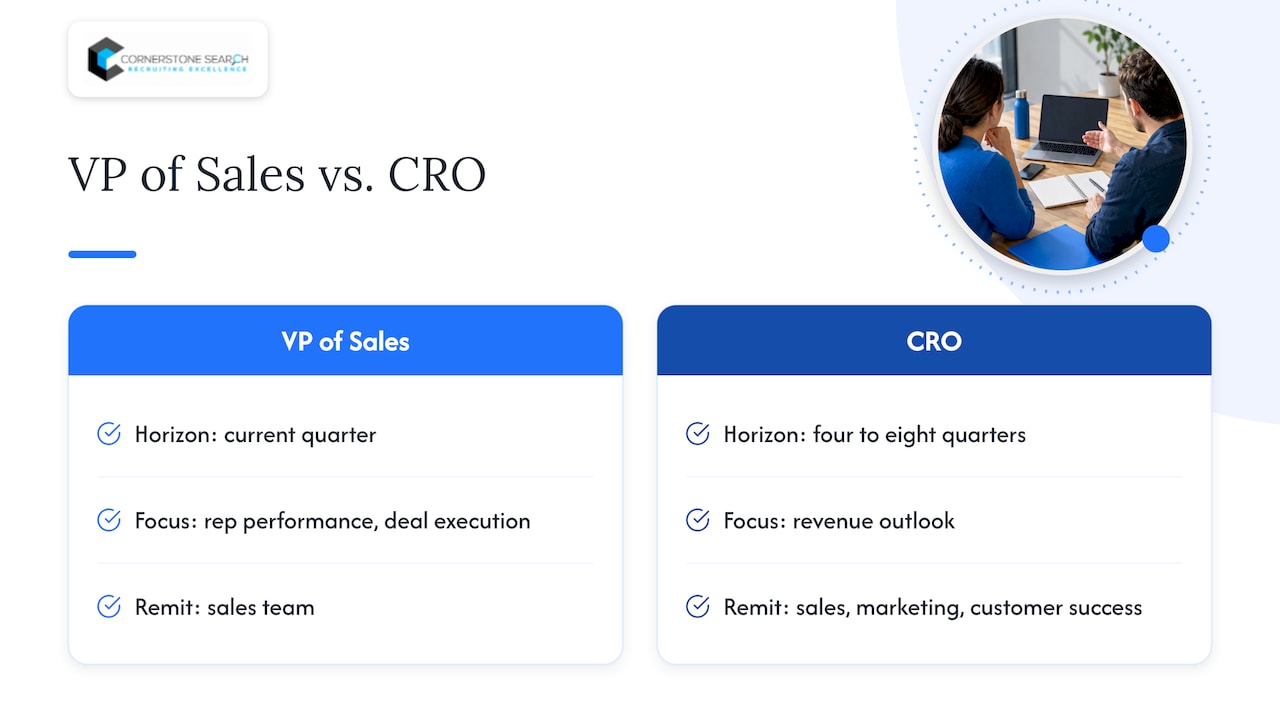
The VP of Sales is a different animal. One comparison of the two roles puts it this way: the VP of Sales lives in the current quarter, focused on rep performance and deal execution. The CRO looks four to eight quarters out and asks where revenue will come from.
A COO is something else again. The COO runs the company’s operating machine, including functions that never touch revenue. Don’t confuse the two just because both have a C in front.
We’ve written a longer breakdown in VP of Sales vs. CRO if you want the org chart view.
The signs you’re ready for a CRO
No magic ARR number flips a switch. But the pattern is consistent. Here’s what I see when the timing is right.
Your revenue problems cross departments
Marketing says sales ignores the leads. Sales says the leads are junk. Customer success says the deals sold were never a fit. Everyone is right about someone else.
That’s a handoff problem, and a VP of Sales can’t fix what they don’t control. When you start digging into sales accepted lead metrics and finding gaps between marketing’s definition of a good lead and sales’ definition, you’re looking at the kind of friction a CRO exists to settle.
Your sales leader is stretched past their strengths
Scalewise points to complex commercial problems, sales and marketing misalignment, and commercial VPs struggling with board-level responsibilities as signs a CRO may be useful. I’d add one from the field: your VP of Sales is a great coach and closer, but now they’re being asked for multi-year forecasting, pricing strategy and board decks. They didn’t sign up for that. They may not want it.
You have a real team and a repeatable motion
A CRO needs something to lead. A large team, several products or segments, more than one sales motion. If you have a handful of reps and one product, there’s nothing for a CRO to orchestrate.
One rule of thumb floating around is that revenue operations becomes worth building at roughly 10 to 15 quota-carrying reps. Treat that as a rough marker, not a law. I’ve seen companies need cross-functional leadership earlier and others limp along fine later.
Growth depends on things beyond new logos
Expansion, renewals, pricing, partnerships, a second market. When the next stage of growth lives in several places at once, one leader needs to see all of them. That’s the CRO job.
The signs you’re too early
This is the part founders skip. Read it twice.
You haven’t nailed the basics
If you’re still working out your value proposition, your ideal customer profile or your sales process, it’s too early for a CRO. A CRO scales what works. If nothing works yet, they have nothing to scale.
At that stage you need someone who can sell, build a first process, and get their hands dirty. We cover that stage in at $500K ARR, hire the right head of sales and when to hire your first VP of Sales.
Your real problem is sales management
Reps missing quota. Ramp taking forever. Managers who don’t inspect deals. That’s a sales-management problem. One analysis notes that a CRO hired to fix it may spend a year rebuilding the sales team. A year. At executive pay.
I’ve watched this happen. Founder panics about pipeline, hires a big title, and the big title spends nine months learning the product while the quarter keeps slipping. A strong VP of Sales would have fixed it in two.
You want a CRO to fix a hire you regret
Bad VP of Sales hire? Fix it directly. Adding a layer above them doesn’t solve anything. It just makes the org chart more expensive and the original problem harder to see. If that’s your situation, read how to replace a VP of Sales quietly.
You think a title will change the outcome
A CRO is not a rescue plan. Roughly half of all CRO hires are reported not to last 18 months. That number comes from a blog, so treat it as directional. But it matches what I’ve seen. Wrong timing, wrong profile, wrong expectations. Pick any two.
A quick gut check: CRO, VP of Sales or something in between?
| Your situation | What you likely need |
|---|---|
| Still finding product-market fit, founder-led sales | A first sales leader who sells, not a CRO |
| Repeatable motion, missing quota, slow ramp | A VP of Sales who can coach and inspect |
| Sales, marketing and CS all misaligned on revenue | A CRO |
| Multiple products, segments or sales motions | A CRO |
| Need senior leadership but unsure about full-time | Interim sales leadership first |
| Board wants a forecast you can defend | A CRO, or a VP with serious forecasting chops |
If you land in the middle row of that table, don’t stretch. Hire the role that matches the problem you have today.
Some companies test the water with interim leadership before committing to a permanent seat. We walk through that route in hiring interim sales leadership in 3 to 4 months. It can show you whether you need daily depth or a steady hand on strategy.
What this looks like in the real world
Here’s a pattern I’ve seen more than once, with details changed.
A SaaS company is around the point where the founder can’t run every deal anymore. There’s a VP of Sales, a handful of managers, a marketing lead and a customer success head. Deals slip, forecasts are shaky, and the board starts asking for a plan to double. The founder decides it’s time for a CRO.
The question I ask is simple: what exactly is broken? Sometimes the answer is that the VP of Sales is fine and marketing doesn’t feed sales what it needs. That’s a CRO-shaped problem. Other times the answer is that the VP can’t forecast and two managers are weak. That’s a VP-shaped problem, and a CRO won’t fix it. They’ll just inherit it and take the heat.
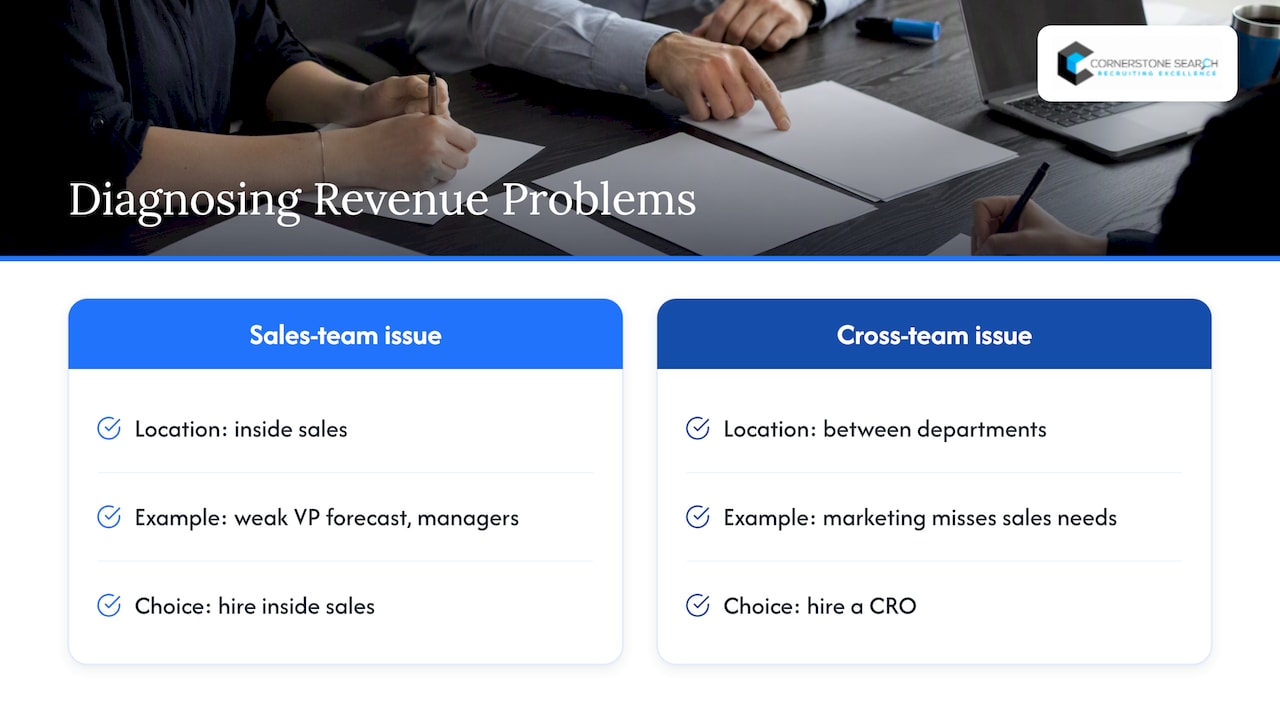
Write down the three biggest revenue problems you have. If most of them sit inside the sales team, hire inside the sales team. If most of them sit between departments, you’ve found your CRO job.
Perspective
We’ve run this search from both sides. The founder who hires a CRO too early pays executive money for a job that doesn’t exist yet. The founder who waits too long watches a good VP of Sales drown in work that was never theirs.
Here’s how we see it. Timing matters less than diagnosis. Before any search starts, we sit down with the founder and push on one question: what’s actually broken? That intake is why every search is run personally by a recruiter with deep SaaS sales experience, and not handed off down a chain.
We’ve placed more than 1,200 sales professionals since 1996. Our average time from kickoff to accepted offer is about three weeks, and our one-year retention rate is 93%. We don’t say that to brag. We say it because speed without precision is just a faster way to hire the wrong person.
The best CRO searches are short on résumé worship and long on questions. What did this person build? What broke on their watch? Who did they hire, and where are those people now? Titles are cheap. Track records at your stage are not.
If you’re not sure whether you need a CRO, a VP of Sales or something in between, call us before you post a job. A 30-minute conversation can save you a year.
Rich Rosen
How to hire a CRO once you’re sure
So you’ve diagnosed it. You need a CRO. Now don’t blow the hire.
Hire for your stage, not their last company
Andreessen Horowitz advises looking for experience scaling in environments with comparable ARR, sales cycles and go-to-market complexity. It also stresses the ability to build data-driven processes, define ICPs and recruit talent over simply having held the CRO title elsewhere.
That’s exactly right. I’ve seen leaders from huge companies fail at small ones because at their old job a machine did the work. Someone else built the process, the pipeline, the comp plan. They never had to. Ask whether they built it or inherited it.
Ask the hard questions
A few that separate real operators from polished talkers:
- What was ARR when you joined, and what was it when you left?
- Which of your direct hires are still there, and which did you replace?
- Walk me through a forecast you got wrong. Why?
- What did you change in the first 90 days?
- What would you cut from our go-to-market motion?
A polished answer with no scar tissue is a red flag. Good revenue leaders have been wrong in public and can tell you how.
Check references the right way
Backdoor references are a gossip casino. You roll the dice on whoever your investor’s friend happens to know. Use structured references with people who worked with the candidate at the stage you care about. Our revenue leader vetting process lays out six stages we use to avoid that coin flip.
Also study red flags in SaaS sales candidates. Job-hopping dressed as ambition, vague attribution, and numbers that don’t add up show up at every level, including the C-suite.
Decide how you’ll run the search
A CRO search is not a job board play. The best candidates are employed and not looking. You need someone who can reach them, sell them on the role and screen hard. Whether that is retained or contingent matters. See how retained search differs from contingency and retained executive search explained. If you’re venture backed, this guide to executive search for venture-backed founders is worth your time too.
Plan the first 90 days before they start
Set the scorecard before the offer goes out. Pipeline coverage, ramp times, forecast accuracy, retention of key reps, cross-team handoffs. Agree on how you’ll measure each. Without that, you’ll be arguing about “fit” by month four.
Budget realistically, too. CRO compensation is heavy on variable pay, so the plan design matters as much as the base. Get current figures from your board or a search partner before you set the range. Guessing is how offers die.
What about the cost of getting it wrong?
A failed CRO costs you more than their pay. You lose the search time, the months of drift, the reps who leave when the new boss changes everything, and the board’s confidence. The one thing I’d tell every founder: the cost of a slow, careful search is small next to the cost of a fast wrong hire.
That said, “careful” does not mean “slow.” A tight, well-run search can wrap in weeks. Dragging it out for six months just means your best candidates take other jobs.
Work with us on your next revenue leader
If you’re weighing a CRO, a VP of Sales or a first sales leader, we can help you figure out which and then find the person. Our executive search recruitment service covers contingent and retained searches for SaaS and software companies, with every search run by a recruiter who has spent decades in this market.
If the role is closer to a sales leader or quota-carrying team build, look at our software sales recruitment page. Either way, start with a conversation about what’s really broken.
FAQ
What is the right company size to hire a CRO?
There’s no single number. Look at complexity, not just revenue. You need a real team, a repeatable sales motion and revenue issues that cross sales, marketing and customer success. If you’re still defining your ICP or sales process, it’s too early.
Is a CRO higher than a VP of Sales?
Usually yes. The CRO owns the full revenue process across sales, marketing and customer success, while the VP of Sales focuses on the selling team. In many companies the VP of Sales reports to the CRO.
Should I hire a CRO or a VP of Sales first?
In most startups, a VP of Sales or head of sales comes first. You need someone to build and coach the team before you need someone to orchestrate several departments. Our guide on when to hire your first VP of Sales covers the signals.
Why do CRO hires fail so often?
Usually it’s timing and profile. Companies hire too early, or hire someone who thrived at scale but never built anything from scratch. One source reports roughly half of CRO hires don’t last 18 months. Better diagnosis up front and tougher vetting fix most of it.
How long does a CRO search take?
It depends on the search design and how fast you move on interviews and decisions. Our average from kickoff to accepted offer is about three weeks. Slow feedback from your side is the usual reason it drags.
Sources
- Hiring a Chief Revenue Officer, Andreessen Horowitz
- When should you hire a CRO?, Scalewise
- CRO vs VP of Sales: Which Role You Need, ORM
- When to Hire a Fractional CRO, InversionCRO
- Sales Accepted Leads: Intake Metrics That Expose Handoff Gaps, AIViral