

TL;DR:
- A strong employer brand significantly boosts inbound applications, shortens time-to-hire, and lowers costs by up to 50%. It shapes candidate perceptions and influences both the quantity and quality of sales talent interested in your company. Improving brand transparency and storytelling leads to better hiring metrics and enhanced sales growth.
Your employer brand is the single biggest filter standing between you and the sales talent you actually want to hire. A strong employer brand doubles inbound applications, cuts time-to-hire by 43%, and lowers cost-per-hire by up to 50%. Those are not soft HR metrics. Those are numbers that show up in your pipeline coverage and your quarterly revenue. Understanding why employer brand affects sales recruiting is the first step toward fixing the part of your hiring process most sales leaders completely ignore.
Why employer brand affects sales recruiting more than you think
Employer brand is defined as how candidates perceive your company’s culture, reputation, and growth opportunity before they ever talk to a recruiter. It is not your careers page. It is not your LinkedIn banner. It is what a top-performing AE tells their friend over drinks when your company’s name comes up.
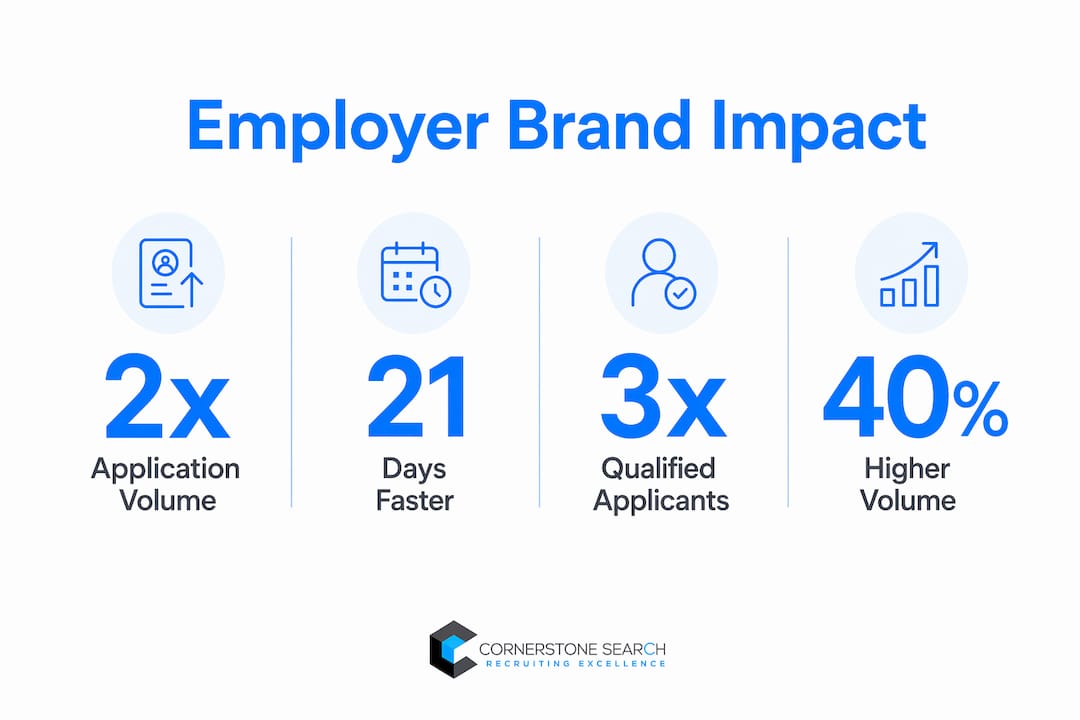
Companies with strong employer brands get twice as many applications and fill sales roles 21 days faster on average. That 21-day gap is not a rounding error. For a SaaS company with a $1.2M quota per rep, three weeks of empty territory is real money walking out the door.

The impact of employer brand on recruiting goes beyond volume. Strong brands attract 3x more qualified applicants who self-select based on culture fit. That means fewer wasted interviews, shorter shortlists, and better offer acceptance rates. You spend less time sorting through noise and more time closing the right people.
How employer brand shapes the quantity and quality of sales candidates
Top sales candidates do not apply to every open role. They apply to companies they have already decided they want to work for. That decision happens weeks or months before your job post goes live.
77% of candidates list culture as a primary factor in where they apply. That number should stop you cold. Compensation matters, but culture is the filter that runs first. If your brand does not communicate a clear, honest picture of what it is like to sell for your company, you lose candidates before the conversation starts.
65% of candidates research employer reputation before applying. They check Glassdoor. They read LinkedIn posts from your current reps. They ask around. A Glassdoor rating above 4.0 meaningfully increases candidate conversion. A rating below 3.5 is a wall most good candidates will not climb over, no matter how strong your OTE looks on paper.
Storytelling is the mechanism that makes employer branding work in sales recruiting. Authentic narratives engage sales talent far beyond what a bullet-point job description ever could. The best AEs and enterprise reps want to join a story, not fill a seat. Show them what winning looks like at your company. Show them a rep who crushed quota and got promoted. That content does more recruiting work than your job post ever will.
- Share real quota attainment data, not just OTE ranges
- Feature current reps talking about why they joined and what they have built
- Highlight your product’s market position and the size of the opportunity
- Be honest about ramp expectations and what support looks like in year one
Pro Tip: Ask your two best-performing reps to record a 90-second video about why they joined. Post it on LinkedIn and your careers page. That content will outperform any job description you have ever written.
What the recruiting funnel numbers actually look like
The measurable recruiting efficiencies tied to employer brand are not theoretical. They show up in every stage of your hiring funnel, and they compound over time.
Top-quartile employer brand companies see 40% higher application volume, 25% higher offer acceptance, 18% higher retention, and 35% lower cost-per-hire compared to companies with weak brands. Each of those numbers represents a different place in your funnel where brand either helps you or hurts you.
| Funnel Stage | Weak Brand Impact | Strong Brand Impact |
|---|---|---|
| Application volume | Below-market inbound | 2x average inbound |
| Qualified candidate ratio | High noise, low signal | 3x more qualified applicants |
| Offer acceptance rate | Below 70% typical | 25% higher acceptance |
| First-year turnover | Industry average or worse | 28% lower turnover |
| Cost-per-hire | Full market rate | Up to 50% lower |
First-year turnover is the number most hiring managers underestimate. Strong employer brands reduce first-year turnover by 28%. When a sales rep leaves in month eight, you lose their ramp investment, their pipeline, and the three months it takes to replace them. That is a nine-figure problem for a scaling SaaS company if it happens across multiple roles.
Tracking time-to-fill delta and offer acceptance rate gives you a quantifiable ROI you can take to your CFO. Strong brands fill critical sales roles one to two weeks faster. Multiply those days by your average daily revenue per rep, and you have a dollar figure leadership will pay attention to.
Pro Tip: Build a simple spreadsheet that tracks your average time-to-fill by role type, then calculate the daily revenue cost of each open seat. Show that number to your CEO once. You will never have trouble getting budget for employer brand work again.
Why sales recruiting is uniquely exposed to brand weakness
Sales hiring is not like engineering hiring or finance hiring. The stakes are different, the candidates are different, and the consequences of a weak brand hit faster and harder.
Sales talent evaluates your company the same way your buyers do. They look at your market position, your customer reviews, your leadership team, and your growth trajectory. A great AE who has options will not join a company with a murky story, a Glassdoor full of complaints about unrealistic quotas, or a leadership team nobody has heard of.
“Weak employer brand creates delivery risk perception in the market. When your best candidates pass on you, your buyers notice too. The same story that makes a rep say no makes a prospect hesitate. In B2B sales, your employer brand and your consumer brand are the same brand.”
The overlap between employer brand and consumer brand directly affects buyer confidence. If your company has a reputation for high turnover in sales, your prospects hear about it. They wonder who will own their account in six months. That perception lengthens sales cycles and increases friction at the close.
Employer brand acts as a talent go-to-market lever that directly unlocks revenue constrained by time-to-fill. Every week a territory sits empty is a week of pipeline not being built. Sales hiring is a capacity constraint on revenue growth, which makes brand an operational issue, not an HR issue. The sales recruitment strategies that work fastest are the ones backed by a brand candidates already trust.
One more thing worth naming: 91% of recruiters acknowledge that AI search impacts employer brand perception, but only 33% feel confident their brand is accurately represented in AI-generated results. When a candidate asks an AI tool about your company, what comes back shapes their decision before you ever reach out. That is a new and underappreciated risk.
Practical steps to strengthen your employer brand for sales hiring
You do not need a six-figure brand agency to fix this. You need a clear message, consistent execution, and a few people inside your company willing to tell the truth publicly.
-
Build a sales-specific Employee Value Proposition (EVP). Generic EVPs do not work for sales candidates. Your EVP needs to address quota attainment rates, ramp support, career path, and what the sales culture actually feels like. Be specific. Vague promises about “growth” and “impact” are ignored.
-
Use real employee stories. Ask your top reps to share their experience on LinkedIn, Glassdoor, and your careers page. Authentic voices beat polished marketing copy every time. One honest post from a rep who hit 130% of quota is worth more than ten job ads.
-
Monitor and respond to Glassdoor reviews. Ignoring negative reviews does not make them disappear. Responding professionally to criticism signals that leadership listens. Candidates read both the reviews and the responses.
-
Activate internal referrals. Your current sales team is your best recruiting channel. If they are proud of where they work, they will refer people. If they are not, no amount of brand work will fix the underlying problem.
-
Audit your careers page for sales candidates specifically. Does it show quota attainment data? Does it feature real reps? Does it explain your sales process and market opportunity? If not, you are leaving candidates cold at the top of your funnel.
-
Track brand-related recruiting KPIs. Measure inbound application volume, offer acceptance rate, and first-year retention by quarter. When those numbers move, you will know your brand work is paying off.
Pro Tip: Set a Google Alert for your company name plus “reviews” and “employer.” Read what surfaces weekly. You will catch problems early and find content opportunities you did not know existed.
Key Takeaways
A strong employer brand is a direct revenue lever in sales recruiting, not a soft HR initiative, because it cuts time-to-hire, raises offer acceptance, and reduces first-year turnover across every stage of your hiring funnel.
| Point | Details |
|---|---|
| Brand doubles application volume | Companies with strong brands get 2x more applications and fill roles 21 days faster. |
| Culture filters candidates before you do | 77% of candidates use culture as a primary application factor, making brand your first screener. |
| Funnel metrics improve across the board | Top-quartile brands see 25% higher offer acceptance and 35% lower cost-per-hire. |
| Sales brand and consumer brand overlap | Weak employer reputation increases buyer friction and lengthens B2B sales cycles. |
| Measure brand ROI in revenue terms | Calculate daily revenue lost per open seat to make the business case to leadership. |
The uncomfortable truth about employer brand and sales growth
I have been placing sales talent in SaaS and software companies since 1996. I have seen this play out hundreds of times. A company has a great product, a real market opportunity, and a CEO who cannot figure out why they keep losing their top candidates to competitors. Nine times out of ten, the answer is brand.
The candidates I work with do their homework. They Google the company. They check Glassdoor. They ask around in their network. If what they find does not match what the hiring manager told them in the first call, they walk. And the best ones always have somewhere else to go.
I had a client a few years back, a solid Series B SaaS company, who kept losing finalists at the offer stage. Their OTE was competitive. Their product was genuinely good. But their Glassdoor was a mess, their LinkedIn presence was dead, and their current reps were not saying anything publicly about the company. The candidates could not find a story to join. So they did not.
We fixed it. Not with a brand agency. With three things: honest rep testimonials on LinkedIn, a cleaned-up Glassdoor response strategy, and a careers page that showed real quota attainment numbers. Within two quarters, their offer acceptance rate went from below 60% to above 80%. Same roles. Same comp. Better story.
The companies that treat employer branding as an HR checkbox will keep losing good candidates to companies that treat it as a sales and growth tool. The math is not complicated. The execution just takes someone willing to own it.
— Rich Rosen
How Cornerstonesearch approaches employer brand in sales hiring
Cornerstonesearch has placed over 1,200 sales professionals in SaaS and software companies since 1996. Every search we run accounts for how a client’s employer brand lands with the candidates we approach.
When your brand is working, our outreach converts faster and your shortlist gets stronger. When it is not, we tell you exactly what candidates are saying and why. We average 21 days from search kickoff to offer acceptance because we combine a deep candidate network with honest brand intelligence that most hiring teams never get. If you want to see what a well-run sales recruitment process looks like from the inside, we are ready to show you.
FAQ
What is employer brand in the context of recruiting?
Employer brand is how candidates perceive your company’s culture, reputation, and opportunity before they apply or respond to outreach. It shapes who applies, who accepts, and who stays.
How does employer brand affect sales recruiting specifically?
Sales candidates evaluate your company the same way buyers do. A weak brand signals instability, kills offer acceptance, and can even erode buyer confidence in B2B markets.
How much does a strong employer brand reduce hiring costs?
Strong employer brands lower cost-per-hire by up to 50% and reduce first-year turnover by 28%, according to employer branding research published in 2026.
How do I measure the ROI of employer brand for sales hiring?
Calculate your average daily revenue per open sales seat, then multiply by the number of days your roles stay open. Faster time-to-fill tied to brand improvement translates directly into that dollar figure.
Does AI search affect how candidates perceive my employer brand?
Yes. 91% of recruiters say AI search impacts employer brand perception, but only 33% feel their brand is accurately represented in AI-generated results. Candidates increasingly use AI tools to research employers before responding to outreach.