

Executive search speed directly determines fundraising outcomes because leadership vacancies create measurable productivity losses, erode investor confidence, and hand your best candidates to competitors. For startup and SaaS founders preparing for a capital raise, the importance of speed in executive search is not a scheduling preference. It is a financial and strategic imperative. A well-run retained search closes within 40 to 48 days, yet many senior roles drag on for 6 to 9 months. That gap costs you more than time.
Why executive search speed matters for fundraising outcomes
Slow executive searches carry a price tag most founders underestimate. Productivity losses from delays run between one and three times the annual salary of the open role. For a $250,000 position, that translates to $83,000 to $250,000 in lost output before a single offer is signed. That number alone reframes how you should think about search timelines.
The financial damage compounds when you factor in fundraising context. Investors and institutional donors read leadership gaps as organizational instability. A missing CFO or VP of Sales during a Series A process signals that your company is not ready to deploy capital responsibly. Leadership transitions are high-risk periods for fundraising, and the absence of a finance leader in the six to twelve months before a raise causes direct donor hesitation and forces you to lean on costly interim advisers.

| Cost Category | Impact of Delay |
|---|---|
| Productivity loss | $83k to $250k for a $250k role over a 6-9 month vacancy |
| Interim adviser fees | Elevated costs replacing absent permanent leadership |
| Investor confidence | Visible gaps signal unreadiness to deploy capital |
| Candidate attrition | Top candidates accept competing offers during stalled searches |
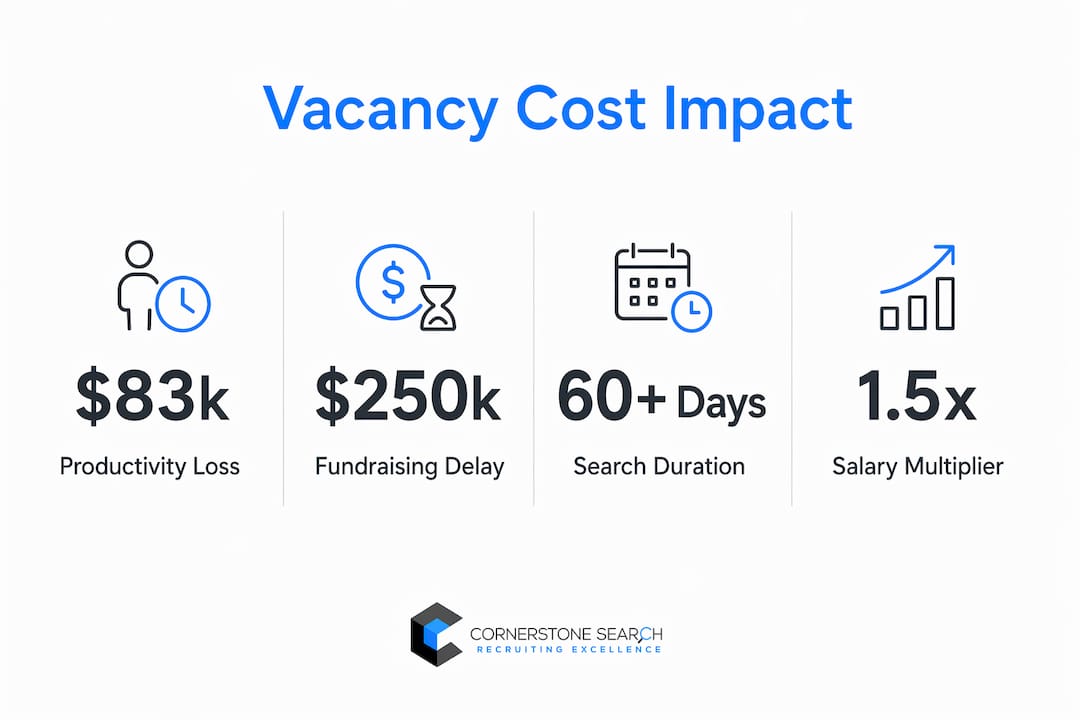
Searches that extend beyond 60 days face a compounding problem: client-side indecision and slow interview scheduling are the primary causes of stalled momentum, not candidate availability. The vacancy cost is not abstract. It shows up in missed pipeline targets, delayed data room preparation, and investor meetings where you cannot answer basic questions about your leadership team.
Pro Tip: Calculate your vacancy cost before launching a search. Multiply the target salary by 1.5 to get a conservative estimate of monthly productivity loss. That number becomes your urgency benchmark for every scheduling decision.
How speed signals organizational alignment to top candidates
Speed is not just an operational metric. Decisive hiring projects confidence and readiness for growth, which attracts high-quality candidates who have multiple options. When a startup moves from kickoff to shortlist in 14 days, it communicates that leadership has clarity on what the role requires and the authority to act. That signal matters enormously to senior executives evaluating their next move.
The reverse is equally true. Top executive candidates evaluate offers in real time, and slow hiring signals indecision, causing candidate enthusiasm to diminish and offers to be lost to competitors. A candidate who was genuinely excited about your Series B growth story in week two becomes skeptical by week eight. They start asking what the delay reveals about your internal alignment.
“Speed to hire signals leadership alignment and discipline, giving organizations a competitive advantage to secure top executive talent in a tight market.” — Hunt Scanlon
The practical mechanics of maintaining candidate momentum include:
- Using AI-assisted outreach to run parallel candidate identification rather than sequential screening
- Scheduling first-round interviews within five business days of shortlist delivery
- Assigning a single internal decision-maker to eliminate approval bottlenecks
- Sharing role success criteria with candidates upfront so evaluations move faster
- Conducting reference checks concurrently with final-round interviews rather than after
Early identification of behavioral risk and parallel candidate outreach increase hiring quality and speed simultaneously, dissolving the assumed tradeoff between moving fast and hiring well. The firms that close searches in under 45 days do not sacrifice rigor. They front-load the work.
What practical strategies accelerate executive hiring for startups?
Founders who close executive searches quickly share one common trait: they do the preparation work before the search launches, not during it. The strategies below are drawn from patterns observed across high-velocity searches at SaaS and software companies.
-
Define the success profile before day one. Write a one-page document describing what the hire must accomplish in 30, 60, and 90 days. This eliminates mid-search scope changes that restart timelines.
-
Designate a single decision-maker. Searches stall when approval requires consensus from five stakeholders. One person owns the hire. Others advise.
-
Pre-approve compensation ranges. Searches lacking pre-approved compensation typically stall and lose top candidates at the offer stage. Benchmark against current market data before you launch, not after you find someone you want.
-
Block interview time in advance. Reserve two-hour blocks on your calendar for weeks two through four of the search. Scheduling conflicts are the single most common reason searches slip past 60 days.
-
Work with a specialized search firm. Specialized firms deliver candidate shortlists within 14 days of kickoff, accelerating decision-making by weeks. Generalist firms lack the pre-built networks that make this possible.
-
Use technology to accelerate outreach. AI-driven prospecting enables parallel candidate identification across multiple channels simultaneously, compressing the sourcing phase from weeks to days.
-
Treat the search like a product sprint. Set a hard close date at kickoff. Communicate it internally and to your search partner. Deadlines create accountability that open-ended timelines do not.
Pro Tip: Founders often start executive searches late, only after a role becomes critical. Align your candidate success profile and organizational readiness at least 60 days before you need the hire in seat. That lead time is the difference between a 45-day search and a 120-day one.
You can also review proven recruitment methods that reduce time-to-hire for leadership roles, particularly when fundraising timelines create external pressure on your internal process.
How timely executive hiring improves investor confidence and team performance
The downstream benefits of a fast executive search extend well beyond filling a seat. A CFO appointed well in advance of fundraising enables improved financial modeling, data room preparation, and investor trust. These are not soft benefits. They directly affect the speed and valuation of your capital raise.
Consider what happens when financial leadership is in place six months before a Series A. Your CFO builds the financial model investors will scrutinize. She prepares the data room. She fields diligence questions with authority. Contrast that with a founder scrambling to answer CFO-level questions in investor meetings because the search took too long. The difference in investor perception is immediate and lasting.
The benefits of rapid executive search on team performance include:
- Reduced uncertainty among existing team members who look to leadership for direction during fundraising
- Faster onboarding because a well-run search produces better-fit candidates who ramp more quickly
- Stronger fundraising narratives because complete leadership teams project execution credibility
- Lower risk of key employee departures triggered by visible leadership instability
Leadership vacuums in fundraising lead to donor hesitation, stagnant growth, and reduced productivity. Active board engagement and transparent communication help maintain momentum during transitions, but they are not substitutes for permanent leadership. Investors know the difference.
Slow or failed leadership searches during fundraising can permanently erode stakeholder confidence. Managed with urgency, however, the same search process can strengthen credibility by demonstrating that your organization identifies gaps and acts on them decisively. The high stakes of startup hiring make this distinction consequential at every stage of growth.
Key takeaways
Executive search speed is a direct input to fundraising success because delays cost money, erode investor confidence, and lose top candidates to competitors who move faster.
| Point | Details |
|---|---|
| Vacancy costs are quantifiable | A $250k role left open for 6-9 months costs $83k to $250k in lost productivity. |
| Speed signals organizational clarity | Fast hiring tells candidates and investors that leadership knows what it needs and can act. |
| Preparation drives speed | Defining success profiles and pre-approving compensation before launch cuts search time in half. |
| Financial leadership timing is critical | A CFO placed 6 months before a raise directly improves data room quality and investor trust. |
| Specialized firms close faster | Search firms with sector-specific networks deliver shortlists within 14 days, not 6 weeks. |
What I’ve learned watching founders win and lose on search timing
I have watched founders lose Series A rounds not because their product was weak or their market was wrong, but because they had a VP of Sales vacancy during investor diligence. The investor asked who owned revenue growth. The founder pointed to a job description. That was the end of the conversation.
The most common mistake I see is treating executive search as something you start when a role becomes urgent. By that point, you are already behind. The founders who close searches in 30 to 45 days are the ones who defined the role, aligned on compensation, and cleared their calendars before they ever called a search firm. The search itself is fast because the decision-making infrastructure was already in place.
There is also a candidate perception problem that founders consistently underestimate. A senior executive who has three offers on the table is not going to wait six weeks for you to schedule a second interview. They read the delay as a signal about how decisions get made inside your company. If you cannot move quickly on a hire, they assume you cannot move quickly on anything. That assumption follows them into their next conversation with a recruiter.
The fix is not complicated. It requires treating executive search with the same urgency you apply to closing a customer or hitting a product milestone. Set a deadline. Own the process. Move when the candidate is ready. The companies that do this consistently are the ones that show up to investor meetings with complete leadership teams and the credibility that comes with them.
— Rich Rosen
How Cornerstonesearch helps you hire faster and raise with confidence
Cornerstonesearch specializes in placing top sales and executive talent at SaaS and software companies, with an average time from search kickoff to offer acceptance of just 21 days. When your fundraising timeline depends on having the right leadership in seat, that speed is not a feature. It is the entire value proposition. Cornerstonesearch’s network of industry-specific candidates means you receive a qualified shortlist within days, not weeks, so your search closes before investor momentum fades.
If you are preparing for a capital raise and need sales leadership placed quickly, or if you want to understand how SaaS-focused recruitment can compress your hiring timeline, Cornerstonesearch has the methodology and the network to deliver.
FAQ
Why does executive search speed matter for fundraising?
Speed matters because leadership vacancies during fundraising signal organizational instability to investors and donors, directly reducing their confidence in your ability to execute. A complete leadership team in place before a raise improves financial modeling, data room quality, and investor trust.
How long should an executive search take?
A well-run retained executive search closes within 40 to 48 days. Searches that extend beyond 60 days face significantly higher risk of losing top candidates to competing offers.
What causes executive searches to take too long?
The primary causes are client-side indecision, lack of role clarity, slow interview scheduling, and compensation ranges that are not pre-approved before the search launches. These are all controllable factors on the hiring company’s side.
How does a CFO hire affect fundraising timelines?
A CFO appointed six to twelve months before a capital raise enables better financial modeling, faster data room preparation, and more credible investor diligence responses. Late CFO hires force founders to cover financial leadership functions during the most critical period of the raise.
Can a specialized search firm actually close faster than an internal process?
Yes. Specialized firms with pre-built networks in a specific sector deliver candidate shortlists within 14 days of kickoff. Internal processes without dedicated sourcing infrastructure typically take four to six weeks to reach the same stage.