

Top SaaS sales reps leave because your system lets them. Fix the system first, then worry about pay. The root causes of SaaS sales turnover almost always trace back to three things: a manager who stopped coaching, a territory or quota the rep knows is unwinnable, and a career path nobody can describe. Compensation shows up in exit interviews because it is the easiest thing to say. It is rarely the real reason.
Here is your 30-day triage checklist before you lose someone you cannot afford to lose:
- Territory sanity check: Pull attainment by rep. If the spread is wider than 40 percentage points, you have a structural problem, not a performance problem.
- Skip-level conversations: Schedule a 30-minute call with every at-risk rep, bypassing their direct manager. Ask one question: “What would need to change for you to see yourself here in two years?”
- Coaching audit: Count actual coaching minutes per manager per week. Not pipeline reviews. Not forecast calls. Real skill-building conversations. If the number is under two hours, you have found your leak.
Manager quality explains a large share of the variance in employee engagement scores, making manager quality the single largest driver of voluntary turnover. Pay is usually the proximate cause of an exit, not the root cause. Fix the system, and the pay complaints often disappear on their own.
Table of Contents
- Why SaaS companies lose top sales reps: the leading causes at a glance
- Your direct manager is your biggest retention risk
- Compensation mistakes that push your best reps out the door
- Quota, territory, and ramp: the structural churn drivers nobody wants to admit
- How weak hiring and broken onboarding cost you your best people
- What Cornerstonesearch sees in the field: hiring benchmarks and retention patterns
- Culture and accountability: how tolerating mediocrity drives stars away
- The real cost of losing a top rep: dollars, months, and forecast damage
- Your retention playbook: 30, 90, and 365 days
- Key Takeaways
- The honest recruiter’s take on why this keeps happening
- Cornerstonesearch helps you stop the bleeding and hire right
- Sources and further reading
Why SaaS companies lose top sales reps: the leading causes at a glance
Busy leaders need a fast map before they go deep. Here are the most common reasons top performers walk, ranked roughly by how fast they drive exits:
- Weak manager coaching — Signal: reps stop bringing deals to their 1:1s because nothing useful happens there.
- Territory or quota unfairness — Signal: bimodal attainment; your best reps are in the bottom half of the distribution.
- Broken comp plan design — Signal: reps can explain exactly why the plan is rigged against them.
- No visible career path — Signal: when you ask “what’s next for you here?” the rep goes quiet.
- Hiring and onboarding failures — Signal: reps miss their first full-quota period and never recover confidence.
- Admin overload and burnout — Signal: reps spend more time in Salesforce updating fields than on calls.
- Product or PMF problems — Signal: reps start blaming the product in every deal debrief.
- Tolerance for underperformers — Signal: your stars start asking why they should work harder than the person next to them.
- Competition and poaching — Signal: LinkedIn profile updates, sudden interest in “career development” conversations.
- Lack of recognition beyond pay — Signal: top reps feel invisible unless they miss quota.
- Work-life balance and burnout — Signal: PTO requests spike, energy in team meetings drops.
- Misalignment with personal goals — Signal: rep mentions a life change or a values conflict in a 1:1.
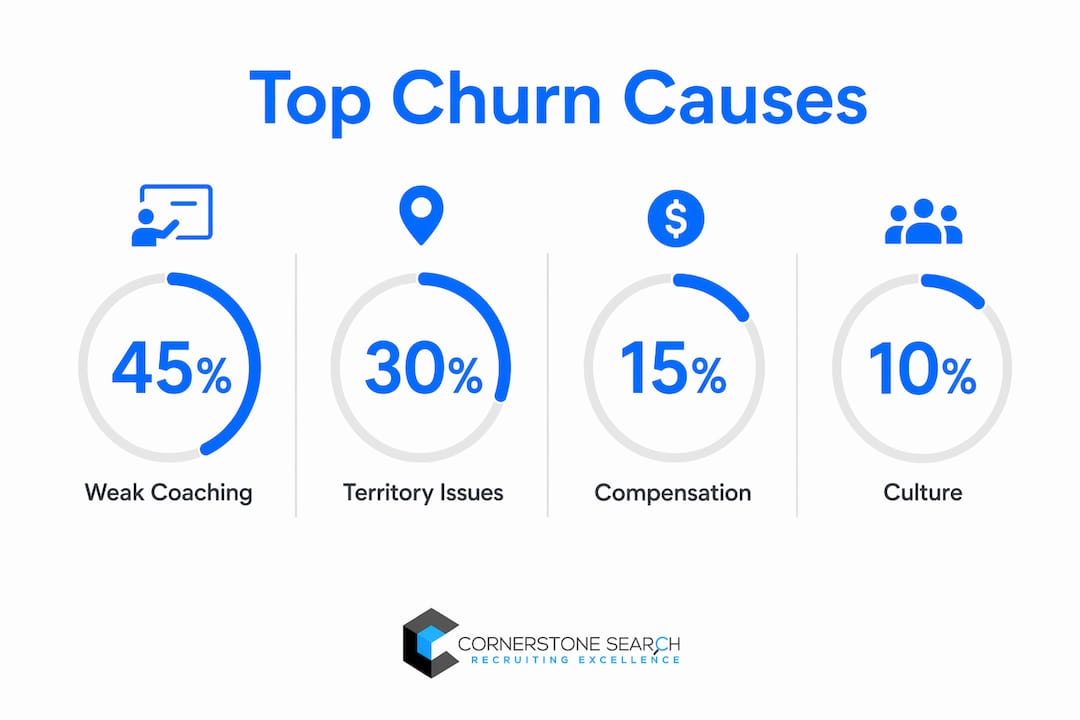
The three causes driving the fastest exits among top performers are weak manager coaching, territory unfairness, and broken comp plans. Fix those three first. Everything else is important, but those three are the ones where a rep goes from frustrated to interviewing in under 30 days.
Your direct manager is your biggest retention risk
Ask any top rep why they left their last job, and they will eventually get to the manager. Not always in the first sentence, but always in the story. Manager quality is the single largest driver of voluntary turnover, and the gap between a great sales manager and a mediocre one is not subtle.
Stat: Manager quality explains a large share of the variance in employee engagement scores. That is not a soft HR metric. It is the number that explains why two reps with identical territories and OTEs perform completely differently.
The specific manager behaviors that push top reps out are predictable. A weak coaching cadence is the most common: the 1:1 becomes a pipeline interrogation, not a skill-building session. The rep stops bringing real problems because nothing useful comes back. Credit-taking is the next one. A manager who presents a rep’s deal to the CRO without naming the rep has just told that rep their contributions are invisible. Tolerating underperformers is the slow poison: when a rep watches a colleague miss quota for three quarters with no consequence, they start doing the math on whether effort is actually rewarded here.
The early warning signs are visible if you look. Declining outbound touches, less multi-threading on active deals, shorter responses in Slack, and profile updates on LinkedIn are all signals a rep is already mentally interviewing. By the time they hand in a resignation, they have usually been gone for six months emotionally.

Pro Tip: Measure attrition by manager, not just by team. If one manager has lost three reps in 18 months and another has lost none, you already know where to look.
The fix is not a management training seminar. It is weekly 1:1s with documented coaching notes, deal reviews with actual feedback, and a manager who can answer the question “what is next for you here?” with something specific. According to Pavilion’s 2024 exit survey data, teams whose managers ran consistent weekly 1:1s with documented coaching notes had 32% higher AE retention than teams running ad-hoc check-ins.
Compensation mistakes that push your best reps out the door
Pay is the thing reps say. Growth and coaching are the things they mean. Exit interviews commonly surface compensation as a reason, but detailed analysis shows that lack of a growth path and manager quality are deeper drivers. Throwing more money at a rep who has lost confidence in the territory or the manager buys you maybe 90 days. Then they leave anyway, and now you have paid a retention bonus for nothing.
That said, comp plan design absolutely can drive exits on its own. Here are the structural mistakes that do the most damage:
- Punitive cliffs: A plan where missing 80% of quota pays the same as missing 50% removes all incentive to grind through a hard quarter. Top reps notice this immediately.
- Opaque accelerators: If a rep cannot calculate their own commission in under five minutes, the plan is too complicated. Complexity reads as distrust.
- Rewarding territory luck: When a rep in a rich territory consistently outperforms a rep in a thin one, and both are evaluated the same way, you are measuring geography, not talent.
- Punishing overperformance: Retroactive quota raises after a blowout quarter are a fast way to lose your best rep. They will not make the same mistake twice.
- Mid-year changes without warning: According to Pavilion survey data, a notable share of departures stem from comp plan changes without warning. A 90-day grandfathering policy on any plan change is the minimum standard.
Pro Tip: Run your comp plan through this test: can your top rep explain exactly how they will earn $50K above OTE? If they cannot, fix the plan before you lose them.
A fair comp plan is transparent, predictable, and rewards the behaviors you actually want. Accelerators should kick in at 100% of quota, not 120%. In-flight deals should always close on the old plan when changes happen. And quota raises should come with a conversation, not a Docusign.
Quota, territory, and ramp: the structural churn drivers nobody wants to admit
Here is an uncomfortable truth: about 55% of territories are materially imbalanced, creating bimodal attainment distributions where some reps cannot miss and others cannot win. Your top performers are the ones who do the math fastest. When they figure out their territory is structurally disadvantaged, they start interviewing within 30 days.
Stat: According to Pavilion’s 2024 rep exit survey, bad territory or lost quota confidence was the number one departure reason, cited by 38% of reps who left. Not pay. Not culture. Territory.
Ramp design is the other structural failure. Standard ramp plans drop full quota on month four or five, and roughly 15–20% of new hires miss their first full period and immediately lose confidence. A graduated ramp with a safety net works better: 50% quota in months one and two, 75% in months three and four, then full quota with a one-month grace period tied to trailing pipeline health. Reps who hit their first quota milestone within 120 days are significantly more likely to stay past 18 months.
A quarterly territory audit is not optional for high-growth SaaS teams. Every 90 days, pull TAM per territory, pipeline coverage, account quality scores, and attainment versus quota by rep. Any imbalance above 20% triggers a rebalance conversation. The minimum transparency reps expect: they want to know how their number was set, what the TAM looks like, and what happens if the territory gets carved. Silence on any of those three points reads as “we do not trust you with this information,” and top reps do not stay where they are not trusted. For current quota attainment context, the RepVue Cloud Sales Index shows overall quota attainment across 252 SaaS companies sitting at 43.60% in Q2 2026, which means most reps are already fighting uphill. A bad territory makes an already hard job impossible.

How weak hiring and broken onboarding cost you your best people
The rep who quits in month eight often had their fate sealed in month one. Fuzzy scorecards, overvaluing charisma over sales judgment, and skipping structured deal-level shadowing during onboarding are the three hiring and onboarding mistakes Cornerstonesearch sees most often. They do not show up as problems immediately. They show up as early attrition six to nine months later, right when the rep was supposed to be hitting full productivity.
The most common hiring errors in SaaS sales hiring are:
- Fuzzy scorecards: Hiring for “culture fit” and “energy” instead of specific sales judgment competencies. You end up with someone who interviews well and sells poorly.
- Overvaluing charisma: Charisma closes a first meeting. Sales judgment closes a complex deal. They are not the same thing.
- Skipping reference validation on ramp: Not asking “how long did it take them to close their first deal at your company?” leaves you guessing about ramp fit.
Onboarding failures are just as damaging. Lack of deal-level shadowing in the first two weeks, no structured enablement with real objection patterns, and unclear early milestones leave new reps guessing what good looks like. SDR attrition hits roughly 45% annually, and a significant portion of those exits trace back to mismatched promotion timelines and poor onboarding.
A practical onboarding checklist to cut ramp time:
- Minimum 8–10 hours of live call shadowing in weeks one and two
- Written milestone map: first discovery call, first demo, first closed deal, with target dates
- Structured objection library built from real deal recordings
- Assigned senior rep as a silent coach for the first 60 days
- Skip-level check-in at day 30 and day 60 to catch problems before they become exits
Where SDR-to-AE promotion timelines exceed 18 months, attrition approaches 45%. Compress that timeline to 12–18 months with clear written criteria, and attrition drops significantly. The path needs to be in a real document, not a verbal promise from a manager who might leave next quarter.
What Cornerstonesearch sees in the field: hiring benchmarks and retention patterns
After placing over 1,200 sales professionals since 1996, Cornerstonesearch has a clear view of where retention risk concentrates and what the numbers look like in practice.
| Metric | Cornerstone Benchmark | Retention Risk Signal |
|---|---|---|
| Time from search kickoff to offer acceptance | 21 days average | Searches exceeding 45 days increase counter-offer risk |
| Time to first quota milestone (new hire) | 90–120 days | Reps missing this window have higher 12-month exit rates |
| Manager attrition correlation | High | Teams with manager turnover see rep exits within 60–90 days |
| Territory imbalance threshold | 20% variance | Above this, top-quartile reps begin interviewing |
| SDR-to-AE promotion window | 12–18 months | Beyond 18 months, attrition approaches 45% |
The pattern Cornerstonesearch sees repeatedly: companies call after they have already lost the rep. The search takes three to six weeks, the new hire ramps for three to four months, and the team runs at reduced capacity for most of a half. The leaders who call before the exit, asking for a territory-aware hire or a manager-fit screen, get a much better outcome.
Territory-aware hiring means building the scorecard around the specific patch: account density, average deal size, competitive intensity, and the rep’s track record in comparable territory conditions. A rep who crushed it in a named-account enterprise territory may struggle in a high-velocity SMB patch, and vice versa. Getting this wrong is one of the fastest ways to create another early exit. Cornerstonesearch’s process includes role-specific scorecards and early ramp milestone validation to reduce the chance of a mismatch showing up at month six.
Culture and accountability: how tolerating mediocrity drives stars away
Top performers have a finely tuned sense of fairness. They know who is pulling weight and who is not. When leadership tolerates chronic underperformance, the message to your stars is clear: results are optional here. Teams where weak performers are tolerated see faster attrition among top reps because the implicit contract between effort and reward breaks down.
The red flags are consistent. Inconsistent consequences for the same behavior across different reps. Unclear performance standards where nobody knows what “good” actually means in writing. Selective enforcement where some reps get coached out and others get protected for reasons nobody can explain. These are not just morale problems. They are retention problems, and they hit your best people hardest because your best people have options.
The action checklist for rebuilding accountability:
- Define performance tiers in writing: What does a top-quartile rep look like? What does a bottom-quartile rep look like? Put it in a document everyone can see.
- Set a 90-day clock on underperformance: If a rep is in the bottom quartile for two consecutive quarters, a formal improvement plan starts on day 91. No exceptions.
- Make accountability visible: When a rep is promoted, say why. When a rep is put on a plan, the team does not need details, but they need to see leadership is paying attention.
- Audit your culture against your stated values: If you say “we hold each other accountable” but your bottom quartile has been there for four quarters, you have a credibility problem.
Rethinking your retention strategy under economic pressure means being honest about what your culture actually rewards, not what your values slide deck says it rewards. Stars leave cultures where the rules do not apply equally. They stay where the bar is high and enforced consistently.
The real cost of losing a top rep: dollars, months, and forecast damage
Leaders underestimate this number every time. Replacing a quota-carrying rep can cost the equivalent of several months of OTE when you account for recruiting, ramp, and lost pipeline. For a rep carrying a $1.2M quota at $180K OTE, the conservative math looks like this:
| Cost Component | Conservative Estimate | Aggressive Estimate |
|---|---|---|
| Total | $275,000 | $535,000 |
The timeline is the part that kills forecasts. From resignation to full replacement productivity, you are typically looking at six to nine months. That is two quarters of reduced capacity in a territory, two quarters of pipeline that does not get built, and two quarters of your CRO explaining to the board why the number is soft.
Stat: Median AE tenure in SaaS is about a year and a half to nearly two years, with top-quartile organizations reaching 30+ months. Every month you add to median tenure is a month of full productivity you keep.
The CFO case is simple: a retention investment of $30,000 to $50,000 (manager coaching, territory rebalance, comp plan adjustment) against a replacement cost of $275,000 to $535,000 is a 5x to 10x return. Most CFOs will approve that math. The problem is leaders wait until the exit to run the numbers. Run them now, before the conversation happens.
The competitive SaaS talent market makes replacement harder than it was three years ago. Good reps have options. Your replacement search will take longer than you expect, and the candidate you want will have two other offers on the table.
Your retention playbook: 30, 90, and 365 days
Priority 1: 30-day triage
- Run skip-level conversations with every rep you consider at-risk. One question: “What would need to change for you to see yourself here in two years?” Listen more than you talk.
- Pull territory attainment data and flag any rep whose attainment is below 60% for two consecutive quarters in a territory with adequate TAM. That is a structural problem, not a performance problem.
- Audit coaching minutes per manager. If a manager cannot show you documented coaching notes from the last 30 days, you have a coaching gap, not a rep gap.
- Check for comp plan surprises. Has anything changed in the last 90 days without a 90-day notice? Fix it retroactively if you can.
Priority 2: 90-day structural fixes
- Rebalance territories using a formal quarterly audit: TAM per territory, pipeline coverage, account quality, and attainment versus quota. Any variance above 20% triggers a rebalance conversation with the rep, not just a spreadsheet update.
- Launch a formal manager coaching program. Weekly 1:1s with documented notes are the minimum. Add monthly deal reviews with structured feedback, not just forecast extraction.
- Publish written career paths. AE to Senior AE to Strategic AE, with named attainment thresholds, tenure floors, and specific competencies. If the path is not in a document, it does not exist.
- Implement 90-day grandfathering on any future comp plan changes. Announce changes 90 days before they take effect. In-flight deals close on the old plan.
Priority 3: 12-month system investments
- Build a career framework with promotion criteria that are evidence-based, not aspirational.
- Redesign onboarding around deal-first shadowing and a graduated ramp with a grace period.
- Implement a pipeline-owner model where reps have clear account ownership and territory stability.
- Redesign your recruiting process around territory-aware scorecards and ramp milestone validation.
Dashboard metrics to track
- Weekly: Coaching minutes per manager, outbound activity by rep, open pipeline by territory
- Monthly: Attainment distribution, 1:1 completion rate, skip-level feedback themes
- Quarterly: Territory TAM balance, attrition by manager, promotion rate versus stated career path timelines
Attrition post-mortem: Every time a rep leaves, run a 30-minute structured debrief with their manager and their skip-level. Ask: what were the signals? When did we first see them? What could have changed the outcome? Document it. If you see the same answer three times, you have a systemic problem, not a one-off.
Key Takeaways
Top SaaS sales reps leave because the system stops enabling predictable wins: fix manager coaching, territory fairness, and comp plan design before anything else.
| Point | Details |
|---|---|
| Manager quality drives most exits | Managers account for up to 70% of variance in engagement; measure attrition by manager, not just by team. |
| Territory is the top departure trigger | A significant proportion of reps cite bad territory or lost quota confidence as a primary reason for leaving, according to Pavilion survey data. |
| Replacement costs 6–9 months of OTE | Recruiting, ramp loss, and lost pipeline add up fast; a retention fix almost always costs less than a replacement search. |
| Comp plan changes need 90-day notice | Mid-year changes without warning contribute notably to voluntary exits; grandfathering in-flight deals is the minimum standard. |
| Cornerstonesearch averages 21 days to offer | For leaders who need to replace a departed rep fast, Cornerstonesearch’s territory-aware search process cuts time-to-productivity. |
The honest recruiter’s take on why this keeps happening
The companies that call me after losing a top rep almost always say the same thing: “We saw it coming but thought we had more time.” You never have more time. The rep who is updating their LinkedIn profile on a Tuesday afternoon has already made the decision. The conversation you are about to have is not a retention conversation. It is an exit interview with extra steps.
Here is what I see from the outside, after placing over 1,200 SaaS sales professionals: the root cause of most turnover is not mysterious. It is a manager who stopped coaching, a territory the rep knows is broken, or a career path nobody can describe. Leaders know this. They have read the same articles. But they still default to a retention bonus when the real fix is a skip-level conversation and a territory audit.
The other thing I see: companies dramatically underestimate how fast good reps move. A top AE with a track record does not sit on the market for six weeks. They get three calls in the first week and an offer by week two. If you are running a 60-day search process, you are not competing for the same candidates as a company running a 21-day process. Speed is a competitive advantage in this market, and most companies treat hiring like a committee project.
The leaders who retain their best people do three things consistently: they measure manager quality as a business metric, they run quarterly territory audits like clockwork, and they have written career paths that reps can actually hold them to. None of those things are complicated. They are just not glamorous, so they get deprioritized until a resignation lands on your desk.
Cornerstonesearch helps you stop the bleeding and hire right
Losing a top rep is expensive. Replacing them slowly is worse. Cornerstonesearch’s SaaS sales recruiting process is built around one goal: getting the right person in the seat fast, with a scorecard matched to your specific territory and manager environment.
Since 1996, Cornerstonesearch has placed over 1,200 sales, presales, and executive candidates for SaaS and software companies. The average search runs from kickoff to offer acceptance in 21 days. That speed matters when your territory is dark and your pipeline is bleeding.
The process includes territory-aware scorecards, manager-fit screening, and early ramp milestone validation so the hire sticks. If you are not sure whether your turnover problem is a hiring problem, a territory problem, or a manager problem, start with a short diagnostic conversation. Cornerstonesearch works with both startups and established SaaS companies across North America. You can start the conversation here or review the sales recruitment fundamentals to see how the process works before you pick up the phone.
Sources and further reading
- Why Sales Retention Is the New Sales Hiring — manager quality, engagement variance, and the proximate vs. root cause distinction in comp
- Sales Rep Turnover Statistics: The Real Cost of Rep Churn — SDR attrition rates, admin burden data, and promotion timeline benchmarks
- Why Your Best Sales Reps Leave (It’s Territory) — territory imbalance research and bimodal attainment distributions
- The Real Reason Your Top Salespeople Keep Leaving — early warning signals and leading indicators of rep departure
- Top 5 Reasons Your Best Sales Reps Leave — underperformance tolerance and culture accountability research
- How Do You Reduce B2B SaaS Sales-Rep Turnover? — Pavilion 2024 exit survey data, territory audit mechanics, and comp grandfathering benchmarks
- Half of Sales and Marketing Hires Will Leave Within 2.5 Years — SaaStr median tenure data across SaaS functions
- RepVue Cloud Sales Index Q2 2026 — current quota attainment benchmarks across 252 SaaS companies
- Cornerstonesearch: How Elite SaaS Sales Candidates Win the Right Role — Cornerstone process notes and candidate-fit methodology
- Cornerstonesearch: Red Flags in SaaS Sales Candidates — scorecard design and ramp milestone validation
- Rethinking Retention: How Economic Pressure Is Changing Workforce Strategy — workforce retention strategy under economic pressure