

SaaS sales hiring is defined by the need for candidates who can sell ongoing commercial relationships, not one-time transactions. The subscription model changes everything: the sales motion, the metrics, the candidate profile, and the consequences of a bad hire. In 2026, with SDR on-target earnings sitting at roughly $83,000 to $85,000 nationally, SaaS companies compete for a narrow pool of candidates who understand churn, lifetime value, and consultative selling. Hiring managers and founders who apply traditional sales recruitment logic to SaaS roles consistently make expensive mistakes. This guide explains exactly where those two worlds diverge and what to do about it.
Why SaaS sales hiring differs from traditional sales roles
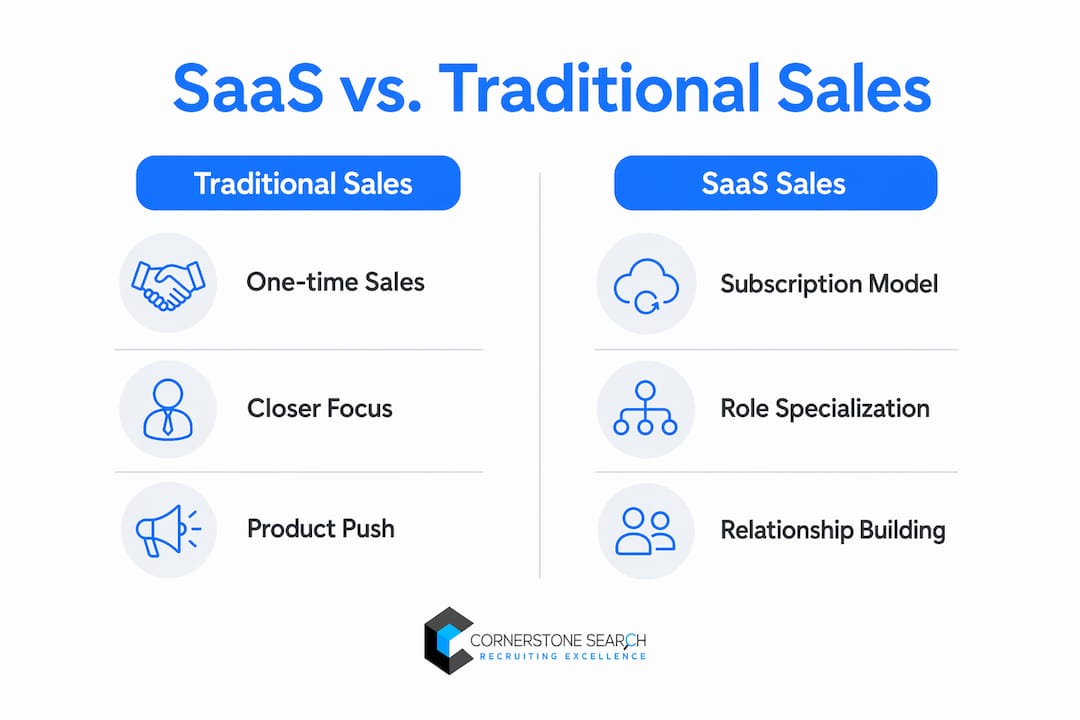
The most fundamental SaaS hiring difference is structural. SaaS sales processes are split into SDR outreach and AE closing roles, whereas traditional sales often assigns both functions to a single rep. That specialization changes what you screen for, how you structure compensation, and which career backgrounds actually predict success.
Traditional sales rewards closers who can move product in a single interaction. SaaS rewards reps who can map a complex buying committee, run a multi-week discovery process, and then retain the customer long enough to generate positive lifetime value. These are different cognitive and behavioral profiles.

The metrics tell the story clearly. SaaS sales managers track pipeline coverage ratios, conversion rates by stage, average contract value, and churn attribution. A rep who has only sold physical goods or one-off services has likely never been held accountable to any of those numbers. Bringing that person into a SaaS environment without significant ramp investment is a gamble most early-stage companies cannot afford.
Pro Tip: When screening candidates, ask them to walk you through how they calculate pipeline coverage and what churn rate they were held accountable to in their last role. A traditional sales rep will not have a clean answer. A SaaS-ready rep will.
The buying process itself also differs. Multi-stakeholder buying cycles in B2B SaaS routinely involve IT, finance, legal, and the end-user team simultaneously. Navigating that requires consultative selling skills, commercial awareness, and patience that pure transactional sellers rarely develop.
Why generalist recruiting fails for SaaS sales teams
Most generalist recruiters evaluate sales candidates on surface signals: years of experience, revenue numbers, and name-brand employers. Those signals matter in traditional sales. In SaaS, they are often misleading.
A rep who hit $2 million in revenue selling enterprise hardware may have done so through a single large account with a six-month sales cycle and no renewal component. That profile looks strong on paper but transfers poorly to a SaaS environment where the rep must generate pipeline, run product-led discovery calls, and protect net revenue retention simultaneously.
Slow hiring and unclear role definitions cause direct revenue delays in SaaS teams. Every week a territory sits uncovered is pipeline that will not close for another 60 to 90 days, given typical SaaS sales cycle lengths. Generalist recruiters who do not understand go-to-market motions cannot communicate role requirements accurately to candidates, which produces misaligned hires and fast turnover.
Here is what a specialized SaaS sales recruitment process looks like when done correctly:
- Define the GTM motion first. Is this a product-led growth model, a field sales model, or a hybrid? The answer determines whether you need an SDR who can qualify inbound leads or one who can build outbound sequences from scratch.
- Screen for SaaS-specific metrics fluency. Candidates should be able to speak to their quota attainment history, average deal size, sales cycle length, and churn rates in their previous roles.
- Assess network quality, not just experience. Candidate networks and aptitude for complex SaaS buying cycles predict success better than years of generic sales experience.
- Move fast. The best SaaS sales candidates are typically interviewing at two or three companies simultaneously. A process that drags past three weeks loses top candidates to faster-moving competitors.
Pro Tip: Specialized recruiters who focus exclusively on SaaS sales often provide replacement guarantees of up to six weeks if a hire leaves early. That guarantee is only possible because they know the candidate pool deeply enough to stand behind their placements.
How candidate evaluation criteria compare: SaaS vs. traditional
The table below captures the core evaluation differences that SaaS hiring managers must internalize before they write a job description or conduct a first interview.
| Evaluation area | Traditional sales hiring | SaaS sales hiring |
|---|---|---|
| Revenue model knowledge | One-time transaction experience | Subscription, ARR, and renewal fluency |
| Sales cycle complexity | Single decision-maker, shorter cycle | Multi-stakeholder, 30 to 120-day cycles |
| Key metrics tracked | Total revenue closed | Churn rate, LTV, pipeline coverage, NRR |
| Role structure | One rep handles full cycle | SDR and AE roles are separated |
| Product complexity | Physical goods or simple services | Technical SaaS products requiring discovery |
| Compensation transparency | Base plus commission | OTE with base, variable, and equity components |
Top SaaS sales candidates evaluate roles based on territory clarity, ideal customer profile definition, average deal size, and commission structure before they accept an offer. If your hiring process cannot answer those questions with specificity, you will lose the candidates who know enough to ask them.
Culture fit and adaptability carry more weight in SaaS hiring than in traditional sales. SaaS companies, particularly at the Series A and Series B stages, change their go-to-market motion frequently. A rep who thrives in a structured, process-heavy environment may struggle when the playbook shifts mid-year. Screening for adaptability and intellectual curiosity is not soft criteria. It is a direct predictor of retention.
Technical discovery calls during the hiring process should emphasize product complexity, average contract value, and go-to-market motions rather than generic sales skills. Asking a candidate to run a mock discovery call on your product reveals far more than asking them to describe their greatest sales achievement.
Common pitfalls in SaaS sales hiring
The most expensive mistakes in SaaS sales hiring share a common root: applying traditional hiring logic to a non-traditional sales environment. Here are the patterns that consistently produce bad outcomes:
- Hiring for general sales energy over SaaS process fluency. Enthusiasm is not a substitute for understanding how to manage a SaaS pipeline. Reps who cannot speak to churn attribution or renewal risk will underperform regardless of how motivated they appear in interviews.
- Reactive hiring after a rep leaves. SDR turnover nationally runs 34 to 40%, which means the average SaaS company is replacing SDRs every two to three years. Waiting until a seat is empty to begin recruiting guarantees a gap in pipeline coverage.
- Vague employer value propositions. Candidates who understand their own market value will not accept a role where the territory, ICP, and quota are undefined. Vague job descriptions attract candidates who do not know enough to ask better questions.
- Overweighting brand-name employers. A rep who spent five years at Salesforce or HubSpot in a support-heavy role may have less relevant experience than a rep who built pipeline from scratch at a Series A company. The context behind the resume matters more than the logo.
- Ignoring ramp program structure. SaaS products require product knowledge before a rep can run effective discovery calls. Companies that expect new hires to produce pipeline in the first 30 days without a structured ramp program set those hires up to fail and then blame the hire rather than the process.
The competitive SaaS sales talent market makes these mistakes increasingly costly. When only 28% of salespeople expect to hit 100% of quota this year, candidates are evaluating role quality more carefully than ever. A poorly structured hiring process signals a poorly structured sales organization.
How to build a high-performance SaaS sales team through better hiring
Building a SaaS sales team that consistently performs requires deliberate decisions at every stage of the hiring process, not just at the point of offer.
- Align hiring to your growth stage. A seed-stage company needs a generalist AE who can run the full sales cycle and help define the playbook. A Series B company needs specialized SDRs and AEs with clear lane separation. Hiring the wrong profile for your stage wastes time and money regardless of individual talent.
- Use specialized recruiters who know SaaS sales motions. Recruiters who focus on SaaS sales recruitment understand the difference between a PLG motion and a field sales motion. That knowledge produces better candidate shortlists and faster time to offer.
- Structure SDR and AE roles with clear handoff criteria. Ambiguous handoff points between SDR outreach and AE closing create friction, missed pipeline, and internal conflict. Define the criteria before you hire into either role.
- Track hiring metrics the same way you track sales metrics. Time to fill, offer acceptance rate, 90-day ramp attainment, and 12-month retention are the hiring equivalents of pipeline coverage and conversion rate. If you are not measuring them, you cannot improve them.
- Build a passive candidate sourcing strategy. The best SaaS sales reps are rarely actively looking. Reaching them requires a proactive outreach strategy, not a job posting.
Key takeaways
SaaS sales hiring requires a fundamentally different approach than traditional sales hiring because subscription models, multi-stakeholder buying cycles, and role specialization demand candidates with skills that general sales experience does not develop.
| Point | Details |
|---|---|
| Role specialization matters | SaaS splits SDR and AE functions; traditional sales often assigns both to one rep. |
| Metrics fluency is non-negotiable | Candidates must understand churn, LTV, pipeline coverage, and ARR to perform in SaaS. |
| Speed protects revenue | Slow hiring creates pipeline gaps; the best candidates accept offers within three weeks. |
| Generalist recruiting underperforms | Recruiters without SaaS context produce misaligned hires that increase turnover and cost. |
| Compensation transparency wins talent | Top candidates evaluate territory, ICP, deal size, and OTE structure before accepting. |
What 28 years of SaaS sales hiring has taught me
I have placed over 1,200 sales professionals in SaaS and software companies since 1996, and the single most consistent mistake I see founders and hiring managers make is treating a SaaS sales search like a general sales search. They write a job description that could apply to any sales role, post it broadly, and then wonder why the candidates who respond cannot speak intelligently about churn or subscription economics.
The SaaS sales talent market has tightened considerably over the past three years. Candidates are more selective, more informed about their own market value, and quicker to walk away from processes that feel disorganized. When only 28% of salespeople expect to hit full quota this year, the best reps are not desperate. They are choosing carefully.
What actually works is specificity at every stage. Specific job descriptions that answer the questions top candidates will ask. Specific interview processes that test for SaaS-relevant skills rather than generic sales charisma. Specific offers that reflect current market compensation rather than what you paid two years ago.
Cultural fit is real, but it is not a substitute for process fit. I have seen companies hire reps who were beloved by the team but could not navigate a multi-stakeholder deal to save their lives. The rep who fits your culture and understands your sales motion is the one worth competing for. The rep who only fits your culture is a retention risk from day one.
The companies that hire well in SaaS treat recruitment as a revenue function, not an HR function. They move fast, they communicate clearly, and they work with people who know the market. That combination produces hires that stick and perform.
— Rich Rosen
Partner with a recruiter who knows SaaS sales
Cornerstonesearch has spent nearly three decades placing top-performing sales professionals exclusively in SaaS and software companies. The average time from search kickoff to offer acceptance is 21 days, which means your territory gets covered before pipeline gaps become revenue problems. Every search is backed by a deep network of SaaS-specific candidates who understand subscription models, multi-stakeholder buying cycles, and the metrics that matter to your board.
If you are building or rebuilding a SaaS sales team and want a recruiter who speaks your language, explore Cornerstonesearch’s SaaS sales recruitment services or review the foundational hiring strategies that have driven consistent results for startups and enterprise teams alike.
FAQ
What makes SaaS sales hiring different from traditional?
SaaS sales hiring targets candidates with subscription model knowledge, multi-stakeholder selling experience, and fluency in metrics like churn and lifetime value. Traditional sales hiring focuses primarily on closing skills and total revenue generated.
What skills are most important for SaaS sales candidates?
The most critical skills for SaaS sales are consultative selling, pipeline management, product discovery, and commercial awareness of recurring revenue economics. Candidates who cannot speak to churn attribution or renewal risk are poorly suited for SaaS roles regardless of their overall sales record.
How long should a SaaS sales hiring process take?
A well-run SaaS sales search should move from kickoff to offer acceptance in 21 days or fewer. Processes that extend beyond four weeks lose top candidates to faster-moving companies, directly impacting pipeline coverage.
Why do SaaS companies split SDR and AE roles?
SaaS role specialization separates pipeline generation from deal closing to increase efficiency and allow each function to develop deeper expertise. Traditional sales assigns both responsibilities to one rep, which works for simpler products but breaks down under complex, multi-stakeholder buying cycles.
What compensation should SaaS SDRs expect in 2026?
The national median OTE for SaaS SDRs in 2026 is approximately $83,000 to $85,000, with base salaries in the $55,000 to $60,000 range. Companies that offer below-market compensation or fail to communicate OTE structure clearly will lose qualified candidates to competitors who do.