

TL;DR:
- Startups need specialized recruiters because they understand niche roles, equity, and market dynamics better. They fill critical sales and leadership roles faster, reducing costly mis-hires and team disruptions. Engaging a specialist saves time, improves candidate quality, and costs less than replacing a poor hire.
Specialized recruiters are the difference between filling a seat and landing a sales hire who actually moves the number. For startups, a bad hire is not just an HR headache. Replacing a tech or exec hire can exceed $240,000 when you factor in recruiting fees, lost productivity, and the cost of starting over. That is a number that can wreck a Series A budget. Why startups need specialized recruiters comes down to one hard truth: generalists do not know your world, your comp structure, your equity story, or your candidates. Specialists do.
What unique challenges do startups face that specialized recruiters solve?
Startups are not small versions of big companies. They operate differently, hire differently, and fail differently when they get it wrong.
Most early-stage companies have no real HR function. The founder is the hiring manager, the recruiter, and the closer. That works fine when you are hiring your first two engineers. It falls apart fast when you need a VP of Sales who can build a repeatable motion from scratch, carry a number, and not quit after six months because the product is still half-baked.
Here is where generalists consistently drop the ball:
- Speed. Startups cannot wait 60 days to fill a sales leadership role. Every week without a strong seller or sales leader is pipeline not built and revenue not closed.
- Niche networks. A generalist recruiter does not have a warm relationship with the VP of Sales at a Series B SaaS company who is quietly open to a new challenge. A specialist does.
- Equity literacy. Candidates at the VP and CRO level read equity packages carefully. If your recruiter cannot explain vesting schedules, refresh grants, and liquidity paths, passive candidates will quietly pass on your offer without telling you why.
- Mis-hire risk. Startups have no margin for error. One wrong VP of Sales hire can cost you 12 months of runway and a board conversation you do not want to have.
- AI application noise. 64% of business leaders say AI-generated applications complicate hiring. Specialized recruiters manually vet candidates instead of drowning in a pile of auto-submitted resumes.
Pro Tip: Before you engage any recruiter, ask them to name five VP of Sales candidates they have placed in SaaS companies in the last 18 months. If they hesitate, keep walking.
The high stakes of startup hiring are real. The cost of getting it wrong is not abstract. It shows up in missed quarters, broken teams, and founders who wish they had done it differently.
How do specialized recruiters speed up hiring and improve candidate quality?
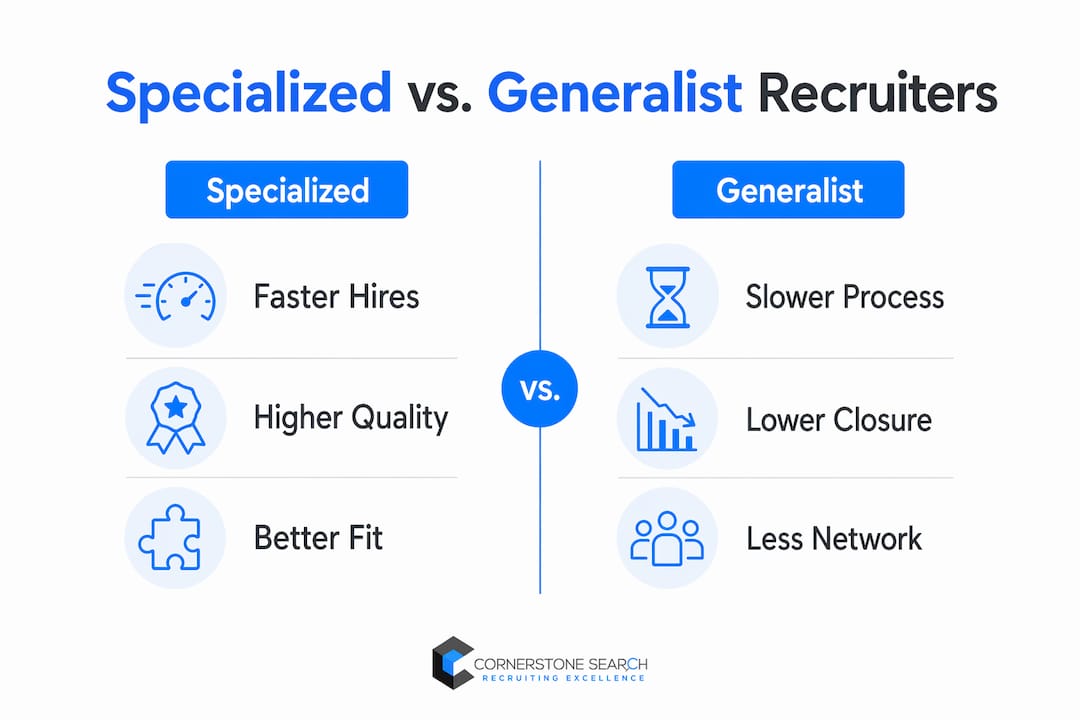
Speed is not just a nice-to-have for startups. It is a competitive weapon. Specialized recruiters fill technical and sales roles 37% faster than generalists, averaging 28 days compared to 45 or more days for generalists. That gap is not a rounding error. It is six weeks of lost selling time.

The reason specialists move faster is simple. They already know the candidates. They are not starting from scratch on LinkedIn. They have a warm pipeline of people who trust them, return their calls, and take their recommendations seriously.
Here is what the process actually looks like with a specialist:
- Days 1–3: Role intake, comp benchmarking, and ideal candidate profile built from real market data.
- Days 4–14: Active outreach to pre-vetted candidates in their network, not cold sourcing from scratch.
- Days 10–14: Qualified shortlist delivered to the hiring manager, with context on each candidate’s motivations and fit.
- Days 15–28: Interviews, feedback loops, offer stage, and close.
Cornerstonesearch averages 21 days from search kickoff to offer acceptance. That is not a marketing claim. It is the result of 30 years of building relationships with SaaS sales professionals before a search ever opens.
| Outcome | Specialized recruiter | Generalist recruiter |
|---|---|---|
| Average time to fill | 28 days | 45+ days |
| Qualified shortlist delivery | 10–14 days | 30–45 days |
| Passive candidate access | High (warm network) | Low (cold outreach) |
| Equity narrative fluency | Yes | Rarely |
| Domain-specific vetting | Yes | No |
The table tells the story. Generalists are not bad at recruiting. They are just bad at this kind of recruiting.
Why generalist recruiters aren’t enough for VC-backed startups
Generalist recruiters were built for a different world. They operate on planning cycles that do not match venture-backed startup urgency. A 10-year planning horizon is fine for a Fortune 500 company filling a mid-level role. It is useless when your board wants a CRO in the seat before the next funding round closes.
The equity problem is even more damaging than the speed problem. Executive candidates evaluate equity stories before they consider base salary. A generalist recruiter who cannot explain the difference between an ISO and an NSO, or who fumbles the liquidity path conversation, will lose top candidates silently. The candidate just stops responding. You never know why.
“Specialized recruiters bring an operating tempo that matches venture-backed startup urgency. They reduce friction in leadership searches because they already speak the language of equity, ramp, quota, and pipeline.” — Field observation from 30 years of SaaS sales recruiting
Pro Tip: Ask your recruiter how they handle the equity conversation with candidates. If they say they leave it to your CFO, find a recruiter who owns that conversation themselves.
Specialized executive search is not just faster. It is more likely to close. Specialists act as deal closers for passive candidates who ignore cold outreach from founders and HR teams.
How to integrate specialized recruiters into your startup hiring strategy
Getting the most out of a specialized recruiter requires more than signing a contract and waiting for resumes. Here is how to do it right.
-
Define the role with brutal clarity. Write down the three things this person must accomplish in their first 90 days. Not a job description. A success profile. Recruiters who know your market will use it to filter fast.
-
Share your equity story upfront. Give your recruiter the full picture: valuation, option pool, vesting schedule, and any liquidity events on the horizon. They need to sell this story to candidates who have options.
-
Commit to a fast feedback loop. If your recruiter sends you three candidates and you sit on them for two weeks, you will lose the best one. Commit to 48-hour feedback turnarounds.
-
Leverage their market intelligence. Specialized recruiters know what candidates in your space are earning, what they care about, and what will make them say no. Use that data to sharpen your offer before you make it.
-
Treat them as a partner, not a vendor. Recruiting partner vs. vendor is not just a semantic distinction. Partners get context, access, and urgency. Vendors get a job description and a prayer.
-
Set a realistic timeline and stick to it. A 21-day search requires your team to show up ready to interview, decide, and close. Delays on your end cost you the candidate.
Small startups with limited HR capacity get the most value from specialized agencies because the agency absorbs the sourcing, vetting, and closing work that founders do not have time to do well.
Key takeaways
Startups that use specialized recruiters fill critical sales roles faster, at lower total cost, and with candidates who actually stay and perform.
| Point | Details |
|---|---|
| Speed advantage is real | Specialized recruiters average 28 days to fill vs. 45+ days for generalists. |
| Bad hires are expensive | Replacing a mis-hired exec can exceed $240,000 in total cost for startups. |
| Equity fluency closes deals | Specialists translate vesting and liquidity paths into compelling offers candidates accept. |
| Passive candidates require relationships | Niche roles need warm recruiter networks, not cold outreach or job board posts. |
| Partner mindset drives results | Founders who treat recruiters as partners, not vendors, get faster and better outcomes. |
What 30 years in SaaS sales recruiting actually taught me
Here is the uncomfortable truth I share with every founder who calls me after a bad hire: the recruiter they used before me was not a bad person. They just did not know the market.
I have seen it play out the same way dozens of times. A founder hires a generalist recruiter because the fee looks reasonable. The recruiter posts the job, screens resumes, and sends over five candidates who look fine on paper. One gets hired. Six months later, the founder is back on the phone with me because the hire could not close enterprise deals, did not understand SaaS sales cycles, and quit when the equity conversation finally happened and they realized they had no idea what they had signed.
The problem was never the candidate. The problem was the recruiter did not know enough to ask the right questions, source the right people, or close the right offer.
Generalist recruiters fail about 80% of specialized searches. That number does not surprise me. It matches what I see in the field. Specialized recruiting is not a premium service for companies with big budgets. It is the only model that actually works for niche sales roles in SaaS.
My advice to founders: stop treating the recruiter fee as the cost of hiring. Treat it as the cost of not making a $240,000 mistake. That math changes the conversation fast.
— Rich Rosen
Cornerstonesearch builds startup sales teams that perform
Startups do not get second chances on their first VP of Sales hire. Cornerstonesearch has placed over 1,200 sales professionals in SaaS and software companies since 1996, with an average search cycle of 21 days from kickoff to offer acceptance.
If you are building a sales team and need to get it right the first time, start with sales recruitment fundamentals built specifically for SaaS founders and hiring managers. Cornerstonesearch works exclusively in SaaS sales recruiting, which means every candidate in the network has been vetted against the specific demands of software sales. No generalists. No guesswork. Just candidates who can actually do the job.
FAQ
Why do startups need specialized recruiters instead of generalists?
Specialized recruiters fill niche sales roles 37% faster and bring pre-built networks of passive candidates that generalists cannot access. They also understand equity compensation, which is critical for closing senior hires at startups.
How much does a bad hire actually cost a startup?
Replacing a mis-hired tech or executive candidate can exceed $240,000 when you account for recruiting fees, lost productivity, and the cost of running a second search.
How fast can a specialized recruiter fill a VP of Sales role?
Specialized recruiters deliver qualified shortlists in 10–14 days and close searches in an average of 28 days. Cornerstonesearch averages 21 days from search kickoff to offer acceptance.
What should founders ask a recruiter before hiring them?
Ask how many VP of Sales or CRO placements they have made in SaaS companies in the last 18 months, and ask how they handle the equity conversation with candidates. The answers will tell you everything.
Are specialized recruiters worth the fee for early-stage startups?
Yes. Recruitment agency fees are offset by better hire quality and the time founders save by not running a search themselves. For senior and niche roles, the cost of a bad hire far exceeds the recruiter fee.