

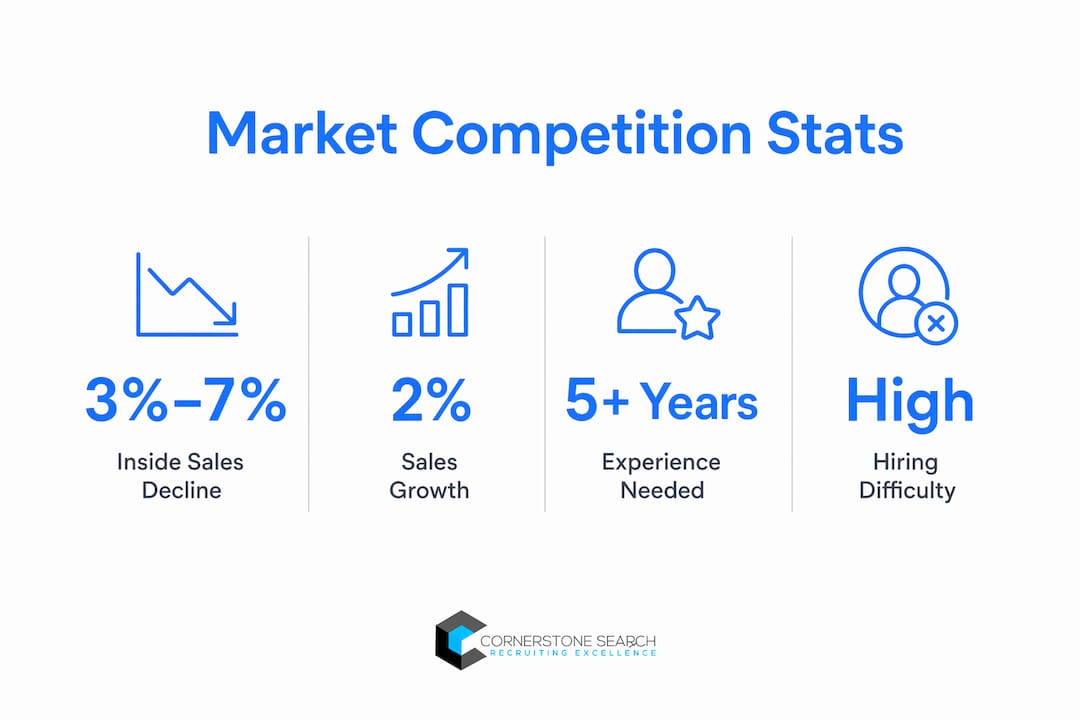
The SaaS sales talent market is competitive because slowed hiring growth, rising skill demands, and increasingly complex buyer behavior have converged to shrink the pool of truly qualified candidates. Bain & Company reports that sales rep headcount growth fell to around 2% or less between 2023 and 2025, with inside sales declining by 3% to 7% in some periods. At the same time, Caliber’s analysis describes a “revenue skills crisis” where commercial capabilities atrophied during years of AI-assisted easy selling. For sales executives and hiring managers at SaaS companies, understanding these forces is not optional. It is the foundation of any recruitment strategy that actually works.
Why the SaaS sales talent market is competitive right now
The supply of available SaaS sales professionals has not kept pace with demand, and the gap is widening. Sales rep headcount growth in SaaS slowed dramatically between 2023 and 2025, turning negative in some segments. That contraction means fewer new reps are entering the market each year, which directly intensifies competition among employers chasing the same shrinking pool.
Inside sales roles saw the steepest declines. Mid-market sales teams experienced significant volatility as companies restructured go-to-market motions around efficiency rather than headcount. The result is a market where experienced reps with a proven track record are rare, and the ones who exist are rarely actively looking for a new role.

| Segment | Headcount trend (2023–2025) |
|---|---|
| Inside sales | Declined roughly 3%–7% |
| Overall SaaS sales reps | Growth fell to ~2% or below |
| Mid-market sales | High volatility, restructuring common |
| Enterprise sales | Stable but compensation premiums rising |
This data matters because it reframes the hiring challenge. You are not competing against a slow recruiter at a rival company. You are competing against a structural shortage. The companies that recognize this shift their strategy from reactive job postings to proactive talent pipeline building.
Pro Tip: Map your open roles against the segments showing the steepest headcount declines. If you are hiring inside sales talent, expect a longer search and build that timeline into your planning cycle.
What is the revenue skills crisis and how does it affect hiring?
The revenue skills crisis is the defining force behind the competitive SaaS sales landscape in 2026. Caliber’s analysis describes a period where AI tailwinds made selling easier, which caused many reps to stop developing the harder commercial skills that close complex deals. Now that those tailwinds are fading, the gaps are exposed.
The skills that are now scarcest include:
- Executive discovery: The ability to run a C-suite conversation that uncovers real business pain, not just surface-level requirements
- Champion-building: Identifying and developing internal advocates within a prospect’s organization who can drive a deal forward without the rep in the room
- Competitive bid defense: Holding a deal under pressure when procurement gets involved and a cheaper alternative appears
- Deal qualification rigor: Knowing when to walk away from a deal that will never close, saving pipeline capacity for winnable opportunities
“The skills that protect revenue in tough markets also accelerate growth in good times.” — Caliber / pclub.io
When AI automates routine sales tasks, differentiation depends on commercial mastery and higher-order selling skills. The reps who have developed these capabilities are the ones every SaaS company wants. That concentration of demand around a small group of high-performers is precisely why SaaS recruits are so sought after and why common SaaS sales talent gaps persist across the industry.
The practical implication for hiring managers is direct. A candidate with five years of SaaS sales experience is not automatically qualified. The question is whether those five years included the conditions that build executive discovery and champion-building skills, or whether they were five years of riding a favorable market with AI-assisted outreach doing the heavy lifting.
How does product complexity shape the competitive SaaS hiring landscape?
Not all SaaS sales roles are equally difficult to fill, and product complexity is the primary variable that determines hiring difficulty. AI sales talent represents the most acute shortage because candidates must combine technical fluency with consultative selling ability. That combination is genuinely rare, and it commands compensation premiums that many companies are unprepared to offer.
| Role type | Primary skill demand | Hiring difficulty |
|---|---|---|
| AI sales specialist | Technical fluency plus consultative selling | Very high |
| Enterprise SaaS AE | Executive discovery, deal defense, long-cycle management | High |
| Mid-market AE | Pipeline management, product knowledge, negotiation | Moderate to high |
| Inside sales / SDR | Outreach volume, qualification, CRM discipline | Moderate |
Enterprise SaaS deals add another layer of complexity. Enterprise roles carry the highest compensation requirements and demand advanced skills because procurement involvement, competitive bids, and longer sales cycles are standard. The Seller Report finds that 69% of SaaS sales postings include equity, with uncapped commissions increasingly common for enterprise-focused roles. That compensation structure reflects how seriously companies are competing for a thin layer of elite talent.
SaaS companies also increasingly require candidates with cross-functional fluency across RevOps, product, and data analytics. A rep who can read a usage dashboard, work with a RevOps team to identify expansion signals, and translate product roadmap updates into customer value is worth far more than a rep who can only run a demo. That hybrid profile deepens the talent gap because it eliminates a large portion of the available candidate pool before the first interview.
What recruitment strategies actually work in this market?
Winning in the competitive SaaS sales talent market requires a fundamentally different approach than posting a job description and waiting. The best practices for SaaS talent acquisition center on proactive sourcing, precise compensation positioning, and retention architecture built before the hire is made.
-
Use specialized recruiters for passive candidate access. The reps you want are not browsing job boards. Specialist recruiters reduce the cost of slow or poor hires by accessing passive candidates and providing real-time compensation benchmarks. Cornerstonesearch, for example, averages 21 days from search kickoff to offer acceptance by working exclusively within SaaS and software sales recruitment, which means the network is already warm when a search begins.
-
Benchmark and lead on compensation. For AI sales roles and enterprise AE positions, compensation below market rate is not a negotiating position. It is a disqualifier. Use current market data to set your range before you post, not after you lose your first-choice candidate.
-
Build career development into the offer. Employer branding and product confidence are critical retention levers for top SaaS sales talent who expect clear career paths and leadership support. A candidate choosing between two competitive offers will favor the company where they can see a path to VP of Sales within three years over the one with a slightly higher base.
-
Align your sales role design with GTM efficiency trends. Future software growth centers on product value and efficient go-to-market execution rather than headcount expansion. Candidates who understand modern GTM motions want to work in environments that match that thinking. If your sales process is still built around volume outreach and spray-and-pray prospecting, you will struggle to attract the consultative sellers who can actually close enterprise deals.
-
Refine your interview process to assess the right skills. A structured approach to evaluating SaaS sales candidates around executive discovery, deal qualification, and champion-building will surface the reps who have developed real commercial skills rather than those who benefited from favorable market conditions.
Pro Tip: Build a talent pipeline before you have an open role. Maintain relationships with two or three high-performers in your target segment so that when a position opens, you have a warm list to call rather than starting from zero.
Key takeaways
The SaaS sales talent market is competitive because structural headcount declines, a widening revenue skills crisis, and rising product complexity have created a small pool of genuinely qualified candidates that every growth-stage company is chasing simultaneously.
| Point | Details |
|---|---|
| Headcount supply is shrinking | Inside sales declined 3%–7% between 2023 and 2025, reducing the available candidate pool. |
| Skills gaps are structural, not cyclical | AI tailwinds masked commercial skill atrophy; executive discovery and champion-building are now genuinely scarce. |
| Product complexity raises the bar | AI sales and enterprise AE roles require hybrid technical and consultative skills that few candidates possess. |
| Compensation must lead the market | 69% of SaaS sales postings include equity; compensation below benchmark disqualifies you before the conversation starts. |
| Specialized recruiters accelerate hiring | Passive candidate access and real-time benchmarks reduce costly delays in high-stakes searches. |
What I’ve learned after three decades of SaaS sales recruiting
The companies that struggle most in this market share one trait: they treat SaaS sales hiring as a transactional process. They write a job description, post it, screen resumes, and wonder why the best candidates are already off the market by the time they schedule a second interview.
What I have seen work, consistently, is treating talent acquisition as a relationship discipline. The reps who can run an executive discovery call, build a champion inside a Fortune 500 procurement process, and defend a deal against a cheaper competitor are not waiting for your LinkedIn message. They are getting calls from people who have been building relationships with them for years. That is the real advantage of working with a firm like Cornerstonesearch. It is not just speed, though 21 days to offer acceptance matters. It is that the network exists before the search begins.
The revenue skills crisis is also a retention opportunity that most companies miss. If you invest in developing executive discovery and competitive defense skills in your current team, you make those reps harder to poach and more valuable to your pipeline at the same time. The SaaS market predictions for 2025 and beyond point consistently toward GTM efficiency as the growth driver. The companies that build skill-dense, lean sales teams now will outperform the ones still chasing headcount growth in two years.
One more thing worth saying directly: posting more jobs is not a strategy. Companies cannot solve talent competition by increasing job postings alone. Efficiency and skill quality are what separate the companies that win in this market from the ones that keep refilling the same seats.
— Rich
How Cornerstonesearch helps you hire in a competitive market
Cornerstonesearch has placed over 1,200 sales professionals in SaaS and software companies since 1996, and the competitive dynamics described in this article are exactly what the firm was built to address. When the qualified candidate pool is thin and every week a role stays open costs revenue, speed and precision are not nice-to-haves. They are the whole game. Cornerstonesearch’s SaaS sales recruitment approach gives hiring managers access to pre-qualified, passive candidates and real-time compensation benchmarks that eliminate the guesswork from high-stakes searches. For a practical framework on building your team in this market, the sales recruitment resource covers the strategic foundations that separate winning teams from perpetually understaffed ones.
FAQ
Why is SaaS sales talent so hard to find right now?
Sales rep headcount growth in SaaS fell to around 2% or below between 2023 and 2025, while skill demands rose sharply. The combination of a shrinking supply and a rising qualification bar makes the market structurally competitive.
What are the most common SaaS sales talent gaps?
Executive discovery, champion-building, and competitive bid defense are the scarcest skills in the current market. These capabilities atrophied during years of AI-assisted selling and are now in high demand as buying conditions tighten.
How do you attract top SaaS sales candidates?
Lead on compensation with equity and uncapped commissions, offer a clear career development path, and use specialized recruiters to access passive candidates. Top performers are rarely active job seekers and require a proactive sourcing approach.
What makes AI sales roles harder to fill than standard SaaS sales roles?
AI sales candidates must combine technical product fluency with consultative selling skills, a rare pairing that commands significant compensation premiums and requires specialized recruitment methods to source effectively.
How long should a SaaS sales search take?
A well-run search with access to a pre-built passive candidate network should reach offer acceptance within three to four weeks. Searches that rely on job postings alone typically take two to three times longer, with higher risk of settling for a suboptimal hire.