

A bad sales hire can cost you as much as the full first-year OTE, depending on role, OTE, and how long you keep them on board. We pulled wage and benefit numbers from the BLS and payroll tax rates from the IRS to build this model, and we run searches at Cornerstone Search every week where this math is the whole conversation.
TL;DR:
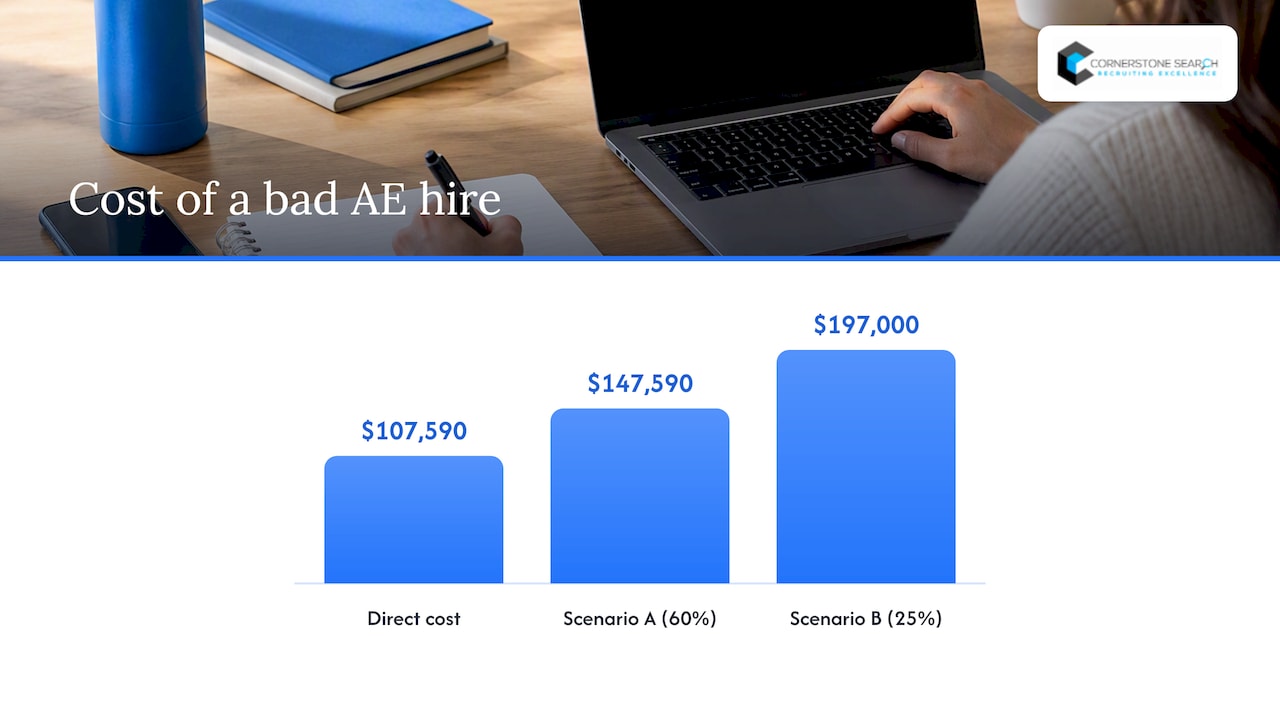
- A midlevel AE with an $80,000 base and $160,000 OTE incurred $107,590 in direct costs over nine months before lost revenue was counted.
- At 60% quota attainment, estimated total cost reached about $147,590; at 25% attainment, it exceeded $197,000, including lost revenue.
- With cloud sales quota attainment averaging 43.83% in Q4 2025, assess territory, lead flow, coaching, and activity before allowing 30 to 90 days for fair evaluation.
- Use structured scorecards, sales simulations, specific reference checks, and a 30/60/90 day ramp plan to assess candidates and track progress beyond interviews.
Table of Contents
- Direct costs: the payroll and hiring line items you must count
- Indirect and opportunity costs: lost deals, pipeline damage, and management time
- Worked example: step-by-step calculation for a mid-level AE (copyable template)
- Diagnosis: before you fire, distinguish a genuinely bad hire from structural problems
- Prevention: hiring processes and fixes that materially reduce the cost of a mis-hire
- Author perspective: lessons from 1,200 SaaS sales placements
- How Cornerstone Search reduces the cost of bad sales hires
- FAQ
- Sources
Direct costs: the payroll and hiring line items you must count
Most hiring managers price a bad hire by salary alone. That’s the rookie mistake.
Here’s what belongs in your fully loaded cost:
- Base salary and OTE paid during the tenure, even for months of zero productivity
- Benefits, calculated on top of wages, not folded into them
- Employer payroll taxes: Social Security at 6.2% and Medicare at 1.45%, per IRS Publication 15
- Recruiting fees, whether paid to a contingency firm or burned as internal recruiter hours
- Onboarding and training costs, including manager and enablement time
- Tools and software seats: CRM, dialer, intent data, usually $150 to $400 a month per rep
- Travel, if the role includes it
- Severance or PTO payout at exit
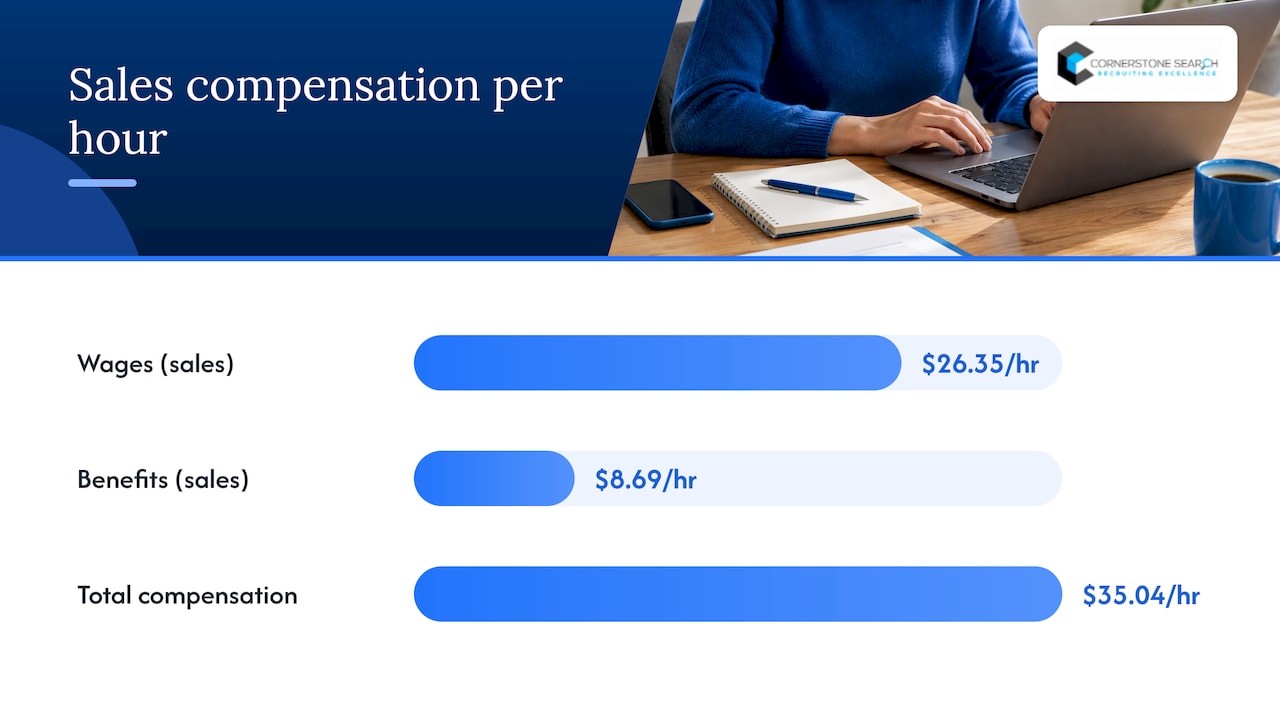
The BLS reports private-industry employer compensation averaged $48.78 per hour in late 2025, with $15.33 of that in benefits. For sales-and-related occupations specifically, total compensation ran $35.04 per hour, split between $26.35 in wages and $8.69 in benefits. That benefits number is not optional.
Multiply by months on payroll. That is your direct cost floor before you even touch what the bad hire cost you in lost deals.
Indirect and opportunity costs: lost deals, pipeline damage, and management time
The direct costs sting. The indirect costs are what actually sink the quarter.
They occupied a territory, got assigned leads, and burned pipeline that a better rep would have converted. That is opportunity cost, and it is almost always bigger than payroll.
- Lost revenue: multiply the quota shortfall by your average deal size and win rate to estimate missed bookings
- Pipeline damage: leads touched by a weak rep convert at a lower rate for months, even after you replace them
- Management time: a struggling rep eats 5 to 10 hours a week of manager coaching that could go to the rest of the team
- Team drag: a visibly underperforming peer quietly lowers the bar for everyone around them
RepVue’s Cloud Sales Index put average quota attainment at 43.83% in Q4 2025. That number should scare you a little. It means a huge share of sellers are missing quota right now, and not all of them are bad hires. Use that context before you assume the worst.
Worked example: step-by-step calculation for a mid-level AE (copyable template)
Here is a template you can run with your own numbers. We’ll use a mid-level SaaS AE: $80,000 base, $160,000 OTE.
- Base salary paid over 9 months before termination: $60,000
- Benefits at roughly 25% of wages, per BLS benefits data: $15,000
- Employer payroll taxes at 7.65% combined Social Security and Medicare, per IRS Pub 15: $4,590
- Recruiting fee (contingency, roughly 20% of first-year base): $16,000
- Onboarding, tools, and manager time over 9 months: $12,000
- Direct cost subtotal: $107,590
Scenario A, partial miss (attaining 60% of quota): lost quota-attributable revenue adds roughly $40,000 in margin, pushing total cost to about $147,590.
Scenario B, large miss (attaining 25% of quota): lost revenue swells to $90,000 or more, pushing total cost past $197,000.
Change the OTE, the months-to-termination, or the attainment rate and the whole number moves. That is the point of building it yourself instead of trusting a generic average.
Diagnosis: before you fire, distinguish a genuinely bad hire from structural problems
Before you write off a rep as a bad hire, check whether you actually gave them a fair shot. We’ve seen plenty of “bad hires” who were actually victims of bad territory design.
Run this checklist first:
- Was the quota set using real data, or guessed by a VP under budget pressure?
- Did the territory have enough total addressable accounts to hit number?
- Was lead flow consistent, or did marketing starve this rep for two months?
- Did onboarding cover product, process, and competitive positioning, or just a login and a Slack invite?
- Did the manager run weekly 1:1s and pipeline reviews, or vanish after week two?
- Does the rep’s pipeline show activity and effort, even if conversion is low?
Quota attainment in cloud sales sits well under half on average, which means missing quota alone is not proof of a bad hire. It is proof that a lot of sellers are working in broken systems. Give it 30 to 90 days of honest data before you pull the trigger, and read our breakdown of red flags in SaaS sales candidates to separate a skill problem from a system problem.
Pro Tip: Pull the rep’s actual call and email activity before the exit conversation. Low effort and low result is a bad hire. High effort and low result is usually a broken process.
Prevention: hiring processes and fixes that materially reduce the cost of a mis-hire
You cannot eliminate mis-hires. You can cut the odds hard with a tighter process.
- Use structured interviews with a scorecard, not a gut-feel conversation. We cover this in detail in our piece on structured interviews as the real fix for mis-hires.
- Run a role-based simulation: a mock discovery call or a deal-review exercise tests sales judgment better than any resume.
- Check references for specifics, not praise. Ask what deals they closed, what deals they lost, and why. Our guide on validating sales candidate claims walks through exact questions to ask.
- Build a 30/60/90 ramp plan with pipeline milestones, not vague “get up to speed” language.
- For VP Sales or CRO roles, retained search earns its fee fast. One avoided bad hire at that level covers the search cost many times over. Our executive search page explains when retained makes sense versus contingency.
On the tooling side, if your team is tracking interviews and candidates in spreadsheets, a free applicant tracking system at least gets your process organized before you scale hiring.
Pro Tip: Score every candidate on the same rubric before the debrief call. Groupthink kills more good hiring decisions than bad candidates ever do.
Author perspective: lessons from 1,200 SaaS sales placements
Three things we’ve learned the hard way. First, candidates who talk about “we” closed a deal and can’t name their individual contribution are a red flag every time. Second, a clean resume with zero job-hopping sometimes hides a rep who never had to prospect. Third, the best predictor of success is how they handle a tough question about a deal they lost, not one they won. If a hire isn’t working after 90 days of fair conditions, cut losses. Waiting rarely saves money.
— Rich Rosen
How Cornerstone Search reduces the cost of bad sales hires
We built our process around one fact: the cost of a slow or sloppy search is almost always smaller than the cost of a bad hire. We deliver searches quickly and have placed many sales and executive professionals for SaaS and software companies over the years.
If avoiding one bad AE hire saves you $150,000 in the math above, a retained search fee pays for itself before the new hire even closes a deal.
- We run software sales recruitment for AE, SE, and sales leadership roles
- We run retained executive search for VP Sales and CRO hires where the cost of getting it wrong is highest
- We offer talent acquisition consulting if you want to fix your internal process instead of outsourcing the search
Start a conversation about your next sales hire before the cost of waiting gets added to the bill.
FAQ
What are marketing and selling costs?
Marketing and selling costs are the expenses a business incurs to generate demand and close revenue, including salaries, commissions, advertising, travel, and sales tools. For a sales hire specifically, these costs also include recruiting fees, onboarding, and the OTE paid during ramp.
How much does a sales rep cost?
A fully loaded sales rep costs more than base salary and commission alone. You need to add benefits at roughly 25% of wages and payroll taxes of 7.65%, per BLS and IRS figures, plus recruiting, tools, and ramp-period productivity loss.
How much does an employee actually cost a company?
An employee’s true cost includes wages, benefits, and employer payroll taxes on top of salary. BLS data shows private-industry benefits averaged $15.33 per hour against $48.78 in total compensation, meaning benefits alone add a substantial percentage above base pay.
How do I calculate the cost of sales for a business?
Add base compensation, benefits, payroll taxes, recruiting and training costs, then layer in lost revenue from missed quota using average deal size and win rate. This produces a fully loaded figure rather than a salary-only estimate that understates the real number.
Sources
- Employer Costs for Employee Compensation News Release – 2025 Q4 Results
- Publication 15 (Circular E), Employer’s Tax Guide
- RepVue Cloud Sales Index | Q4 2025