

The fastest reliable way to fill a senior SaaS sales role is a specialist retained search run on a disciplined 21-day milestone plan, led by someone who has actually closed these searches before. We have placed many sales, presales, and executive candidates over the years, and we can tell you: speed without a process is just luck wearing a nice suit.
TL;DR:
- Lock the success profile by day three, including the go to market motion, quota history, team scope, and first 90 day outcomes.
- Schedule structured interviews of at least an hour, use a shared scoring rubric, debrief within 24 hours, and run reference checks alongside final rounds.
- Agree on compensation bands and keep interview panels small before sourcing begins; internal delays over budget or title can add three weeks after candidates emerge.
- Ask search firms for average days to offer and one year retention, then update candidates within 24 hours after each interview.
- Set a 30, 60, and 90 day plan before the leader starts, then check in at day 30 and track pipeline, team feedback, and results.
Table of Contents
- Why Speed Matters for Executive Hires
- What a Fast Executive Search Actually Looks Like
- Step-by-Step Plan to Run a Rapid, High-Quality Executive Search
- Cornerstone Search Associates: Proof, Process, and Outcomes
- Managing Candidate Experience in a Fast Search
- Post-Placement Support and Onboarding
- Strategies to Source and Attract Top-Tier SaaS Sales Executives Rapidly
- Using Technology and Data to Speed Up Screening and Matching
- Best Practices for Fast but Thorough Interviews
- Author Perspective: Battle-Tested Rules for Fast Hiring
- If You Need a Rapid Placement Now: How Cornerstone Engages
- FAQ
- Sources
Why Speed Matters for Executive Hires
Every week your VP Sales seat sits empty, you are paying for it twice. Once in missed pipeline, once in the chaos that spreads when nobody owns the number.
SHRM’s benchmarking data shows executive hires cost substantially more than nonexecutive hires, and screening plus interviewing together typically take over a week per stage. That is before you get to offer. Stack three or four stages like that and you have burned a full quarter before anyone signs anything.
Executive cost-per-hire increased in 2026, according to SHRM’s recruiting benchmarking brief, and time-to-fill for senior roles stayed elevated compared to nonexecutive roles. That gap is not shrinking on its own.
Here is where speed stops being a nice-to-have and starts being survival:
- You are mid-fundraise and investors are asking who runs go-to-market.
- Your current sales leader just gave notice and the pipeline is already wobbling.
- A competitor just poached your top rep and morale is cracking.
Speed is optional when you are hiring a backup or a bench role. Speed is not optional when revenue, funding, or team trust is on the line.
What a Fast Executive Search Actually Looks Like
“Fast” gets thrown around by a lot of people who have never actually run a search to close. Here is how you tell a real rapid search from a rushed one:
- Intake precision. The recruiter nails down the exact GTM motion, the success metrics for the first 90 days, and whether you need a builder or a manager, before a single resume moves.
- Sourcing depth. You should hear specifics on daily outreach volume and passive candidate reach, not vague talk about “a strong network.”
- Interview rigor. Senior hires need immersive interviews, often an hour or more, that dig into values and judgment, not just résumé bullet points. HBR’s conversation with hiring experts backs this up directly: deep interviews catch what a scorecard misses.
- Verification that holds up. Real reference checks, documented retention numbers, and placement history you can actually see, not just a logo wall.
Pro Tip: Ask any search partner for their average days-to-offer and their one-year retention rate before you sign anything. If they cannot answer both in one breath, keep looking.
The warning signs are easy to spot once you know what to watch for. A recruiter who skips intake and jumps straight to names. A firm that cannot tell you how many passive candidates they actually contacted. A process that compresses the interview but never touches references. That is not fast. That is reckless, and you will pay for it in a bad hire within six months.
Step-by-Step Plan to Run a Rapid, High-Quality Executive Search
You do not need magic to move fast. You need a plan and the discipline to stick to it.
- Day 0 to 3: Intake and alignment. Get every stakeholder in one room. Nail the success profile: quota history, team size they have managed, the exact GTM motion they need to run.
- Day 3 to 10: Targeted sourcing. This is where most searches die slow. A real search hits daily outreach quotas and tracks response rates, not just activity for activity’s sake.
- Day 10 to 16: Immersive interviews. Run structured, hour-long conversations with scoring rubrics, then debrief as a team within 24 hours of each round.
- Day 16 to 21: References, negotiation, offer. Reference checks happen in parallel with final interviews, not after. Negotiation starts the moment you know you have your person.
A few ways to compress this further without cutting corners:
- Run reference checks and final-round interviews in the same week instead of sequentially.
- Pre-align compensation bands with finance before the search even starts, so offer negotiation does not stall.
- Keep interview panels small and decisive. Six interviewers means six calendars to coordinate and six opinions to reconcile.
The biggest bottleneck we see is not sourcing. It is internal indecision. Companies find great candidates in week two and then take three more weeks arguing about budget or title. If you want a 21-day search, your internal team needs to move at a 21-day pace too. For more on compressing standard timelines, see our breakdown of strategies for faster leadership hiring and how it contrasts with a typical 60 to 120-day search.
Cornerstone Search Associates: Proof, Process, and Outcomes
We built our practice around one idea: SaaS sales leadership hires are too expensive to get wrong, and too urgent to get slow.
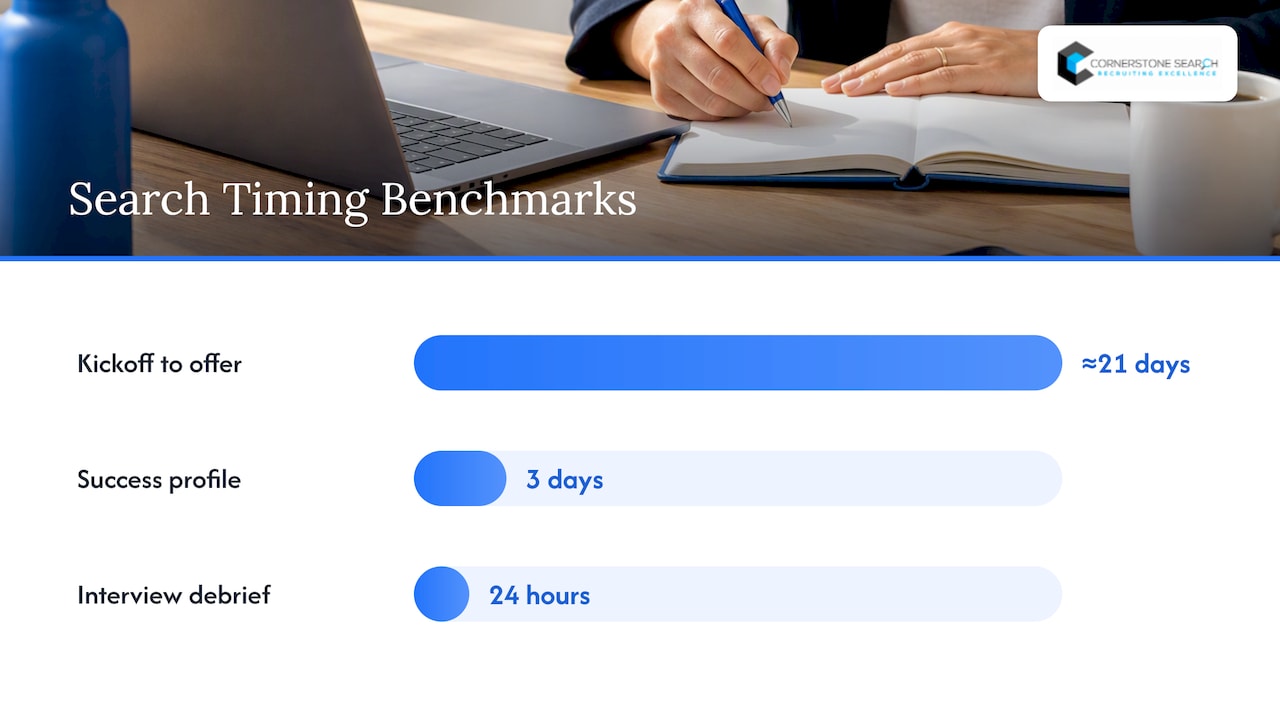
Since 1996, we have placed over 1,200 sales professionals, and our average time from search kickoff to offer acceptance runs around 21 days. That 21-day benchmark is not a marketing number. It is what disciplined intake, focused sourcing, and fast decision-making actually produce when nobody drags their feet.
What we run on every rapid search:
- A locked success profile within the first three days, built with your hiring team, not around them.
- Daily sourcing targets against a defined SaaS sales candidate pool, not a generic resume database.
- Interview debriefs scheduled within 24 hours of every round, so momentum never stalls.
- Reference checks that happen in parallel with final interviews, never after.
We work specifically inside SaaS and software sales, which means we already know what a good AE ramp looks like, what a realistic OTE structure is for your market, and which CRO backgrounds actually translate across company stages. That specialization is what lets us move fast without guessing on fit. You can see how this applies to a specific hire on our software sales recruitment page.
Managing Candidate Experience in a Fast Search
Speed can feel like pressure to a candidate if you handle it wrong. The fix is not slowing down. It is communicating constantly.
Every top SaaS sales leader worth hiring is talking to multiple companies at once. If you go quiet for a week between rounds, you lose them to whoever responded faster. A tight search actually protects candidate experience, because it respects their time instead of stretching a decision over two months.
Set a communication cadence up front: confirm next steps within 24 hours of every interview, give a real timeline for decisions, and never leave a finalist guessing. Candidates read radio silence as disorganization, and disorganization reads as a preview of what it is like to work for you.
The best candidates are also evaluating you just as hard as you are evaluating them. A crisp, respectful, fast process signals a company that knows what it wants. A messy, drawn-out one signals the opposite, and your strongest finalist will notice.
Post-Placement Support and Onboarding
Closing the offer is not the finish line. A sales leader who ramps slowly costs you the same quarter you just tried to save by hiring fast.
The first 30 days matter more than people think. Set a 30-60-90 day plan before the start date, not after. Define what pipeline coverage, team restructuring, or quota attainment should look like at each checkpoint, so your new leader is not guessing what success means.
Stay involved past the handshake. A short check-in at 30 days catches friction before it becomes resignation. We stay engaged with both the client and the placed executive through the first few months, because a placement that does not stick is not a win for anyone, least of all the company that paid for it.
Ramp time for a sales leader is different from ramp time for an individual rep. Give them room to assess the team and adjust the motion, but hold them to the same early signals you would hold any hire to: pipeline quality, team feedback, and whether the numbers are trending the right direction by day 90.
Strategies to Source and Attract Top-Tier SaaS Sales Executives Rapidly
You cannot fast-talk your way into a strong SaaS sales leadership bench. You need reach into people who are not actively looking.
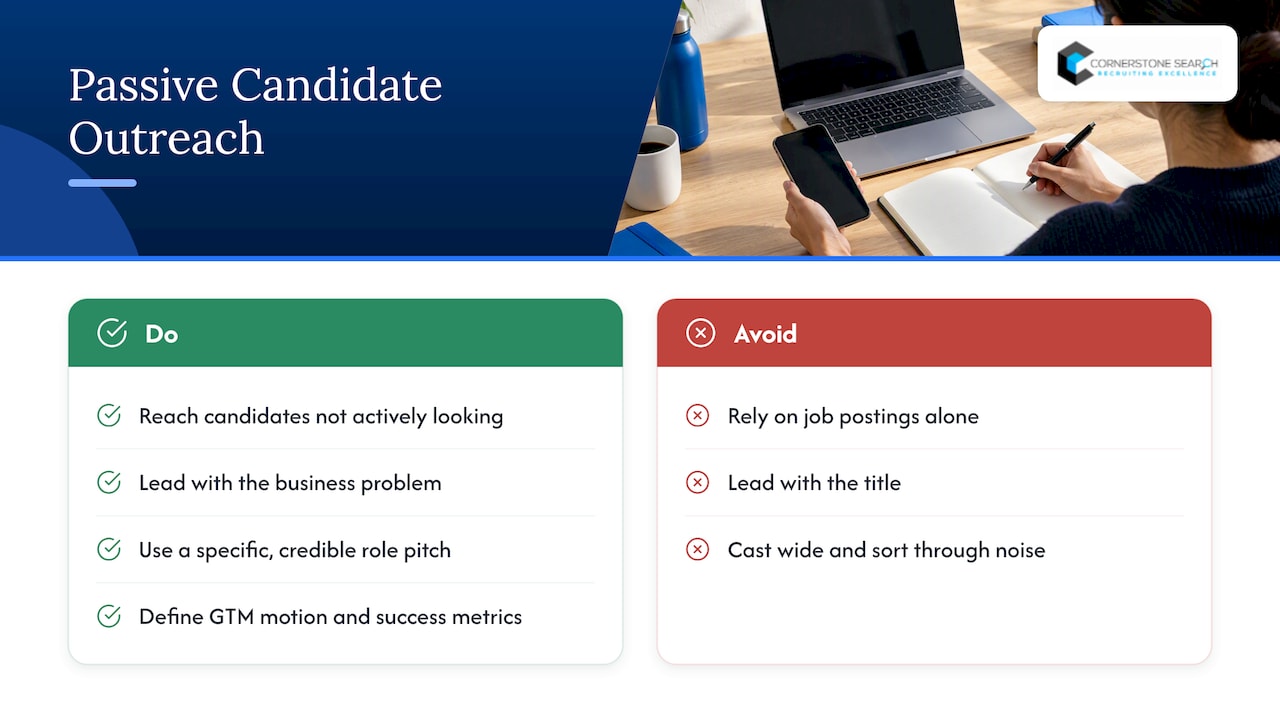
The best VP Sales and CRO candidates are usually employed, usually performing, and usually not browsing job boards. Reaching them takes direct outreach, a specific and credible pitch about the role, and a network built over years, not a job posting and a prayer.
What actually works: lead with the business problem, not the title. “We need someone who can scale a $5 million ARR motion to $20 million” gets a reply. “VP of Sales opening” does not. Specificity signals you know what you are building, and that is what pulls a strong passive candidate off the sidelines.
Speed here comes from precision, not volume. Defining the exact GTM motion and the specific success metrics narrows your outreach to people who are genuinely qualified, instead of casting wide and sorting through noise. For a tactical breakdown on reaching candidates who are not actively job hunting, see our playbook on sourcing passive SaaS sales talent.
Using Technology and Data to Speed Up Screening and Matching
Technology does not replace judgment in a senior search. It clears the noise so judgment has something good to work with.
Structured candidate data, built around specific GTM experience and quota history, lets you filter fast without missing the right person. If you are fielding a high volume of inbound responses during a public search, tools that automatically parse and organize incoming résumés can save real hours, for example RecrutFlo’s approach to turning inbox CVs into a searchable database.
For companies running significant outbound outreach as part of sourcing, AI-driven lead generation tools built for recruiting, like the verified outreach approach from AIViral, can help identify and pre-qualify responses at scale, freeing the search team to focus on evaluation instead of chasing replies.
None of this replaces a recruiter’s judgment on fit. It just means the people doing the evaluating spend their time on the right 20 candidates instead of wading through 200.
Best Practices for Fast but Thorough Interviews
Fast does not mean shallow. It means structured.
Build a scoring rubric before the first interview, not after the third. Every interviewer should be evaluating against the same criteria: quota history, team-building experience, specific GTM motion fit, and communication under pressure.
HBR’s reporting on hiring and firing decisions backs up what we have seen for 30 years: immersive interviews, often running an hour or longer, are what separate a candidate who talks a good game from one who actually delivers. Surface-level 30-minute chats do not catch that.
If your panel cannot schedule a video screen within 48 hours, consider tools built for high-volume preliminary screening, such as Facecruit’s approach to one-way video interviews, to keep candidates moving without sacrificing the in-depth final rounds that actually matter.
Keep panels small, keep scoring consistent, and debrief within a day. That is how you stay fast and still catch the red flags that a rushed process would miss.
Author Perspective: Battle-Tested Rules for Fast Hiring
Thirty years in this business taught me a few things the hard way.
Rule one: speed without intake discipline is just a faster way to make the same mistake. Rule two: if a recruiter cannot tell you their actual days-to-offer average, they do not track it, and if they do not track it, they are not managing it.
Rule three: reference checks are not a formality. They are where you catch the gap between a great interview and a great employee. Rule four: the best candidates are never the ones applying. They are the ones you have to go find.
In your first meeting with any search partner, ask two questions: what is your average time-to-offer, and what is your one-year retention rate. Watch how fast and how specifically they answer. That tells you more than any pitch deck ever will.
— Rich Rosen
If You Need a Rapid Placement Now: How Cornerstone Engages
If your sales leader seat is open right now, you do not have time for a search that drags into month three. We run a three-week cadence based on refined processes and experience, and we know exactly where searches usually stall.
Here is what week one looks like once you reach out:
- We run intake within the first 48 hours, locking the success profile and GTM specifics.
- Sourcing starts immediately against candidates we already know in the SaaS sales space.
- You get a shortlist of qualified, vetted candidates before week one ends.
| Milestone | Timing |
|---|---|
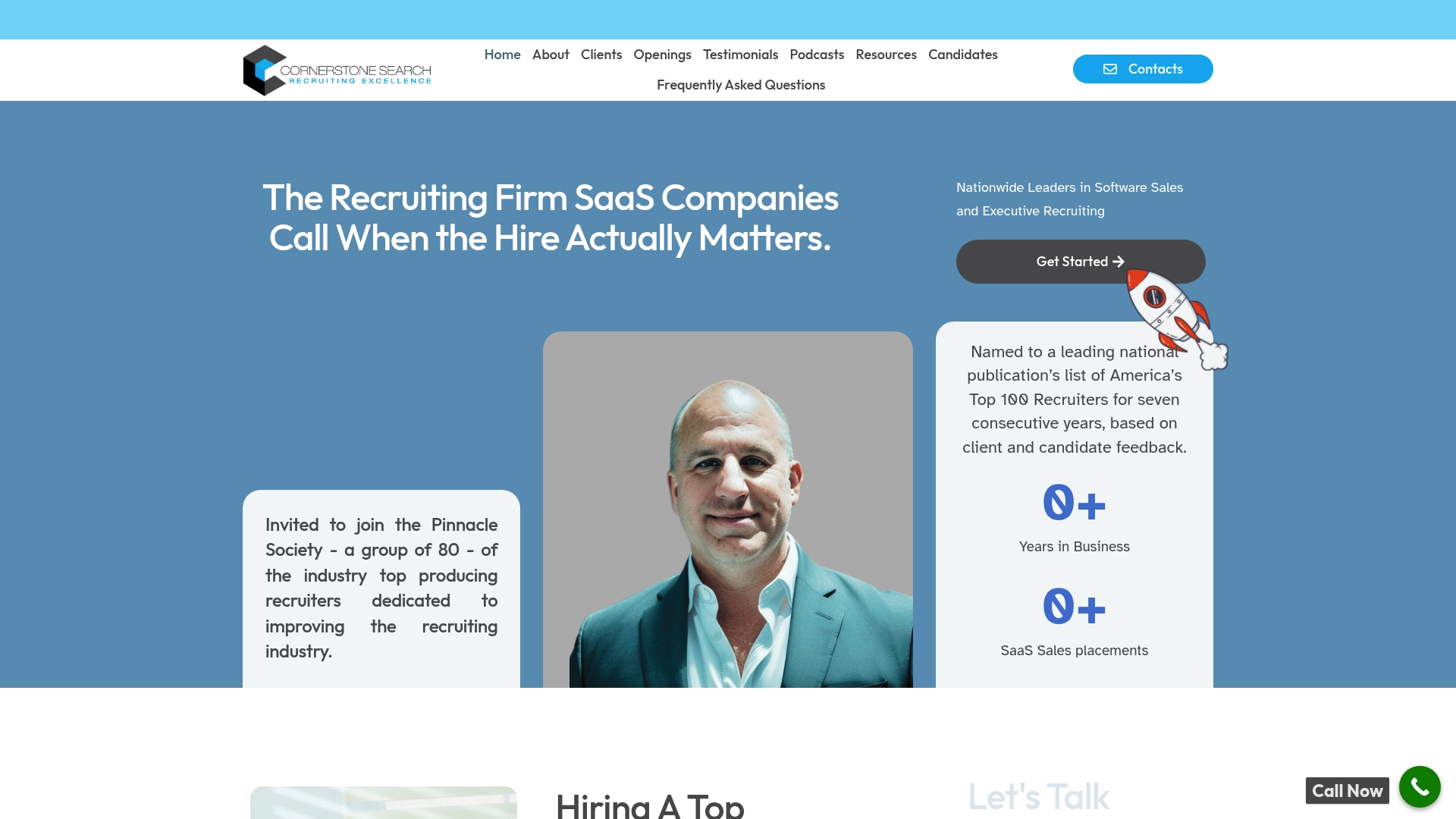
| Intake and success profile locked | Days 0 to 3 |
| Targeted sourcing and outreach | Days 3 to 10 |
| Interviews and debriefs | Days 10 to 16 |
| References, negotiation, offer | Days 16 to 21 |
Start with our executive search recruitment page or go straight to software sales recruitment if the open seat is a sales leadership role. Reach out and we will get intake scheduled this week.
FAQ
How fast can a company realistically fill an executive sales role?
A specialist search with disciplined intake and sourcing can reach offer acceptance in around 21 days, compared to the 60 to 120 days common with unfocused searches. The gap comes down to intake precision and sourcing targeting, not luck.
What makes an executive search “fast” without cutting corners?
A legitimate fast search still runs immersive, hour-long interviews and full reference checks, it just compresses timing between stages instead of skipping steps. HBR’s hiring research confirms depth in interviews remains essential even under time pressure.
Why do executive hires cost more and take longer than other roles?
SHRM’s benchmarking data shows executive hires carry substantially higher costs than nonexecutive hires, driven by longer screening and interview stages that average 8 to 9 days each.
What should I ask a search firm to confirm they can move quickly?
Ask for their average days-to-offer and their one-year retention rate on past placements. A firm that tracks and shares such metrics is managing speed deliberately rather than promising it.
How do I know if a candidate found quickly is actually a good fit?
Check that the search included structured scoring, immersive interviews, and completed reference checks, not just a fast resume match. Speed and fit are not opposites when the intake and sourcing process is built correctly from day one.
Sources
- SHRM releases 2025 benchmarking reports: How does your organization compare?
- How to make better hiring and firing decisions (HBR podcast)