

If a senior hire will move revenue, shape your next raise, or protect runway, use a specialist venture-backed executive search partner. You get speed and real assessment depth, not a stack of résumés. Fees vary by model, and recruiter placement fee coverage is worth reading before you sign. We run these searches at Cornerstone Search for SaaS sales leaders.
TL;DR:
- Contingency fees run from the mid teens to 30% of first year pay, while retained searches cost about 30% to 35% of total first year compensation.
- Confirm whether the fee applies to base salary or total first year compensation, including bonus or commission, and put the definition in writing.
- A smaller company hiring a VP Sales may suit contingency or engaged terms; CRO searches watched by the board or thin candidate pools favor retained.
- Before signing, ask for timelines to the first slate and offer, candidate vetting counts, and written replacement terms if the hire leaves.
- Verify recruiters through the firm’s official contact details; legitimate search firms charge the hiring company, never candidates, and do not request sensitive data.
Table of Contents
- What venture-backed executive search means for founders
- Contingency, engaged, and retained: how the fees work
- What to expect from the process
- How to choose a search partner
- Why we run SaaS sales searches the way we do
- Blunt advice from a recruiter who has seen the wreckage
- Ready to hire? Here is your next step
- FAQ
- Sources
What venture-backed executive search means for founders
Venture-backed executive search is hiring a CRO, VP Sales, or other senior leader through a partner who understands what investors expect. Not a generic recruiter. Someone who knows your burn, your board, and your go-to-market clock.
That changes the brief. A public company can wait for the perfect résumé. You can’t. Your investors want pipeline growth before the next round, and a slow or wrong hire eats months you don’t have. A bad VP Sales doesn’t just miss quota. They drain runway, scare off reps, and leave you explaining the miss to your board.
So the search has to start from your stage. Seed-stage founders often need a builder who will carry a bag. A Series C company needs someone who can manage managers and forecast cleanly. Same title, totally different person.
Then there is who actually does the work. Large global firms bring brand and reach. Boutiques usually bring more senior attention and sector focus. Better Headhunting’s look at the big firms versus boutiques makes this point, and it matches what we see. The biggest global firms make sense for highly visible CEO searches at scale. For a venture-stage sales leader, you want the partner who picks up the phone and runs your search personally, not a junior researcher three levels down.
Contingency, engaged, and retained: how the fees work
Three models, three ways of paying. Know which one you’re signing.
- Contingency: you pay only when you hire. According to industry fee coverage, fees run from the mid-teens to 30% of first-year pay.
- Engaged or container: you pay part up front, and that money is credited against the final fee. It sits between the other two.
- Retained: you pay in stages whether or not you hire. The same coverage puts retained fees around 30 to 35% of total first-year compensation.
Watch the fee base. Some firms charge on base salary. Others charge on total first-year comp, which includes bonus or commission. For a CRO with a big variable, that gap is real money. Ask which number the percentage applies to, and get it in writing.
Which model fits? A VP Sales at a smaller company, where you can interview fast and the market is deep, often works on contingency or engaged. A CRO whose hire the board is watching, or a role with a thin candidate pool, usually calls for retained. You want the partner locked in and putting senior hours into it. Our own retained search guide covers payment schedules in more detail.
Contract items to watch: what triggers each payment, whether you’re exclusive, and what happens if you hire a candidate the firm introduced later.
What to expect from the process
A senior sales search should not drag. Speed matters because your pipeline, your hiring plan, and your fundraising story all wait on this seat. We covered why in our piece on search speed and fundraising.
Here is the sequence a good partner follows:
- Intake kickoff: the partner learns your quota targets, comp range, team gaps, and what the last leader got wrong.
- Market map: a target list of companies and people, including those not looking.
- Slate delivery: a short list of vetted candidates, not a data dump.
- Interview management: scheduling, feedback loops, and keeping candidates warm.
- Reference checks: real conversations, including the backdoor kind your candidate didn’t hand you.
- Offer support: comp negotiation, closing, and keeping the deal alive through a counteroffer.
Pro Tip: Ask for three numbers before you sign: time to first slate, time to offer, and the replacement terms if the hire leaves. A partner who dodges any of them is telling you something.
Also demand a count of how many candidates were vetted, not just presented. Executive turnover in venture-backed companies is a real risk, so a guarantee that actually covers a replacement matters. Push for the window in writing.
One more thing. Stay involved. Your search partner can’t read your mind about culture. If you disappear, expect a slate that misses.
How to choose a search partner
Use discovery calls as a test. You are interviewing them harder than they interview you.
What to evaluate:
- Specialization in SaaS sales, not “all executive roles”
- Who personally runs your search
- Placements in roles like yours, at companies your size
- Access to passive candidates, the people who aren’t on job boards
- Speed from kickoff to slate
Questions to ask on the call:
- Who runs the search day to day, and who just sold it to me?
- When will I see the first slate?
- Is your fee calculated on salary or total comp?
- What guarantee do you offer, and what does it actually cover?
- How do you vet quota claims? Our revenue leader vetting playbook shows how we approach it.
Contract checkpoints:
- Payment schedule and what triggers each installment
- Exclusivity terms and length
- Fee base definition
- Replacement window and refund or credit policy
- Who owns candidate relationships after the search ends
Also, verify any recruiter who contacts you. The FTC warns about fake recruiters, and red flags include personal email domains and requests for money or sensitive data. A real search firm doesn’t charge candidates anything.
Hiring a leader with a strong CEO background can matter too, but research on professional versus founder CEOs finds neither model wins everywhere. Stage and context decide. Same logic applies to your sales leader.
Timing details matter as well. If you’re also planning financing, look at how lenders assess startup repayment ability before you commit to a heavy comp package.
Why we run SaaS sales searches the way we do
We have placed over 1,200 sales professionals, and every search is run personally by a recruiter with deep SaaS sales experience. That is the point of a founder-led search: the person on your intake call is the person working your slate.
Our process is simple. Fast kickoff. Targeted market mapping across companies that sell what you sell. Founder-led vetting of quota history, ramp, and deal size. Then offer and close support, because a great candidate who takes a counteroffer helps nobody.
We also don’t hide from the hard conversation. If your comp plan can’t land a real CRO, we say so on day one.
We move from search kickoff to offer acceptance quickly. That is our own measure of how fast a focused, founder-led search can move.
Speed is not a gimmick. It is how you protect pipeline and keep the board off your back.
Blunt advice from a recruiter who has seen the wreckage
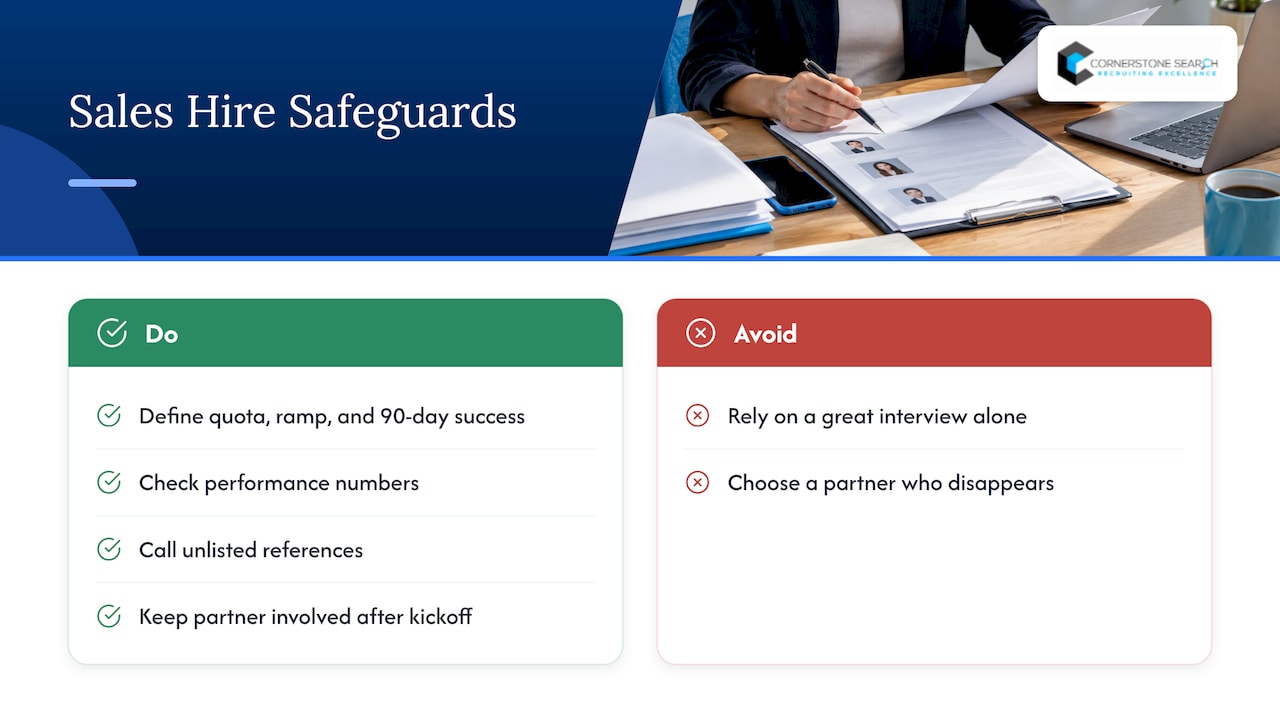
Three rules. First, define the number before you define the person: quota, ramp, and what “good” looks like at 90 days. Second, never hire a sales leader off a great interview alone. Check the numbers and call people they didn’t list. Third, don’t pick a partner who disappears after the kickoff.
The one question to answer before you hire anyone: what will this person own early on that you can’t own today?
Skipping that question can lead to a mismatch. A polished VP Sales who talks about “enterprise motion” may not fit a company selling to the mid-market.
— Rich Rosen
Ready to hire? Here is your next step
We offer Executive Search Recruitment, Software Sales Recruitment, and Talent Acquisition Consulting for venture-backed companies.
Book a kickoff call. Bring your target quota, comp range, a short list of who you’ve already talked to, and an honest account of why the last hire didn’t work. We move fast, and we run the search ourselves.
FAQ
What are the big five executive search firms?
The biggest global firms are tracked in Hunt Scanlon’s Big 5 roundup. They fit large, highly visible searches. Venture-stage founders often get more senior attention from a specialist boutique.
How much does an executive headhunter cost?
It depends on the model. Industry coverage puts contingency fees from the mid-teens to 30% of first-year pay, and retained fees around 30 to 35% of total first-year compensation. Always confirm whether the percentage applies to salary or total comp.
Do legitimate executive search firms charge candidates?
No. The FTC has taken action against a firm that charged job seekers upfront placement fees. Real search firms are paid by the hiring company.
How do I know a recruiter is real?
Check the firm’s verified office number and email domain. The FTC advises never paying fees or handing over sensitive personal data during outreach, as noted in its recruiter scam alert.
Sources
- Recruiter placement fees: contingency vs retained | dreach
- Scammers impersonate well-known companies, recruit for fake jobs on LinkedIn and other job platforms | Consumer Advice
- SHREK Firms in Executive Search | Better Headhunting
- The Big 5 Executive Search Firms – Hunt Scanlon Media